
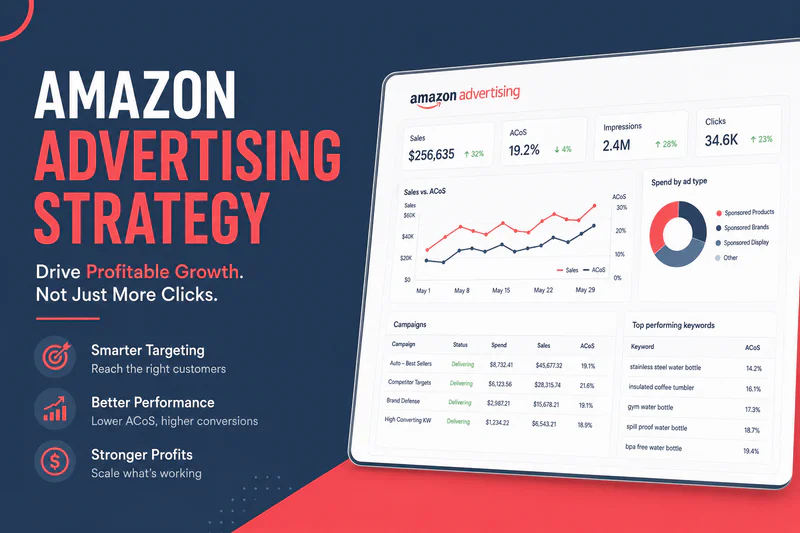
You're spending $12,000 a month on Amazon ads. Your campaign manager sends you a report - ACoS is 22%, impressions are up 40%, clicks are growing. Everything looks like it's working.
Then you open your bank statement. Flat. Maybe worse than last quarter.
Here's what happened: you had an advertising budget. You didn't have an advertising strategy. And on Amazon, the difference between those two things is the difference between scaling profit and funding Amazon's ad revenue with yours.
Every Amazon advertising strategy article out there gives you the same playbook: run Sponsored Products, optimize keywords, lower your ACoS. That's not strategy. That's campaign management. Strategy is knowing which dollars are building your business and which ones are just keeping the lights on — and having the discipline to treat them differently.
This is the playbook I use with every brand I work with. Not theory. Not a list of ad types. The actual operating framework for running Amazon ads profitably in 2026 as a US seller.
Key Takeaways
An Amazon advertising strategy isn't a campaign structure - it's a profit allocation framework tied to your product lifecycle.
Budget splits should change by month. Running the same allocation in launch and maturity is how brands bleed margin.
A significant portion of branded ad spend cannibalizes organic sales. Incrementality testing tells you exactly how much.
Amazon Marketing Cloud isn't just for enterprise brands anymore - mid-size US sellers doing $50K+/month can use it to make smarter budget decisions.
Seasonal pulsing - not flat monthly budgets - is what separates profitable brands from everyone else.
Table of Contents
Incrementality Testing — Are Your Ads Actually Generating New Sales?
Sponsored TV and Amazon Posts — The Funnel Nobody's Building
The Profit-First Advertising Framework
Here's what nobody tells you: most Amazon advertising strategies are built around revenue. More impressions. More clicks. More attributed sales. But revenue is not profit - and the gap between those two numbers is where most US sellers lose the game.
A profit-first Amazon advertising strategy starts with three numbers:
Break-Even ACoS per SKU - the maximum ACoS at which your ad-driven sales are still profitable after all costs. If you don't know this number for every product, you're bidding blind.
TACoS trend over 90 days - not your ACoS, your TACoS. A declining TACoS means your organic rank is strengthening and your ad dependency is shrinking. A flat or rising TACoS means you're on a treadmill.
Contribution margin after ads - what's actually left in your pocket after COGS, FBA fees, referral fees, returns, and ad spend. This is the only number that matters at the end of the month.
Every decision in this playbook ties back to these three numbers. If a tactic doesn't move one of them in the right direction, it doesn't belong in your strategy.
If you haven't calculated your Break-Even ACoS yet, start with our full breakdown of what Amazon ACoS really means for your profit before reading further. The math there is the foundation everything below sits on.
Budget Allocation by Product Lifecycle Stage
Running the same ad budget allocation in month 1 as you do in month 8 is not a strategy. It's a default. And defaults are expensive on Amazon.
Here's the allocation framework I use with every US brand:
The red flag: If you're in the maturity phase and your TACoS hasn't compressed below 18%, the allocation doesn't matter - your product economics or keyword strategy is broken. Fix that first. More ad spend on a leaking bucket just leaks faster.
During launch, Sponsored Products gets the lion's share because you're buying rank. Nothing else matters until you have organic keyword positions worth defending. Sponsored Brands Video takes the second slot - not banner, video - because video ads at the top of search convert at 2-3x the rate of static SB ads for new products with limited review history.
By growth phase, you're shifting toward brand defense and audience building. Sponsored Display retargeting becomes meaningful because you finally have enough traffic volume to make retargeting pools worthwhile. Below 1,000 monthly sessions on an ASIN, retargeting spend is largely wasted.
Campaign Architecture That Scales
Campaign structure is where most sellers either overcomplicate or underinvest. Here's the architecture that works at scale for US brands running $5K-$50K/month in ad spend:
Tier 1: Discovery Campaigns
Automatic campaigns with default bids, running on each ASIN. Purpose: keyword harvesting. Budget: controlled. Review search term reports weekly and extract converting terms. These are your research engines - not your revenue drivers.
Tier 2: Conversion Campaigns
Manual exact match campaigns built from proven search terms (2+ conversions at sub-break-even ACoS). One campaign per ASIN, one ad group. Clear naming conventions. This is where 60-70% of your Sponsored Products budget should sit once you're past launch.
Tier 3: Brand Defense
Branded keyword campaigns (exact match on your brand name and variations) plus Sponsored Display on your own ASINs. This prevents competitors from stealing your product page traffic. Non-negotiable for any brand doing $100K+/month in revenue.
Tier 4: Competitive Conquest
Product targeting on competitor ASINs - specifically those with lower ratings, higher prices, or weaker image sets than yours. Don't target category leaders unless you have a clear conversion advantage. This is surgical, not spray-and-pray.
For a deeper dive into how PPC campaigns should map to your P&L, read our guide on what Amazon PPC really looks like from a profit perspective.
Incrementality Testing - Are Your Ads Actually Generating New Sales?

This is the section nobody writes. And it's the one that could save you more money than any bid optimization ever will.
Here's the problem: a meaningful portion of your branded Sponsored Products spend is cannibalizing sales you would have gotten organically. You're paying Amazon for traffic that was already yours.
I've seen US brands where 30-40% of branded ad revenue would have converted without the ad. That's not a campaign problem. That's a $3,000-$5,000/month leak that shows up as "good ACoS" in your campaign manager.
How to Run a Simple Incrementality Test
Pick a control period: 14 days of normal branded SP spend. Document total sales (organic + paid) for those ASINs.
Pause branded SP campaigns: Run for 14 days with branded ads off. Keep all non-branded campaigns running normally.
Compare total sales: If the gap between the two periods is less than 15%, your branded ads were mostly paying for sales you would have gotten anyway.
Calculate your true incrementality rate: (Sales with ads - Sales without ads) / Sales with ads = the percentage of ad-driven sales that were genuinely incremental.
Most sellers have never run this test. The ones who have usually discover they can cut 20-30% of their branded spend without losing meaningful revenue - and that freed-up budget goes into non-branded exact match campaigns that actually drive new customer acquisition.
Simple funda: not every ad dollar is incremental. Find the ones that aren't before you scale the ones that are.
Amazon Marketing Cloud for Mid-Size Brands
Every Amazon advertising strategy article treats AMC like an enterprise-only tool. It's not. If you're doing $50K+/month on Amazon US, AMC gives you data that Seller Central literally cannot provide - and the brands using it are making budget decisions with 3x the visibility of those who aren't.
What AMC Actually Gives You
Multi-touch attribution: Instead of Amazon's last-click model (which credits the final ad click for the sale), AMC shows you every touchpoint in the customer journey. You might discover that your Sponsored Brands Video ads are initiating 40% of conversions that Sponsored Products ultimately closes. Without AMC, you'd think SP is doing all the work and potentially cut the SB Video budget that's actually feeding it.
Overlap analysis: See how many customers saw your Sponsored Brands ad AND your Sponsored Products ad before converting. High overlap with incremental lift means the combination works. High overlap without lift means you're double-paying for the same customer.
Custom audiences: Build audiences from cart abandoners, repeat purchasers, and category browsers - then target them through DSP or Sponsored Display. These audiences convert at 2-4x the rate of cold traffic.
Who Should Use AMC in 2026
If you're a US brand doing $50K-$500K/month on Amazon and you're running at least Sponsored Products + Sponsored Brands, AMC is worth the setup. You can access it through Amazon's self-serve console or through your agency. The data it surfaces will change how you allocate budget - not by guessing, but by seeing which touchpoints actually drive purchases.
Sponsored TV and Amazon Posts - The Funnel Nobody's Building
Two formats most US sellers are sleeping on in 2026. Both are underpriced relative to their impact.
Sponsored TV
Self-serve, no minimum spend, streaming TV inventory. This isn't brand awareness for Fortune 500 companies. This is a top-of-funnel play for brands doing $100K-$500K/month who want to capture demand before the shopper even opens the Amazon search bar.
Sponsored TV ads appear on Amazon Freevee, Twitch, and Fire TV. The targeting uses Amazon's first-party shopping data - so you're reaching audiences based on what they've actually purchased, not what they've browsed. Early CPMs are running 30-40% below established programmatic channels because inventory is still scaling.
The play: use Sponsored TV to build awareness, then retarget those viewers via Sponsored Display when they show up on Amazon. Your top-of-funnel cost is a fraction of what it would be on YouTube or Meta, and the attribution is native to Amazon's ecosystem.
Amazon Posts
Free. Organic. Social-style content that appears on product detail pages, category feeds, and related product carousels. Zero ad spend required.
Here's what nobody's connecting: Amazon Posts build engagement and product discovery at zero cost. Shoppers who interact with your Posts but don't convert immediately become a retargetable audience via Sponsored Display.
The free-to-paid funnel: Posts (free top-of-funnel) → Sponsored Display retargeting (paid mid-funnel) → Conversion. Your customer acquisition cost on the first touch is zero. No other Amazon ad format gives you that.
Brands running 3-5 Posts per week with lifestyle imagery and benefit-driven copy are seeing 15-25% increases in detail page views - organic traffic that feeds directly into their conversion campaigns.
The Seasonal Pulsing Calendar
Running the same ad budget in February as you do during Prime Day is not a strategy. It's a default. And on Amazon, defaults cost you money in both directions - you overspend when demand is soft and underspend when conversion rates peak.
Here's the pulsing calendar I build for every US brand:
The real move happens 30-45 days before the event. That's when you seed audiences via Sponsored Display and DSP. You're building the retargeting pool before the sale starts. On event day, you're converting warm traffic at half the CPC of everyone else who's bidding cold. By the time they ramp up, you've already captured the demand.
One critical rule: never run peak-event budgets into thin inventory. Check inventory cover every 48 hours during November and December. Running $500/day in ads on a product with 12 days of stock left is how you pay $6,000 to build rank you'll lose the moment you go out of stock. For more on this, read our breakdown of the FBA mistakes that kill your profit margins - stockouts during peak season are at the top of that list.
What a Healthy Ad Account Looks Like on a P&L
At the end of the month, a profitable Amazon advertising strategy produces these numbers:
If your TACoS is above 25% on an ASIN that's been live for 6+ months, something is structurally wrong. Ads aren't the problem - they're surfacing the problem. It could be weak listing conversion, poor keyword targeting, or broken unit economics underneath. For a deeper look at what healthy margins look like after fees and ads, see our breakdown of what's a normal Amazon FBA profit margin.
The metric most sellers ignore is the organic-to-paid ratio. If more than half your revenue on a mature ASIN still comes from ads, your PPC isn't building organic rank - it's substituting for it. That's a TACoS problem disguised as a revenue number. Read our full guide on why TACoS matters more than ACoS to understand this dynamic.
FAQ
What's the best Amazon advertising strategy for new US sellers?
Start with Sponsored Products only. Run automatic campaigns for keyword discovery, extract converting terms into manual exact match campaigns after 2-3 weeks, and don't touch Sponsored Brands or Display until you have 50+ reviews and a proven conversion rate. Nail your Break-Even ACoS math before you set your first bid.
How much should I spend on Amazon advertising in 2026?
There's no universal number. Set your budget by what your unit economics can absorb - not by a percentage-of-revenue rule. Start with enough for 10-15 clicks/day on your top keywords. Evaluate TACoS after 3 weeks of clean data. Scale only when TACoS is compressing.
Is Amazon DSP worth it for mid-size brands?
If you're doing $200K+/month and have maxed out Sponsored Products + Brands efficiency, yes. Below that threshold, DSP's minimum effective budget ($15K-$25K/month through most providers) makes it hard to justify. Maximize your Sponsored Ads ROI first.
How often should I review my Amazon ad campaigns?
Weekly reviews at the campaign level. Bi-weekly at the keyword level. Monthly for structural changes - new campaigns, budget reallocation, targeting overhauls. Allow 30-50 clicks before judging keyword performance. Daily micro-adjustments create more problems than they solve.
What's a good TACoS for Amazon in 2026?
For a mature ASIN (6+ months live): 10-18% is healthy. During launch, 20-30% is acceptable if it's trending down. If your TACoS has been flat at 25%+ for two consecutive 14-day review periods, trigger a full campaign audit. The number isn't the goal - the trend is.
The Bottom Line
An Amazon advertising strategy for 2026 isn't about running more campaigns or finding the perfect ACoS. It's about knowing which dollars are building your organic rank, which ones are defending territory you've earned, and which ones are just paying Amazon for traffic you already owned.
The brands that win on Amazon aren't spending more. They're spending smarter - with lifecycle-based budget allocation, incrementality testing, seasonal pulsing, and tools like AMC that show them what's actually driving conversions underneath the surface metrics.
Run the math first. Then open Campaign Manager.
Sellerview surfaces your TACoS per ASIN, organic vs. paid revenue split, and real contribution margin - so you can see exactly where your ad spend is building profit and where it's just maintaining a treadmill. Not another dashboard. Actual answers, per SKU.
Try Sellerview free - see your true ad-adjusted profit in minutes →