
Why Amazon FBA Profit Numbers Often Mislead Sellers
You ran the numbers before you launched. The product looked profitable. Then the first few months of sales came in - and the margins were nowhere near what you planned.
The Amazon calculator isn't broken. You just didn't know what every field actually means.
Most sellers treat the Amazon FBA Revenue Calculator like a price estimator. Enter selling price, see profit. Done. But that's not how the tool works - and that's why the numbers you pull from it rarely match your actual payouts.
This breakdown covers every fee field in the Amazon calculator: what it includes, what it excludes, and where sellers consistently lose money by misreading it.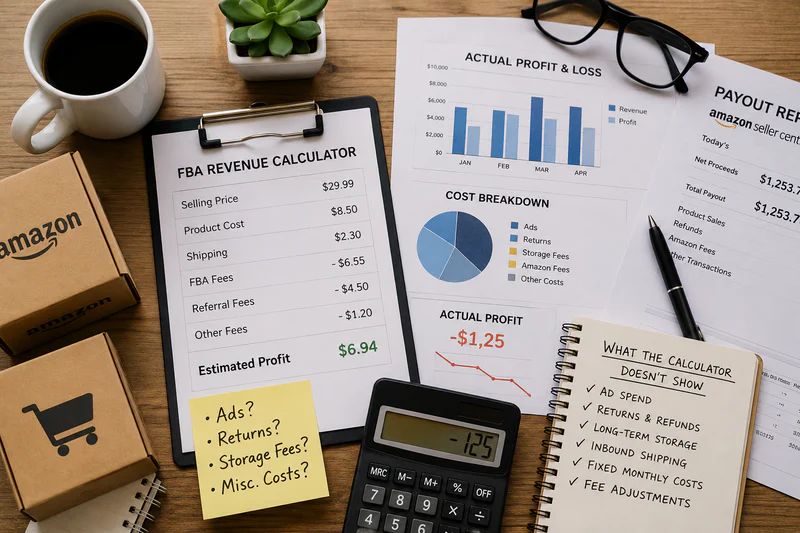
What the Amazon Calculator Actually Shows You
The official Amazon FBA Revenue Calculator is a pre-launch estimation tool. It shows you an estimated profit based on the inputs you give it. It is not a real-time profitability tracker. It doesn't pull your actual account data.
What it does: takes your selling price, cost of goods, and shipping assumptions, then calculates an estimated net margin after Amazon's fees.
What it doesn't do: account for returns, refund fees, storage aging charges, sponsored ad spend, or variation-level cost differences.
That gap - between what the calculator shows and what hits your bank account - is where seller margin quietly disappears.
Every Fee Field, Explained
Referral Fee
This is Amazon's commission. It gets charged as a percentage of the total sale price - including shipping if you charge it - not just the product price.
Referral fees range from 6% to 45% depending on category. Electronics run around 8%. Clothing and accessories hit 17%. Beauty adjusts based on price tier. Jewelry can reach 20%.
Most sellers know this fee exists. The mistake is not knowing Amazon calculates it on the total customer-facing price. If you charge $2 for shipping, that $2 gets pulled into the referral fee base too.
FBA Fulfillment Fee
This is what Amazon charges per unit to pick, pack, and ship your product. It depends on size and weight.
As of 2026, a small standard item (8 oz or less) costs $3.06 to fulfill. A large standard item between 1 and 2 lbs runs about $4.75. Large bulky items can exceed $10 per unit.
The calculator asks for your product dimensions and weight. Get these wrong and your fee estimate is off from the start. Amazon measures at the time of receiving — not at what you declare. If your packaged product bumps into the next size tier, you pay the higher rate. Every time.
Monthly Storage Fee
This is where the calculator gets genuinely misleading for new sellers.
Standard monthly storage runs $0.87 per cubic foot from January through September. Then it jumps to $2.40 per cubic foot from October through December. That's nearly a 3x spike during Q4.
The calculator typically shows you a blended monthly average. But if you're launching in September and still holding inventory in November, your actual storage cost is dramatically higher than what the calculator estimated.
Aged inventory surcharges don't appear in the calculator at all. Units sitting beyond 181 days attract surcharges. Units past 365 days can cost up to $6.90 per cubic foot per month in long-term storage fees - on top of standard storage.
Cost of Goods
This is the one field the calculator doesn't fill in for you. You enter it yourself.
Where sellers go wrong: they enter the per-unit manufacturing cost but leave out inbound shipping, prep fees, inspection costs, and import duties. A $4 unit that costs $1.20 to ship from China, $0.30 to inspect, and $0.40 in import duties is a $5.90 COGS - not $4.
That $1.90 gap per unit doesn't sound significant until you're moving 500 units a month and wondering where $950 went.
Closing Fee (Media Categories)
For books, music, video, and software - Amazon charges a $1.80 closing fee per sale on top of the referral fee. If you sell in these categories and overlook this field, you'll consistently overestimate margins across every single ASIN.
What the Calculator Completely Ignores
The Amazon calculator is a partial picture. These costs don't appear anywhere in its interface - but they hit every seller's P&L:
Advertising (PPC): Most sellers spend 8-15% of revenue on sponsored ads. The calculator has no ad cost field. If your ACOS is 20% and you're running ads on 70% of your sales, your real margin is nowhere near what the calculator output says.
Returns and Refund Processing Fees: Amazon charges a per-unit refund administration fee - typically 20% of the referral fee, capped at $5.00 - when a customer returns a product. Categories like clothing and electronics regularly see 10–15% return rates. That fee adds up fast.
FBA Removal and Disposal Fees: Clearing dead stock costs money. Standard-size removal fees run $0.97- $1.80 per unit depending on size. You pay this even when Amazon's telling you to remove it or it'll be disposed.
Reimbursement Gaps: Amazon occasionally loses or damages inventory. The reimbursement process isn't automatic for every case - and under reimbursements are common. That's lost margin the calculator never accounts for.
How to Use the Calculator Without Getting Burned
Run three scenarios, not one.
Optimistic: Your declared dimensions are accepted, velocity is high, no returns, no ad spend. This is the calculator's default view of the world.
Realistic: Add 10-15% for PPC. Use your actual all-in COGS including freight and duties. Apply peak-quarter storage rates if you're launching near Q4.
Stress test: Assume an 8% return rate, Q4 storage pricing, and 20% ACOS. If this scenario still shows margin, you likely have a real product worth launching.
The Amazon calculator is a useful structural starting point — not a green light to launch.
FAQ
What does the Amazon FBA Revenue Calculator include in its fee estimates?
The Amazon FBA Revenue Calculator includes the referral fee, FBA fulfillment fee, and monthly storage fee. It does not include advertising costs, return fees, aged inventory surcharges, or long-term storage fees — so actual net margin is almost always lower than what the calculator shows.
How accurate is the Amazon calculator for estimating profit?
The calculator gives a rough structural estimate but isn't accurate for real-world profitability planning. It misses PPC spend (typically 8–15% of revenue), return processing fees, and variable storage costs - especially the Q4 spike from $0.87 to $2.40 per cubic foot. Always overlay your actual cost inputs before trusting the output.
Why does the Amazon calculator show higher profit than my actual payout?
The most common reasons: understated COGS (excluding inbound freight and duties), missing ad spend, Q4 storage rate spikes, and return fees not accounted for. Always run a realistic scenario with all-in COGS and a PPC cost assumption before treating the calculator output as final.
What is the referral fee on Amazon and how is it calculated?
The referral fee is Amazon's sales commission, charged as a percentage of the total customer-facing price - including any shipping charges you collect. Rates range from 6% to 45% depending on category, with most product categories sitting between 8% and 17%.
Does the Amazon calculator account for sponsored ads?
No. The Amazon FBA Revenue Calculator has no field for advertising costs. Sellers need to manually subtract their estimated PPC spend - typically 8-20% of revenue for new listings - from the calculator's output to get a realistic margin estimate.