
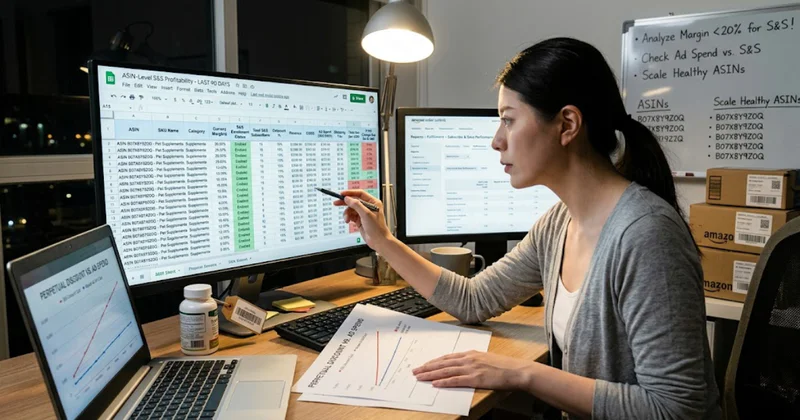
If you're sourcing from Alibaba for Amazon FBA, you need five tools, not one: a platform to find suppliers, a way to cross-check who reputable sellers already use, a third-party inspector, a freight comparison tool, and a way to track whether the landed cost you locked in actually turns into profit once the product sells. Here's exactly which tool covers each stage, what each one costs, and where sellers usually skip a step and pay for it later.
Key Takeaways
• 71% of US Amazon sellers sourced products from China in 2023, and Alibaba is still the default starting point, but landed cost typically runs 1.5x to 2.5x the factory quote once freight, duties, and prep are added.
• No single tool covers the full sourcing workflow. You need one for supplier discovery, one for quality control, one for freight, and one for tracking what the product actually earns after it lands.
• Skipping a pre-shipment inspection to save $300 to $600 is one of the most common ways sellers turn a sourcing decision that looked profitable on paper into a margin trap.
• The tools below map to five stages: find, verify, inspect, ship, and track profit. Sellerview.ai closes the loop by tracking per-SKU profit against the landed cost you modeled before you ever placed the order.
At a Glance: Tools for Amazon FBA Sourcing
Why Alibaba Sourcing Is Where Amazon FBA Margins Actually Get Decided
71% of US Amazon sellers sourced their products from China in 2023, and Alibaba remains the default starting point for finding a factory. The problem isn't finding a supplier. It's what happens between the quote you get on Alibaba and the number that actually lands in your Amazon FBA warehouse.
Landed cost, meaning the total price to get one unit from the factory floor to a shelf in an Amazon fulfillment center, typically runs 1.5x to 2.5x the factory quote once you add freight, duties, customs brokerage, and prep. A supplier quote of $3.75 per unit can land closer to $6 to $9 once everything is accounted for. If you priced the product against the $3.75 number, the margin was gone before the listing went live.
Run your own landed cost against your sell price with the free Amazon FBA profit calculator before you commit to a supplier quote.
This is exactly why sourcing needs more than one tool. Each stage of the process, from finding the supplier to verifying what you're actually paying for after launch, catches a different kind of mistake.
The 5 Tools You Need Across the Sourcing Workflow
Sourcing from Alibaba to Amazon FBA breaks into five stages: discover, verify, inspect, ship, and track. Here's the tool for each one.
1. Alibaba.com: Where You Find and Vet Suppliers
Alibaba.com is the marketplace where most Amazon FBA sourcing starts. It connects you directly with manufacturers and trading companies, and Trade Assurance gives you payment protection if the goods don't match your order agreement.
Most sellers only look at the first 2 to 3 pages of search results and contact the most polished-looking listings, which is exactly where competition and pricing are highest. A better filter: search for Verified Supplier plus Trade Assurance, then sort by response rate or years in business. Mid-tier suppliers on the list are often the sweet spot, established enough to be reliable, but not so large that a small brand's order is a rounding error to them.
Pricing: free for buyers to browse, message, and place Trade Assurance orders. Best for: initial supplier discovery and first contact with verified factories.
2. Jungle Scout Supplier Database: Confirm Who Already Ships to Amazon
Jungle Scout's Supplier Database lets you search by ASIN, company, or product to see which manufacturers are already producing for top-selling Amazon listings. Instead of vetting a supplier from zero, you're starting from one that's already proven it can ship FBA-compliant product at scale.
The feature is bundled into Jungle Scout's Growth Accelerator plan, priced around $49/month (lower on annual billing). There's no traditional free trial, Jungle Scout backs its plans with a 7-day money-back guarantee instead.
Best for: sellers who want a shortlist that's already proven, rather than starting supplier vetting from a blank search.
3. QIMA: Catch Defects Before They're Your Problem
QIMA books a third-party inspector to check your goods against your specification before they leave the factory, with inspectors typically onsite within 48 hours and same-day digital reports. This is the step most new sellers skip on their first order to save a few hundred dollars, and it's consistently the most expensive mistake in this list.
Pricing starts from $309/man-day for Zone A coverage, which includes China. A standard two-man-day inspection runs roughly $600 or more. For smaller orders, some sellers use lower-cost regional inspectors in the $200 to $300 range, but the tradeoff is usually slower turnaround or less standardized reporting.
Best for: any order over $5,000, or your first order with a new supplier regardless of order size.
4. Freightos: Stop Taking One Forwarder's Word for It
Freightos pulls live freight quotes from more than 40 forwarders across ocean, air, and trucking, so you can compare pricing instead of accepting whatever number your factory's recommended forwarder gives you.
It's free to compare and get quotes, you only pay once you actually book a shipment. For a first-time importer, that alone is often worth a few hundred dollars in freight savings on a single container or LCL shipment.
Best for: sellers who've been using their supplier's default forwarder without ever comparing rates.
5. Sellerview.ai: Where Landed Cost Becomes Real Profit
The first four tools get a product sourced, inspected, and shipped. None of them tell you whether the product is actually making money once it's selling on Amazon. That's the gap Sellerview.ai closes.
Once your product is live, Sellerview.ai pulls your actual landed COGS together with Amazon fees, ad spend, and returns at the SKU level, so you're looking at real profit per unit instead of the sourcing spreadsheet estimate from three months ago. Most sellers use the 1/3 pricing rule at the sourcing stage, meaning the sell price should be at least 3x landed COGS, but that rule is a sourcing filter, not a profit target. Sellerview.ai tracks the full picture automatically once the product launches.
For a closer look at where that rule breaks down in 2026, see the 1/3 pricing rule breakdown on Sellerview.ai.
Pricing: $15/month with a 30-day free trial. Best for: knowing whether an Alibaba sourcing decision is still profitable after Amazon takes its cut.
Tools for Amazon FBA Sourcing: Full Comparison
What a Sourcing Run Actually Costs
Before you commit to a supplier quote, run these ranges against it. This is what typically sits between the factory price and the number that lands in FBA.
The Order These Tools Should Run In
1. Shortlist at least 5 suppliers on Alibaba.com. Filter for Verified Supplier plus Trade Assurance, and sort by response rate or years in business rather than price alone.
2. Cross-check your shortlist against the Jungle Scout Supplier Database if you're targeting a category with proven top sellers.
3. Order samples and negotiate payment terms, typically 30% deposit and 70% before shipment, with Trade Assurance covering the transaction.
4. Book a QIMA (or comparable) pre-shipment inspection before the order ships, especially on your first order with a new supplier.
5. Compare freight quotes on Freightos instead of accepting the factory's recommended forwarder.
6. Once inventory lands and starts selling, run true landed cost, fees, ads, and returns through Sellerview.ai to see real per-SKU profit, not the pre-launch estimate.
FAQ
What tools do I need for Amazon FBA sourcing from Alibaba?
At minimum: Alibaba.com for supplier discovery, a third-party inspection service like QIMA before goods ship, and a freight comparison tool like Freightos. Once the product is live, a profit tracking tool like Sellerview.ai tells you whether the sourcing decision actually paid off.
Is Alibaba safe for Amazon FBA sourcing?
Alibaba is safe when you use Trade Assurance and stick to Verified Suppliers with a real trading history. It's not automatically safe just because a supplier appears on the platform, always request samples, verify business licenses, and avoid wiring payment outside of Trade Assurance protection.
How much does it cost to source and ship a product from Alibaba to Amazon FBA?
Beyond the factory price, plan for ocean freight at $0.50 to $3.00 per kg (or $4.00 to $8.00 per kg by air), import duties from 0% to 25%+ depending on category, $200 to $500 in customs brokerage, and inspection costs starting around $309 per man-day. As a rule of thumb, total landed cost runs 1.5x to 2.5x the factory quote.
Do I need a third-party inspection on every Alibaba order?
Not every reorder, but yes for any order over $5,000 and for your first order with any new supplier regardless of size. The inspection cost is small compared to the cost of a rejected FBA shipment or a wave of returns from a defective batch.
What's the difference between Alibaba and 1688 for Amazon sellers?
Alibaba is built for international buyers, with English listings, Trade Assurance, and export-ready suppliers. 1688 is Alibaba's domestic Chinese counterpart, often cheaper, but listings are in Chinese and suppliers are geared toward the domestic market, so most FBA sellers need an agent or a Chinese-speaking partner to use it directly.
How do I know if my Alibaba-sourced product is actually profitable on Amazon?
A pre-launch estimate using the 1/3 pricing rule tells you if the math can work in theory. Once the product is selling, you need real numbers: landed COGS, Amazon fees, ad spend, and returns, all tracked at the SKU level. Sellerview.ai pulls this together automatically so you're looking at actual margin, not a sourcing spreadsheet from before launch.
See Your Real Profit Before You Reorder
Finding a supplier is the easy part. Knowing whether that supplier is still making you money after Amazon's fees, ad spend, and returns is where most sellers lose track.
See your real profit on Sellerview.ai. Start your free trial.
Sources
• 71% of US Amazon sellers sourced from China in 2023: https://meetanshi.com/blog/amazon-seller-statistics
• Landed cost typically 1.5x to 2.5x factory price; ocean freight $0.50-$3.00/kg, air freight $4.00-$8.00/kg, duties 0-25%+, customs brokerage $200-$500: https://freightfba.com/sourcing-from-china-for-amazon-fba/
• Alibaba supplier vetting strategy, mid-tier suppliers, inspection cost guidance, 30/70 payment terms: https://awildovasquez.com/blog/source-products-china-amazon-fba/
• QIMA pricing from $309/man-day, Zone A China: https://www.qima.com/pricing
• Jungle Scout Growth Accelerator plan pricing and Supplier Database inclusion: https://www.capterra.com/p/249574/Jungle-Scout/
• Freightos free instant freight quotes from 40+ forwarders: https://www.freightos.com/instant-freight-quote/
• 1/3 pricing rule and landed COGS breakdown: https://sellerview.ai/blog/amazon-fba-calculator-one-third-pricing-rule