
Introduction
Amazon FBA has made it easier than ever to build an e-commerce business — but "easier" doesn't mean "risk-free." Thousands of sellers launch products every month, run ads, manage listings, and still watch their profit slowly disappear. The frustrating part? Most of those losses are preventable.
This guide goes beyond the basics. Yes, we'll cover the well-known pitfalls — but we'll also expose the 5 profit-killing Amazon FBA mistakes most blogs never talk about. If you're serious about building a sustainable FBA business, these are the ones that will make the difference.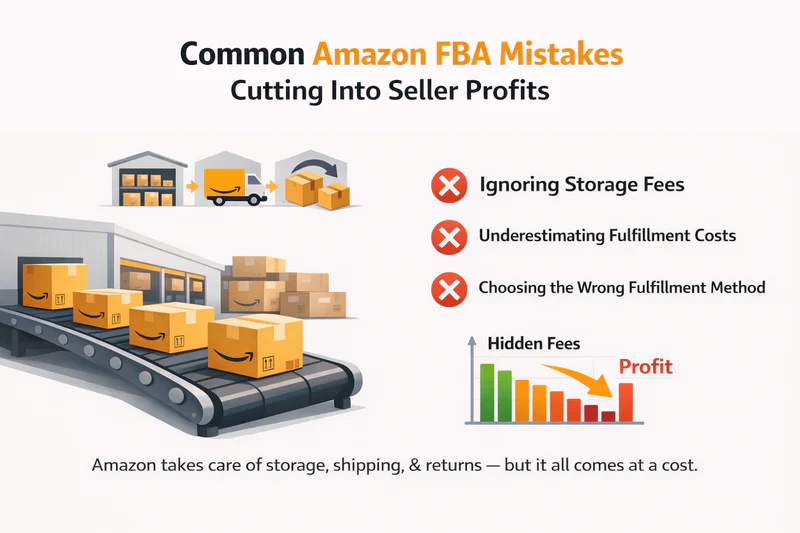
Why FBA Profits Are Harder to Protect in 2025
The FBA landscape has changed significantly. Amazon has raised fulfillment fees three years in a row. Storage surcharges now kick in at 180 days instead of 365. Advertising costs have climbed as more brands compete for the same keywords. Returns fraud is rising. And with US-China tariff pressures squeezing supply chains, landed costs are higher than ever.
In this environment, sellers who run on intuition and approximations get hurt first. The ones who survive and scale are the ones who track every dollar, know their true FBA profit margin per ASIN, and plug the leaks before they become crises. The mistakes below are where most of those leaks start.
The Common Amazon FBA Mistakes (That You've Probably Heard Of)
Before we get to the hidden killers, let's quickly address the foundational mistakes that trip up new and intermediate sellers alike.
1. Poor Product Research
Launching based on gut feeling instead of data is still the #1 reason sellers fail. You need to validate demand, check competition density, analyze price trends, and calculate your true landed cost — before you spend a dollar on inventory. Many sellers look at a product selling well and assume they can enter the market without understanding why it's selling, who is buying it, and whether there is room for another competitor at a viable price point.
Fix: Use data tools to analyze search volume, review velocity, and profit margins before committing to a product. Demand without margin is just revenue theater. Look for niches where the top 3 listings have fewer than 300 reviews — that's usually a sign you can compete without a massive launch budget.
2. Underestimating Amazon FBA Fees
FBA fees have grown significantly. In 2025, the combined weight of referral fees, fulfillment fees, storage charges, and returns processing can consume 45–65% of your revenue on low-to-mid ticket products. Sellers who calculate fees casually end up in the red without knowing why.
Here's what a typical fee stack looks like on a $25 product: referral fee (~15%) = $3.75, FBA fulfillment fee = $4.50–$6.00, inbound shipping = $1.00–$1.50, storage = $0.30–$0.50/month, returns buffer (~5%) = $1.25. That's $11–$13 in fees before you account for COGS or ads. On a $25 product with a $10 COGS, you're left with $2–$4 gross profit. One bad month of returns wipes that out.
Fix: Use Amazon Profit Calculator and build a full cost model before sourcing. Include referral fee, FBA fee, prep costs, shipping to Amazon, and a returns buffer. If you can't hit 20%+ net margin after all costs, the product isn't worth launching.
3. Inventory Mismanagement
Two sides of the same coin — running out of stock kills your BSR and Buy Box eligibility, while overstocking triggers long-term storage fees (now kicking in at 180 days in 2025). Either extreme costs you money. Sellers who manage inventory reactively — reordering only when they're nearly out — constantly battle stockouts and ranking drops that take weeks to recover from.
Fix: Use demand forecasting tools tied to your actual sell-through rate. Build a reorder point formula that accounts for lead time, seasonality, and safety stock. A simple rule: reorder when your days of inventory remaining = your lead time + 30-day safety buffer.
4. Listing Optimization Gaps
A poorly optimized listing is a conversion killer. Missing keywords in the title, low-quality images, vague bullet points, and no A+ Content leave shoppers bouncing to competitors. Amazon's A9 algorithm rewards listings that convert well — so a weak listing doesn't just hurt your sales directly, it also suppresses your organic ranking over time.
Fix: Treat your listing like a landing page. Lead with the primary keyword in the title, use all 7 image slots, write benefit-first bullets, and invest in A+ Content if you're brand registered. Test your main image — it is the single biggest lever for improving click-through rate from search results.
5. Uncontrolled PPC Spending
Running ads without a strategy is just burning money. High ACoS from broad match keywords, no negative keyword management, and zero campaign structure are the most common culprits. Many sellers set up auto campaigns during launch, get some sales, and then never evolve their strategy — leaving massive inefficiencies running for months.
Fix: Structure campaigns by match type, audit search term reports weekly, add negative keywords aggressively, and track TACoS (Total Advertising Cost of Sale) — not just ACoS. A healthy TACoS benchmark for established products is 8–12%. If yours is above 20%, your organic sales aren't covering the ad load.
6. Race-to-the-Bottom Pricing
Dropping your price to beat competitors without calculating your break-even point is a fast track to losses. You can win the Buy Box and still lose money on every sale. This is especially dangerous for sellers using repricing tools set to automatically match the lowest competitor — the tool wins the Buy Box, but the math doesn't work.
Fix: Know your minimum viable price before you list. Price should be driven by your cost structure, not by fear of competition. Calculate your floor price (COGS + all fees + minimum acceptable margin) and never reprice below it, regardless of what competitors domon mistakes above, these are harder to spot because the damage is invisible — there's no single alert or notification telling you money is leaking out.
Mistake #7: Not Auditing Amazon for FBA Reimbursements
Here's a truth most sellers don't know: Amazon owes you money.
When Amazon's fulfillment centers lose your inventory, damage products, miscount units, or incorrectly process returns, they are required to reimburse you. But they don't always do it automatically — and they have a limited claims window.
Studies suggest the average FBA seller with consistent sales volume is owed between $1,000–$5,000+ in unclaimed reimbursements at any given time. Over a year, that's a significant chunk of profit silently evaporating.
What most sellers do: Nothing. They assume Amazon handles it.
What you should do:
Audit your FBA reimbursements quarterly using a reimbursement tool or manually through Seller Central reports (Inventory Adjustments + FBA Customer Returns + Received Inventory reports).
Cross-reference what was shipped vs. what was received vs. what was returned and restocked.
File claims for discrepancies within the allowed window (typically 18 months for most claim types).
This is essentially free money sitting unclaimed in Amazon's system. Don't leave it there.
Mistake #8: Ignoring Listing Hijacking (Buy Box Theft)
If you're brand registered and selling private label, you might assume your listing is safe. It's not.
Listing hijackers — often overseas sellers — attach themselves to your ASIN, undercut your price with counterfeit or unbranded products, and steal your Buy Box. When they win the Buy Box, every sale goes to them, not you. Your conversion rate tanks, your BSR drops, and customers receiving inferior products leave negative reviews on your listing.
This can wipe out months of ranking work overnight.
Warning signs:
Sudden drop in sales with no change in your campaigns or price
"Other Sellers on Amazon" appearing on your listing
Negative reviews mentioning product quality you know isn't yours
Your Buy Box ownership percentage dropping in Brand Analytics
What you should do:
Enroll in Amazon Brand Registry if you haven't already
Monitor your listing daily (or use automated tools that alert you when new sellers join)
Use Amazon's Report a Violation tool to file IP infringement claims immediately
Consider using Transparency Codes or Project Zero for high-risk ASINs
Mistake #9: Confusing Revenue With True Net Profit
This is one of the most dangerous mindsets in FBA: celebrating a $50,000 revenue month while losing money.
Revenue is vanity. Profit is sanity. Most sellers look at their Seller Central payout and think that's their profit. It's not. That payout already has FBA fees and referral fees deducted — but it does NOT account for:
Cost of goods (COGS)
Inbound shipping to Amazon
PPC ad spend
Returns and reimbursements
Monthly software subscriptions
Prep and inspection fees
Samples and photography
Taxes
Here's a real-world example. A seller does $50,000 in revenue. Amazon's payout is $32,000 after FBA and referral fees. That looks healthy — until you subtract COGS ($15,000), PPC spend ($5,500), inbound shipping ($800), prep fees ($400), and software ($200). The real net profit is $10,100 — a 20.2% margin. Still decent. But if returns spike to 8% that month, add another $1,500 in losses. Now you're at $8,600 net — a 17.2% margin. And that's before taxes. Most sellers celebrating a "$50K month" have no idea their actual take-home is closer to $8,000–$10,000.
When you subtract all of these, many sellers discover their actual net margin is 5–12% — or even negative.
What you should do:
Build a true P&L for every ASIN, not just your account overall
Track these metrics monthly: Revenue → Gross Profit → Net Profit → Net Margin %
Use a dedicated FBA analytics tool that captures every cost category in real time
If you don't know your net margin per unit, you don't know if your business is actually working
A business that generates $500K in revenue but earns a 3% net margin is one bad product cycle away from collapse.
Mistake #10: Walking Into the Sales Tax Nexus Trap
This one has caught thousands of FBA sellers off guard — and the financial consequences can be severe.
When Amazon stores your inventory in its fulfillment centers across the United States, it creates what's called economic nexus or physical nexus in those states. This means you may be legally obligated to collect and remit sales tax in every state where Amazon has warehoused your products — even if you've never set foot there.
With Amazon's distributed fulfillment network, your inventory could be spread across 15–20 states at any given time. Most sellers only discover this problem when they receive a state tax notice or get flagged during an audit. By then, they're dealing with back taxes, penalties, and interest that can reach tens of thousands of dollars.
What you should do:
Register for an automated filing service like TaxJar or Avalara and integrate it with your Seller Central account
Use the Amazon FBA Inventory report to identify which states your inventory is currently in
Register for sales tax permits in the states where you have nexus
Do not ignore this — tax authorities have been increasingly targeting e-commerce sellers since the 2018 South Dakota v. Wayfair Supreme Court ruling expanded nexus rules
This isn't a someday problem. If you're doing volume on FBA, it's a right now problem.
Mistake #11: Launching Without a Product Moat
Most FBA sellers launch a product, rank it, start selling — and within 6 months, there are 10 identical products from competitors undercutting them at half the price. This happens because they launched a commodity with no competitive protection.
A product moat is what makes your listing hard to replicate. Without it, you're always one competitor away from losing your edge. The sellers who dominate their categories long-term all have at least one of these moats in place — and most of them built it before they ever launched.
Common product moats that most articles don't discuss:
Utility patents or design patents — Even a provisional patent application can deter copycats and strengthen your IP position
Exclusive supplier agreements — Lock in a manufacturer relationship that competitors can't easily replicate
Product bundling — Create a unique bundle that forms its own ASIN with no direct competitors
Proprietary formulations or materials — Especially powerful in consumables, supplements, or beauty products
Brand equity + external traffic — A brand with a loyal audience on email, social, or a Shopify store is far more defensible than a nameless private label product
What you should do:
Before launch, ask: "What stops someone from copying this in 6 months?"
If the answer is "nothing," reconsider the product or find a differentiator
Invest in branding early — a recognizable brand name, professional packaging, and brand story give you pricing power and customer loyalty that a white-label product never will
Quick Reference: Amazon FBA Profit Killers Checklist
Where to Start: A Quick Profit Audit
If you've read this far and recognized your business in several of these mistakes, don't try to fix everything at once. Start with the highest-leverage actions first:
This week: Run a reimbursement audit in Seller Central. Check your inventory adjustments report for the last 6 months.
This week: Pull your top 5 ASINs and calculate true net margin for each. Use actual COGS, actual ad spend, and actual returns — not estimates.
This month: Check every listing for unauthorized sellers. File a Brand Registry complaint for any hijacker you find.
This month: Verify your sales tax nexus exposure. If you're in 10+ states, set up automated filing.
Next product: Before sourcing, define your moat. Patent, bundle, exclusive, or brand. Pick one and build it in before you launch.
If you want a deeper look at how to approach these systematically, our guide on the most common Amazon FBA mistakes sellers make by category breaks down the patterns by business stage — from first launch through scaling past $1M in revenue.
Final Thoughts
The sellers who build profitable, durable FBA businesses aren't just avoiding the obvious mistakes — they're operating with clarity that most sellers never reach. They know their true margin on every ASIN. They protect their listings. They audit Amazon for money owed to them. They stay compliant. And they build products that competitors can't easily knock off.
Profit doesn't disappear all at once. It leaks — slowly, across dozens of small inefficiencies that each seem minor on their own. The goal is to find those leaks before they compound into a serious problem. The sellers who do that consistently are the ones still growing five years from now.
If you're serious about your FBA business, start with the areas where you have the most blind spots. Run a reimbursement audit this week. Calculate your real net margin on your top 3 products. Check if you have a hijacker on any of your listings.
Small fixes in the right places can add thousands of dollars back to your bottom line — without launching a single new product.
Want to track your true FBA profitability in real time?Sellerview gives you the clarity to see exactly where your profit is going — and how to protect it.