
Login / Signup
Amazon Profitability

Amazon Fees on One Order (Why a 34% Margin Becomes 14%)

A $29.99 kitchen organizer costs $10.00 to land. After the referral fee and the FBA fulfillment fee, $10.07 is left, a 34% margin on paper. Then the order settles, and the real profit is $4.16, or 14%.
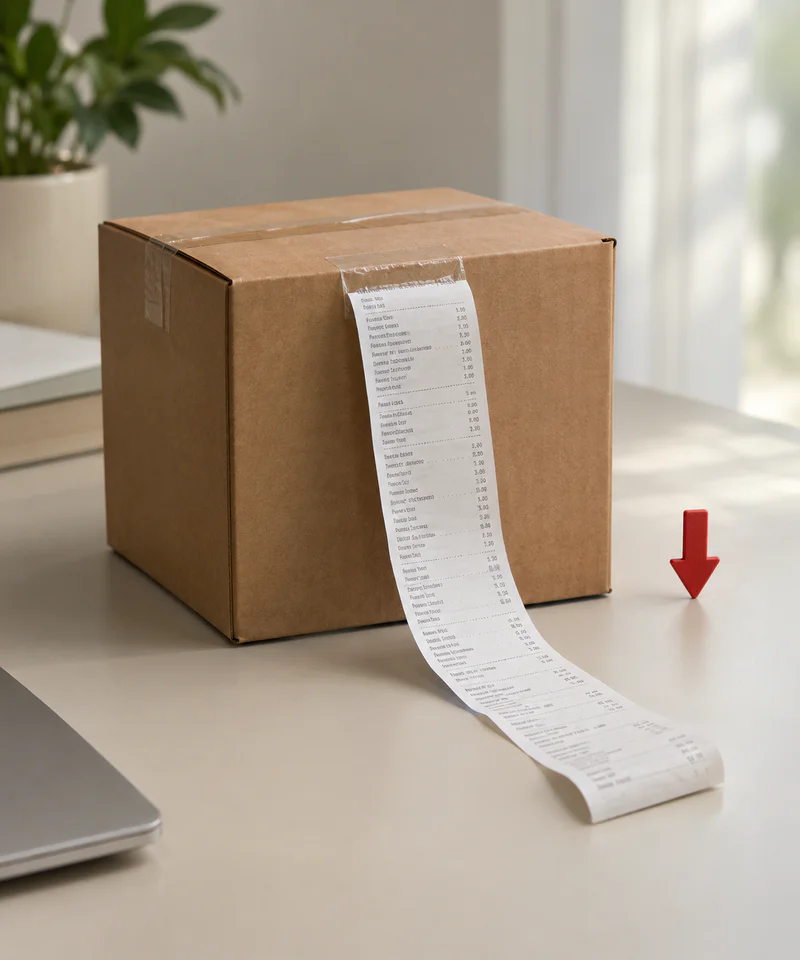
Shipping box with a long receipt of Amazon fee charges attached, showing a 34% margin falling to 14%

The Amazon fees on one order are every charge that can touch a single sale, from the selling plan and inbound shipping to the ad click, fulfillment, storage, returns and removal. We count 31 of them. Most sellers build 3 or 4 into their pricing, and in our 2026 survey of 63,610 products across 100 Amazon seller accounts, 37% of products cost more to sell than they brought in.

We have worked with more than 300 Amazon brands. Roughly 150 of them could not tell us exactly how much money they made last month. Ask them for a margin and they say "8 to 10 percent" with total confidence. Ask for the dollar amount and the conversation stalls.

That is not laziness. Amazon never sends you one bill. It sends small charges, spread over weeks and sometimes months, under names that sound harmless: inbound placement service fee, aged inventory surcharge, refund administration fee. Nobody lines them up next to the order that caused them.

So we will do it here. This post follows one $29.99 order from the click that wins it to the return that might reverse it, and puts a price on all 31 charges that can touch it.

Do all 31 charges hit every order?

No, and that is the trap. A charge that lands on 1 order in 10 still comes out of your margin. You just never see it sitting next to the sale. Every charge below carries a tag:

  • Every order: it hits, or is shared across, every unit you ship.

  • Some orders: it hits a share of units, like returned or aged ones.

  • If you use it: it applies only when you opt into that plan or program.

All rates are Amazon.com (US), 2026. Where Amazon keeps a rate behind the seller login, we describe the rule instead of guessing a number.

The 31 charges, stage by stage

What does it cost to get stock to Amazon? (8 charges)

#

Charge

What triggers it

Tag

1

Professional selling plan

$39.99 a month, flat. Ship 1,000 orders a month and it spreads to about $0.04 each.

Every order

2

Individual plan per-item fee

$0.99 on every unit sold. It beats Professional only under roughly 40 units a month.

If you use it

3

Inbound placement service fee

A per-unit fee when you send stock to fewer Amazon locations than Amazon wants. Amazon-optimized splits cost $0.

Every order

4

Inbound defect fee

Charged when units arrive with labeling, prep or carton problems. Amazon stopped prepping and labeling in the US on January 1, 2026, so the fix is on you.

Some orders

5

Partnered carrier freight

The cost of moving boxes to the fulfillment center on Amazon's partnered carrier, billed through Seller Central.

Every order

6

AWD storage fee

Monthly, per cubic foot, for pallets held in Amazon Warehousing and Distribution.

If you use it

7

AWD processing fee

About $1.40 per box going in and $1.40 per box going out.

If you use it

8

AWD transportation fee

Per cubic foot, for moving stock from AWD to an FBA fulfillment center.

If you use it

What does it cost to win the click? (7 charges)

#

Charge

What triggers it

Tag

9

Sponsored Products

Pay per click on keyword and product targeting. For most brands this is the biggest line outside Amazon's own fees.

Every order

10

Sponsored Brands

Pay per click on headline and store ads.

If you use it

11

Sponsored Brands video

Video ads in search. Every ad type is its own auction, so the same keyword can cost a different amount here.

If you use it

12

Sponsored Display

Remarketing and product targeting ads.

If you use it

13

Coupon fee

$5 per coupon plus 2.5% of coupon sales. This replaced the old $0.60 per redemption in June 2025.

If you use it

14

Deal fee

Best Deals and Lightning Deals cost $70 a day plus 1% of deal sales, capped at $2,000 per deal outside peak events.

If you use it

15

Vine enrollment fee

Up to $200 per parent ASIN, plus the free units you give away.

If you use it

What does the sale itself cost? (6 charges)

#

Charge

What triggers it

Tag

16

Referral fee

15% in most categories, including Home and Kitchen, with a $0.30 minimum. Rates did not change for 2026.

Every order

17

Variable closing fee

$1.80 per item in media categories such as books, DVDs and video games.

If you sell media

18

FBA fulfillment fee

Set by size tier, shipping weight and price band. Average fees rose about $0.08 a unit on January 15, 2026.

Every FBA order

19

Fuel and logistics surcharge

3.5% on top of the fulfillment fee since April 17, 2026. It is not in the published rate cards.

Every FBA order

20

Holiday peak fulfillment fee

Runs October 15, 2026 to January 14, 2027, with the 3.5% surcharge stacked on top.

Q4 orders

21

Seller-fulfilled shipping label

If you ship an order yourself, you pay postage through Buy Shipping.

FBM orders only

What does it cost to hold stock on the shelf? (4 charges)

#

Charge

What triggers it

Tag

22

Monthly storage fee

Per cubic foot, standard size: $0.78 from January to September, $2.40 from October to December.

Every order

23

Storage utilization surcharge

Applies when your stock runs past 22 weeks of sales and you have been shipping to Amazon for over a year. From $0.44 to $1.88 per cubic foot on stock older than 30 days.

Some sellers

24

Aged inventory surcharge

Units that sit 181 days or longer pay it every month on top of storage, and the rate rises with each age band.

Some orders

25

Low-inventory-level fee

A per-unit fee on shipped units when days of supply is under 28 in both the last 30 and 90 days. Judged per variation since January 15, 2026.

Some orders

What does a return cost? (3 charges)

#

Charge

What triggers it

Tag

26

Refund administration fee

Amazon credits back the referral fee on a refund but keeps the lesser of $5.00 or 20% of it.

Some orders

27

Returns processing fee

A weight-based fee on returned units above your category's return-rate threshold. Apparel and shoes pay on every return.

Some orders

28

Prepaid return label (FBM)

Since February 8, 2026, US seller-fulfilled returns use Amazon prepaid labels, with the cost deducted from your account.

FBM returns only

What does it cost to get rid of unsold stock? (3 charges)

#

Charge

What triggers it

Tag

29

Removal order fee

A per-unit fee to have Amazon send stock back to you. Set by size and weight.

If you use it

30

Disposal order fee

A per-unit fee to have Amazon destroy units.

Some orders

31

Liquidation fee

Amazon takes a referral fee plus a processing fee on each liquidated unit.

If you use it

What does one $29.99 order really keep?

About $4.16, or 14%. Here is the order: a kitchen organiser, large standard size, 1.4 lb, sold in Home and Kitchen.

Assumption

Value

Selling price

$29.99

Landed cost

$10.00, one third of the price, a rule of thumb we use for healthy economics

Referral fee

15%

FBA fulfillment fee

$5.42, the 2026 non-peak rate for a large standard item of 1.25 to 1.5 lb priced $10 to $50

Inbound placement

$0.40 a unit (assumed, minimal split)

Storage

0.13 cubic feet, two months on the shelf at $0.78 per cubic foot (assumed)

Selling plan

$39.99 a month across 1,000 orders

Ads

10% TACoS, which is total ad spend divided by total sales

Returns

10 of every 100 orders come back, 3 of those 10 are unsellable. Home and Kitchen threshold is about 8.1%

Start with the margin most sellers carry in their head: price, minus landed cost, minus referral fee, minus the FBA fulfillment fee.

$29.99 - $10.00 - $4.50 - 5.42 = * *10.07**

That is a 34% margin. Looks great. Scale it.

Now the real one.

Line

Per order

Sale price

$29.99

Landed cost

-$10.00

Referral fee (15%)

-$4.50

FBA fulfillment fee

-$5.42

Fuel and logistics surcharge (3.5% of $5.42)

-$0.19

Inbound placement

-$0.40

Storage, two months

-$0.20

Selling plan, share per order

-$0.04

Ads at 10% TACoS

-$3.00

Returns, expected cost per order

-$2.08

Profit per order

$4.16

Margin

13.9%

34% on paper. 14% in real life. How crazy is that. Same product, same price, same order, and the margin is less than half of what the paper math says.

Bar chart comparing a 34% paper margin with a 14% real margin on a $29.99 Amazon order, a $6.00 gap from uncounted fees

Your own fee load will differ with price, size and category. In our 2026 survey of 100 seller accounts, Amazon fees took about 22% of sales on average, but the range between sellers was 18% to 71%. This $29.99 order sits at 36%, on the heavy side because it is low priced and bulky. A rule of thumb is not safe to price against.

Amazon's own fees (referral, fulfillment, surcharge, placement, storage and plan) took $10.75, or 36% of the sale. Ads and returns took another $5.08. Together that is 53 cents of every sales dollar gone before you paid for the product.

And look at what sits outside the two fees everyone tracks: placement, storage, the surcharge, the plan, ads and returns add up to $5.91. That is about 20 cents of every sales dollar.

Where does the $2.08 for returns come from?

Take 100 orders. Ten come back, seven are sellable and three are not.

Per 100 orders

Amount

Refunded sales (10 x $29.99)

-$299.90

Referral fees credited back (10 x $4.50)

+$45.00

Stock recovered, 7 sellable units x $10.00

+$70.00

Refund administration fee (10 x $0.90)

-$9.00

Returns processing fee (1.9 units above the threshold x $4.01)

-$7.62

Disposal, 3 unsellable units x about $2.27

-$6.81

Net cost of returns

-$208.33

That is $2.08 per order shipped. The fulfillment fee on those 10 returned orders is not refunded either, but it is already in the table above, so it is not counted twice.

In our 2026 survey of 100 seller accounts, about 1 in 10 units came back as a return. That is 8% of sales value, and it is only the refund, before you count the fulfillment fee, the return handling and the units that come back broken.

Plug your own SKU in before you read on.

Which five charges should you check first?

The five that show up far away from the order that caused them. That distance is why nobody connects the cost to the cause. In the same survey, 1 in 6 products sold nothing at all, and every one of them still cost storage money every month.

  1. The returns processing fee. Amazon deducts it between the 7th and 15th of the third month after the units shipped. A sloppy listing in July becomes a fee in October, and nobody ties the two together. Pull return rate by ASIN, and set an alert at 80% of your category threshold so you have time to act. Our full breakdown of Amazon return fees walks through the whole cost waterfall.

  2. Q4 storage. The standard-size rate went from $0.78 to $2.40 per cubic foot on October 1. That is about three times the price for the same shelf. One slow November and the shelf bills you triple. The monthly storage fee guide has the numbers by size tier.

  3. The low-inventory-level fee, per variation. Since January 15, Amazon judges each variation on its own days of supply. A healthy parent listing no longer hides a thin child. If one color is down to 20 days of stock, it pays the fee on every unit it ships.

  4. The aged inventory surcharge. It starts at 181 days. I audited a brand where sales fell three months in a row. The December stock never moved, and long-term storage fees climbed about a third in a single month. Nobody had planned for it. That is direct profit you can put back in your pocket just by planning inventory better.

In the US you are squeezed from both sides. Under 28 days of supply and you pay the low-inventory fee. Past 181 days of age and you pay the surcharge. The corridor in between is where your margin lives.

  1. The 3.5% fuel and logistics surcharge. It has applied since April 17, it sits on top of the holiday peak fee, and it is not in the published rate cards. Any pricing model built straight from a rate card is 3.5% light on fulfillment. On a $5.42 fee that is 19 cents. Ship 5,000 units a month and it is about $950.

Sellers love to say Amazon takes all their money. If you leave the settings open, Amazon will take what the rules allow. Don't be that seller.

How do you check all 31 on your own account?

In about 20 minutes, with the reports Amazon already gives you. This is the order I would run them in:

  1. Pull your Fee Preview report. List referral plus fulfillment fee for each SKU. This is your paper margin.

  2. Pull the SKU Economics report. Find the returns processing fees and match each one to the SKU, remembering the three-month lag.

  3. Pull the Inventory Age report. Flag every unit within 30 days of the 181-day mark.

  4. Work out TACoS per SKU. Total ad spend divided by total sales, not ad sales. Healthy for a mature brand is 10 to 15%, and 15 to 20% for newer ones.

  5. Rebuild the margin per SKU with every line. Put it next to the paper margin. The gap is your profit clarity.

  6. Run it twice a month. A quick pass early in the month, and the real one after the 15th, once refunds and ad attribution have settled.

Then act on what you find:

If you see

Do this first

Real margin under 15%

Fix price or landed cost before you touch ads. Healthy is 20 to 25% after every deduction.

Return rate above your category threshold

Fix listing accuracy and imagery. Fees hit only the units above the threshold, so every point you pull back is money.

Days of supply under 28 on a variation

Restock that variation now. The fee is charged on every unit shipped.

Units within 30 days of 181 days old

Discount them, bundle them or remove them.

TACoS above 15% on a SKU live for a year

Audit the campaigns. Our TACoS guide shows what good looks like by lifecycle stage.

The simple truth about the 31 charges

They are not hidden because Amazon is sneaky. They are hidden because they arrive one at a time, under different names, in different months, and nobody adds them up per SKU. Do the sum and every other decision gets easier: what to price, what to advertise, what to restock, what to kill. Rest are all tactics.

Sellerview.ai builds that sum for every SKU you sell: fees, ads, returns and landed cost in one P&L, so the second table in this post is a screen you open, not a spreadsheet project. For the rate-by-rate view, start with our Amazon seller fees breakdown for 2026.

See your real profit on Sellerview.ai. Start the 3-day free trial and check your five biggest SKUs first.

Rates in this post come from Amazon's 2026 US fee announcement and the Seller Central fee pages for fulfillment, storage, inbound placement, low-inventory-level, returns and coupons, checked October 2026. Amazon changes fees often, so confirm your own numbers in the Fee Preview report before you price against them. Amounts marked "assumed" are illustrative.

Frequently Asked Questions

How many fees can Amazon charge on one order?
Up to 31 different charges can touch a single order across the selling plan, inbound, ads, fulfillment, storage, returns and removal. In the $29.99 example, 8 of them hit the average order and took 53% of the sale price before product cost.
What percentage of an Amazon sale goes to fees?
36% in the example: $10.75 of a $29.99 sale goes to referral, fulfillment, surcharge, inbound placement, storage and selling plan fees. Adding ads and returns lifts it to 53%. Your own figure depends on size tier, category and return rate.
What is the Amazon fuel and logistics surcharge?
3.5% surcharge added to the FBA fulfillment fee on US and Canada orders since April 17, 2026. It is not included in the published rate cards. On a $5.42 fulfillment fee it adds about $0.19 per unit.
When does the aged inventory surcharge start?
At 181 days. Units that stay in an Amazon fulfillment center for 181 days or more pay the surcharge every month on top of regular storage, and the rate climbs with each age band.
How much is the refund administration fee?
The lesser of $5.00 or 20% of the referral fee. On a $29.99 order with a 15% referral fee, Amazon keeps $0.90 when the order is refunded.
When does Amazon charge the returns processing fee?
Between the 7th and 15th of the third month after the units shipped, and only on units returned above your category's return-rate threshold. Apparel and shoes are charged on every return.

Which of your Amazon ads actually make money?

A free Google Sheet showing profit after ads for every ASIN - and the ones quietly losing money.

Sellerview

The Sellerview blog shares practical insights to help Amazon sellers grow profitably. Learn how to analyze your P&L, reduce ACoS, identify hidden profit leaks, optimize advertising, and make smarter decisions using Amazon data. We break down complex metrics into simple, actionable strategies so sellers can scale their business without sacrificing profitability.