
Your Campaign Manager says ACoS is 18%. Amazon Marketing Cloud would tell you which ads a shopper saw before buying. Neither one tells you whether you made money on the ƒorder.
Amazon Marketing Cloud (AMC) is Amazon's privacy-safe analytics environment, often called a clean room. Advertisers run queries on pseudonymized, aggregated signals from Amazon Ads, shopping and streaming, and can combine them with their own data. You get the customer journey behind your ad results, without ever seeing who an individual shopper is.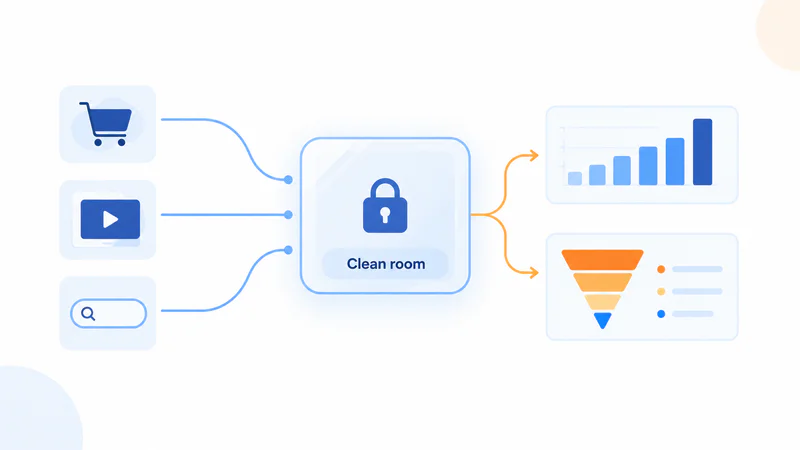
The short answer
AMC shows how your ads work together and who they reach. It does not show profit.
Since September 2025, any advertiser running Sponsored Products, Sponsored Brands, Sponsored Display or Sponsored TV can open it from the ads console.
It pays off when your basics are already solid and someone on your team can read the output. If they aren't, it's an expensive way to look busy.
What can you do inside AMC?
AMC answers questions about the journey, not just the click. Each ad type in Campaign Manager reports its own sales. AMC lines the touchpoints up, so you can see what a group of shoppers saw before they bought.
The overlap question matters most for brands that run several ad types on one keyword. We push sellers to take more of the roughly 70 products a shopper sees on a results page, and running Sponsored Products, Sponsored Brands and video together does that. AMC is how you check whether the overlap wins new shoppers or just shows the same person three ads.
Who can access Amazon Marketing Cloud?
Any advertiser running sponsored ads. Amazon announced on September 18, 2025 that AMC is open to everyone using Sponsored Products, Sponsored Brands, Sponsored Display or Sponsored TV, and the option now sits in the ads console under Measurement & Reporting. Amazon said it would extend the same streamlined access to Amazon DSP advertisers in early 2026.
That is a big change. AMC used to require Amazon DSP, then opened up through agency paAny advertiser running sponsored ads. Amazon announced on September 18, 2025 that AMC is open to everyone using Sponsored Products, Sponsored Brands, Sponsored Display or Sponsored TV, and the option now sits in the ads console under Measurement & Reporting. Amazon said it would extend the same streamlined access to Amazon DSP advertisers in early 2026.rtners. Plenty of articles still say you need a DSP account or a large budget. Amazon's own announcement mentions no spend minimum, so check the console before you believe an older post, including this one a year from now.
What you see when you open it:
No-code templates for campaign performance and audience insights, with visual output.
Low-code templates in a use case library, for people who know a little SQL.
A query editor for custom analysis and audience building.
If you'd rather not do the analysis yourself, Amazon's partner directory lists agencies, software vendors and consultancies that specialize in AMC.
Source: Amazon Ads, September 18, 2025
Is AMC right for you?
Access is easy now. Getting value out of it is not. AMC sharpens decisions you're already able to make, so it works best when the basics are in place. If shoppers see your product and still don't buy, the problem is the product or the listing, and no clean room fixes that.
The 14-day cycle matters here too. Sponsored Products data takes about 7 days to attribute, Sponsored Brands and Sponsored Display about 14. Read AMC results before that window closes and you're acting on incomplete data, the same mistake as changing campaigns every day.
Where AMC stops: it doesn't know your profit

AMC knows impressions, clicks, purchases and the path between them. It doesn't know your cost of goods, FBA and referral fees, return costs or storage fees. You can bring your own data into AMC, but then you build and maintain the cost side yourself, SKU by SKU, in SQL, every month.
That gap is where money disappears. In Sellerview's 2026 survey of 63,610 products across 100 Amazon seller accounts, 37% of products at the typical seller cost more to sell than they brought in. 7 out of 10 products had ads running on them, and some of those ads sit on products that lose money. The losers made up only about 7% of sales, so the losses hide in the slow sellers. Campaign Manager and AMC both show you the ad. Neither shows you the loss.
ACoS compares ad cost to ad sales and stops there. Real profit has five parts:
Most sellers track two of them. A better audience built in AMC will lift conversions on a SKU, but if that SKU loses money on every unit, you've just scaled the loss faster.
That's why we start with the financial ceiling, the most you can pay for a click on a product. The formula is simple:
For a $30 product converting at 10% with a 25% ACoS target, that's $0.75 per click. AMC can tell you which audience converts best. Break-even CPC tells you what that audience is worth paying for. Sellerview tracks the cost side for you automatically, so you can see which SKUs deserve a better audience before you build one.
How to start with AMC without wasting it
Open the no-code templates first. Don't write SQL on day one. The templates show you what the data looks like and which questions are worth a custom query.
Pick one question and your top SKUs. The products behind 60 to 80% of your sales are where a finding will move the account. Start with ad overlap or new-to-brand share, not everything at once.
Build one audience, not ten. Shoppers who engaged with your ads or listings and didn't buy are the obvious first one. Most people who click don't buy the first time. They forget, or they wanted a second opinion, and remarketing brings them back.
Check profit before you scale anything. Put the winning audience next to SKU-level profit. If the SKU doesn't clear its fees, returns and ad cost, fix that before you spend more on it.
Then wait for attribution, review every 14 days, and repeat. AMC rewards sellers who ask narrow questions on a schedule. It punishes the ones who log in once, get overwhelmed, and never come back.
The bottom line on Amazon Marketing Cloud
AMC is worth opening if you run more than one ad type and you already know your numbers. It shows who your ads reach and how they work together. It can't tell you whether any of it made money.
AMC tells you what drives sales. Sellerview.ai shows you what drives profit, SKU by SKU, after ads, fees, returns and COGS. Run both and you stop scaling SKUs that were never paying for themselves.
See your real profit on Sellerview.ai. Start your free 3-day trial.