
You already pay Amazon to store your inventory. MCF lets that same stock fill your Shopify, TikTok Shop and Walmart orders too. The catch is the fee. A single-unit MCF order on a $25 product now costs about $8.46 to ship. That's a third of the sale gone before you pay for the product or the ad that sold it.
Amazon Multi-Channel Fulfillment (MCF) is Amazon's service for shipping orders you get outside Amazon. Your products sit in the same fulfillment centers FBA uses. When someone buys from your Shopify store, TikTok Shop, Walmart listing, eBay or your own site, the order goes to Amazon, and Amazon picks, packs and ships it. You pay a fee per unit. There's no referral fee, because the sale didn't happen on Amazon.
That's the simple version. The money side is where most sellers get it wrong, so we'll cover both.
How Amazon MCF works, step by step
You send inventory to FBA as usual. One pool of stock now serves Amazon orders and every other channel you connect.
An order comes in somewhere else. An app or integration sends it to Amazon automatically. Amazon has an official Shopify app and more than 100 prebuilt integrations. You can also create orders by hand in Seller Central.
Amazon ships it at the speed you pick. Standard is 3 business days, Expedited is 2, and Priority is 1.
Tracking flows back to your store. If the customer returns the item, it goes back into your FBA inventory.
MCF orders now ship in plain, unbranded boxes by default at no extra cost. There are exceptions. Apparel, footwear, non-sortable items and anything over 56 inches or 49.9 lb can still go out in Amazon packaging.
That matters for Walmart. Walmart allows MCF for its orders, but only in unbranded packaging and only with Amazon Logistics blocked as a carrier. Get either one wrong and you risk your Walmart account, not just one order.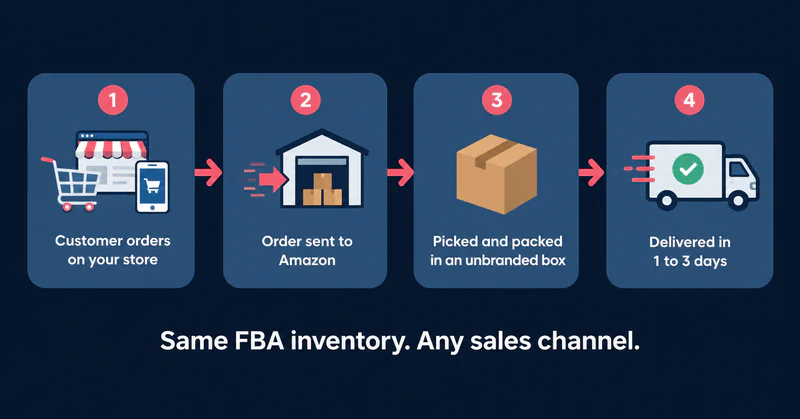
Who should use MCF, and who shouldn't
MCF makes sense if you already sell on FBA and want to open a second channel without a second warehouse. It works best when your off-Amazon customers expect 2 to 3 day delivery, often buy more than one unit, and your products are light.
It's a poor fit if you're brand new and not on FBA yet, if your brand depends on a branded unboxing, or if you ship heavy items. A 10 lb standard item costs about $13.29 to ship through MCF in 2026, while mid-market 3PLs often quote $6 to $7 for the same parcel.
What Amazon MCF costs in 2026
MCF fees depend on four things: size tier, shipping weight, units per order and delivery speed. Here's what standard 3-day delivery costs per unit on the non-peak rate card.
Those are base fees. Three more things change the number you actually pay:
A 3.5% fuel and logistics surcharge has applied to MCF fees since May 2, 2026.
Holiday peak rates run from October 15, 2026 to January 14, 2027. If you're shipping now, check the peak table.
The January 2026 hike landed on single-unit orders. They went up $0.35 to $0.41 per unit, while FBA rose about $0.08. Orders of 3 or more standard-size units saw no MCF increase at all.
There's some relief. Amazon's Preferred Pricing program gives eligible sellers up to 15% off MCF fees and up to $1 in FBA fee credits per MCF unit shipped. It's invite-only and aimed at sellers who have used MCF steadily for around six months. Amazon has also waived the usual 5% surcharge on Walmart orders fulfilled through MCF until January 14, 2027.
Here's why the fee table alone won't tell you if MCF pays. Across 63,610 products in our 2026 seller data, Amazon fees took about 22% of sales. But that number ranged from 18% to 71% between sellers. If your Amazon fee share is that hard to predict, adding MCF on top without tracking it per order is a guess, not a plan.
The single-unit trap
Let's run one real order. You sell a $25 product on Shopify. It's small standard, 8 to 12 oz, and costs you $7 to make. Shopify Payments takes about 2.9% plus $0.30.
Same product, same customer, same warehouse. The single-unit order keeps 34 cents of every dollar before ads. The 3-unit order keeps 49. Shipping three units in one box instead of three separate orders saves $10.71 in MCF fees alone.
Now take your ad cost out of that $8.51. On a TikTok Shop or Meta campaign, there may be nothing left. And most sellers never see this per order, because MCF fees land in the settlement report mixed in with everything else.
So the fix isn't to drop MCF. It's to stop sending it single, cheap units. Bundles, multi-packs and a free-shipping threshold that nudges carts to 2 or 3 units do more for MCF margin than any discount program.
Returns cost you twice on MCF
About 1 in 10 units comes back as a return in our 2026 data, worth 8% of sales value. And that's only the refund.
On an MCF order, a return also triggers a return processing fee, about $3.45 for a small standard 8 to 12 oz item. The $8.46 you paid to ship it out is gone too. At a 10% return rate, that works out to roughly $1.20 extra on every order you ship, before you count a single refund or a damaged unit you can't resell.
If a SKU has a high return rate on Amazon, assume it'll be at least as bad on Shopify or TikTok Shop. Those buyers didn't get to read your Amazon reviews first.
MCF vs FBA vs a 3PL
The trade-off comes down to price point. On a $25 product, the referral fee you skip (about $3.75 at 15%) roughly cancels out MCF's higher fulfillment cost. Above about $40, with multi-unit orders, MCF usually comes out ahead. Below that, or on heavy items, a 3PL often wins on cost and MCF wins only on simplicity.
One more thing changed this year. Amazon stopped offering FBA prep and labeling in the US on January 1, 2026, so MCF stock has to arrive prepped too. We covered what that does to your per-unit cost in FBA prep service costs.
Which SKUs to send through MCF
In our 2026 data, 37% of products lost money on every sale. But those products made up only about 7% of sales. The losses sit in the slow, low-price SKUs, and those are exactly the worst ones to push through MCF.
Before you switch a SKU on, check six things:
Price. Above $25 at minimum, ideally $40 or more.
Size and weight. Standard size, under 3 lb.
Order size. Customers regularly buy 2 or more, or you can bundle it.
Returns. Under 10% on Amazon.
Packaging. Not apparel or footwear if you sell on Walmart, since those can ship in Amazon boxes.
Profit on Amazon. If it doesn't make money on FBA, MCF won't fix it.
A SKU that passes all six is a strong MCF candidate. Two or more misses, and you're better off with FBM or a 3PL for that channel.
Where MCF profit quietly leaks
One Amazon order can carry 31 different fees, and most sellers build only 3 or 4 into their pricing. MCF adds its own lines on top: the fulfillment fee, the fuel surcharge, peak rates, return processing and storage on the same shared pool. We broke down how fast those stack in Amazon fees on one order.
This is exactly the gap Sellerview.ai closes. It pulls every fee line from your Amazon settlement data into profit per SKU, so you see what each product really makes after fees, returns and ads, not what the rate card suggests.
Is Amazon MCF worth it?
Yes, when your off-Amazon orders are multi-unit, mid-priced and light. No, when they're single, cheap units, especially in Q4 when peak rates kick in. Most sellers sit somewhere in between, which is why the answer has to come SKU by SKU, not from one account-level average.
If you want the full picture of what selling on Amazon costs before you add a channel, start with how much it costs to sell on Amazon.
See what MCF and FBA fees are really doing to every SKU. Start your 3-day free trial of Sellerview.ai.