# Amazon Product Validation: 7 Checks Before You Buy Inventory
Author: Himanshu Gaba
Author URL: https://sellerview.ai/blog/author/himanshu-gaba
Published: 2026-10-15
Category: Amazon Data & Analytics
Category URL: https://sellerview.ai/blog/category/amazon-data-and-analytics
Meta Title: Amazon Product Validation: 7 Checks Before You Buy Inventory
Meta Description: Learn how to validate an Amazon product idea using demand, keyword, competitor, review, and margin data before you invest in inventory.
Tags: Amazon Product Research, Amazon Product Validation, Amazon FBA product research
Tag URLs: Amazon Product Research (https://sellerview.ai/blog/tag/amazon-product-research), Amazon Product Validation (https://sellerview.ai/blog/tag/amazon-product-validation), Amazon FBA product research (https://sellerview.ai/blog/tag/amazon-fba-product-research)
URL: https://sellerview.ai/blog/amazon-product-validation-before-buying-inventory

A product can look excellent on a Tuesday afternoon. Search volume is high. A few listings appear to be making serious sales. The supplier offers a better price for 1,000 units. By Friday, the deposit is paid.
Then the less exciting facts show up. One established brand owns most of the demand. The main keyword attracts shoppers looking for a different product. Advertising leaves almost no margin. A repeated review complaint turns out to be a manufacturing problem, not an easy feature gap.
Now the seller owns a large pile of evidence, packed into cartons.
Amazon product validation is how you find those problems before inventory makes them expensive. A useful validation process tests a product idea from several angles, then looks for agreement between the signals. Demand matters, but so do competition, search intent, customer complaints, price structure, and the cost of getting a sale.
## **Key takeaways**
• Product validation should prove that demand is stable and accessible, not merely large.
• Search volume means little when the search intent does not match the product you plan to sell.
• Reviews can reveal a useful product gap, but only if the problem is common and practical to fix.
• A product passes only when the likely selling price can absorb fees, advertising, returns, and landed cost.
## **What Amazon product validation should answer**
Many Amazon product research guides begin with attractive thresholds for monthly revenue, review count, or search volume. Those filters can build a shortlist. They cannot make the final decision.
A market with low review counts may be new or weak. A high-volume keyword may hide several buying intentions. Estimated sales can look healthy while one brand takes most of the clicks and orders.
The better question is simple: can a new offer earn attention, convert that attention, and leave money after the full cost of the sale?
That question creates seven checks. If an idea fails one of the early checks badly, stop. Research is cheap. Samples, molds, packaging, freight, and stale FBA inventory are not.
The examples below follow a hypothetical leak-resistant lunch container for adults. The findings are illustrative, not claims about a live Amazon category.
## **Check 1: Is demand stable enough to survive your lead time?**
A screenshot of this month's search volume is not demand validation. It is one frame from a film.
Review search and sales patterns across a longer period. Look for sharp spikes, seasonal peaks, and sudden drops across several related terms. A market built around one viral phrase may cool before your first shipment reaches an Amazon warehouse.
For the lunch container example, terms such as “adult lunch box,” “leak proof lunch container,” and “meal prep container for work” may point to different segments. Stable movement across several relevant terms is stronger evidence than one giant spike around a social media trend.
[SellerSprite](https://www.sellersprite.ai/) combines Category Insights, Keyword Research, and Product Research for this stage. Use the data to see whether demand fits your sourcing timeline, cash cycle, and selling season.
A seasonal product can still be a good product. It simply needs a seasonal purchasing plan. Treating a three-month peak as twelve months of steady demand is where the trouble starts.
## **Check 2: Is the demand shared, or does one brand own the room?**
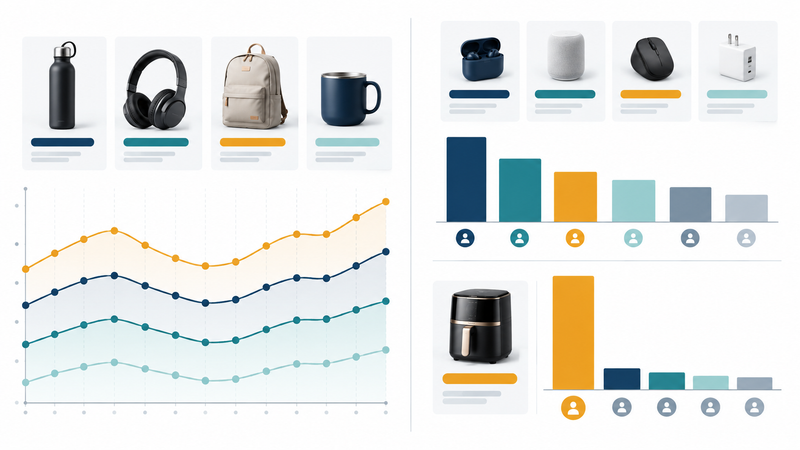
Two markets can produce the same total monthly revenue and offer completely different chances to a new seller.
In the first market, ten listings share the sales and newer listings gain traction. In the second, one brand takes most orders while the rest fight over crumbs. Total demand may look identical. Entry risk does not.
Review sales concentration, click concentration, review velocity, price bands, and the age of the leading listings. Compare several ASINs instead of treating the category leader as the whole market. SellerSprite's market and competitor analysis can help show whether buyers move between offers or default to a small group of entrenched listings.
Our hypothetical lunch container stays on the shortlist if demand is spread across multiple designs and price points. It becomes far less attractive if a household name dominates the main queries and wins through brand recognition that a new listing cannot copy.
## **Check 3: Do the keywords match the product people intend to buy?**
High search volume is often a trap because broad terms hide several jobs.
Someone searching “lunch box” might want a child's insulated bag, a stainless steel bento box, a disposable catering pack, or an adult container for the office. Those shoppers are not interchangeable. If your planned product fits only a small slice of the term, using the full search volume in a sales forecast will exaggerate demand.
Build a keyword set around the exact product concept. Then examine the ASINs already ranking for those searches. A Reverse ASIN analysis shows which terms bring visibility to competing products, while keyword tools help separate core purchase terms from loose associations.
Check the product types filling page one, the price range attached to each intent, and the words repeated across relevant listings. For our example, “adult,” “microwave safe,” and “leak proof” may describe a cleaner opportunity than “lunch box.”
This work also sets up the launch. Exact search intent keeps images, copy, and PPC targets focused on the same buyer. Starting with a broad keyword means paying Amazon to teach this lesson after launch.
## **Check 4: Can you name the reason a buyer would choose your offer?**
“Better quality” is not a product gap. Neither is “nice packaging.” Those phrases disappear the moment a supplier asks what needs to change.
A usable gap is specific. The current lids trap water in the seal. The dividers shift during transport. The popular size does not fit standard work bags. Buyers like glass containers but complain about their weight. Each observation suggests a product decision that can be tested in a sample.
Compare leading products by material, dimensions, bundle size, rating, price, and repeated selling points. Look for a gap buyers care about that still fits the cost target. A change that adds four dollars to landed cost may fail in a narrow price band.
The lunch container idea should leave this check with a sentence a supplier can act on, such as: “A two-compartment adult container with a removable silicone seal that is easier to clean, sized to fit a standard commuter bag.” If the only plan is to copy the top seller in another color, the product has not passed.
## **Check 5: Do reviews show a fixable problem?**
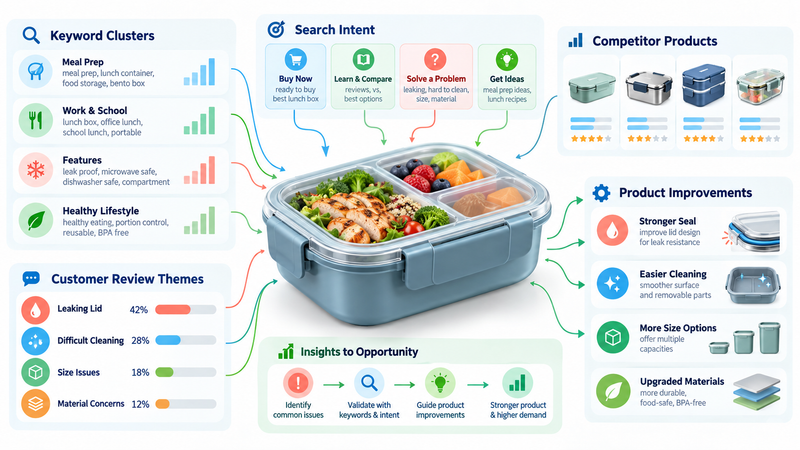
Reviews are a record of what customers expected and where the product missed. They are also noisy. One furious paragraph can feel important even when 2,000 other buyers never mention the issue.
Group complaints by theme and check how often they appear across several competing ASINs. Separate product defects from delivery damage, misuse, and preference. Also separate variants when possible. A lid complaint attached to one size should not condemn an entire product family.
SellerSprite's Review Analysis can organize repeated feedback and distinguish variant-level patterns. A common complaint is useful only when you can fix it without creating a new problem or destroying the margin.
Suppose reviews repeatedly say the lunch container leaks after the seal is removed for cleaning. That is a promising design brief. Suppose they say glass is too heavy, plastic feels cheap, and stainless steel cannot go in a microwave. That is not one gap. It is a trade-off between materials, and every product must choose a side.
## **Check 6: Does the margin survive an ordinary launch?**
A product that is profitable before advertising has not finished the test.
Build the unit model with selling price, landed cost, Amazon fees, packaging, promotions, advertising, returns, and a safety buffer. Run more than one case. The conservative case shows whether a rough first month could drain the account.
SellerSprite's Profitability Calculator can help compare price and cost assumptions before inventory is ordered. You can also use Sellerview's [Amazon FBA profit calculator](https://sellerview.ai/amazon-fba-profit-calculator) as a second check on the economics.
Focus on contribution profit per unit and break-even ACoS. If the product earns $6 before ads and the expected advertising cost is $7 per order, more sales produce a larger loss. No keyword chart can rescue that arithmetic.
For the lunch container, test the expected price, a launch discount, and a lower competitive price. Add a return allowance. If the idea works only at the highest price with cheap clicks and almost no returns, it is not ready for a purchase order.
## **Check 7: Is there a feedback loop after launch?**
Pre-launch estimates are decisions made with incomplete information. Once the product begins selling, actual search terms, conversion, ad cost, returns, Amazon fees, and SKU-level profit replace the estimates.
The two tools handle different jobs. SellerSprite supports research before and around launch: demand, competitors, keywords, reviews, and market movement. Sellerview connects operational data after launch to show what each SKU makes after fees, ads, returns, and cost of goods.
A promising keyword may still acquire traffic at an unsustainable cost. A feature added to solve a complaint may reduce returns, or do nothing. Compare the original thesis with live results and adjust bids, price, content, or the next purchase order.
Amazon's Search Query Performance report can add another layer by showing where a product wins or loses impressions, clicks, cart adds, and purchases. Sellerview explains [how to read Search Query Performance](https://sellerview.ai/blog/what-is-search-query-performance-amazon-sellers) without confusing traffic with profit.

## **A practical SellerSprite research workflow**
The seven checks do not require seven disconnected projects. A candidate can move through a simple sequence:
1\. Use Product Research and Category Insights to create a shortlist based on demand, seasonality, price bands, and competition.
2\. Open the market view and compare several ASINs to see how sales, clicks, reviews, and prices are distributed.
3\. Use Keyword Research and Reverse ASIN to define the exact search intent and identify the terms competitors rely on.
4\. Run Review Analysis across relevant products and variants, then turn repeated complaints into sample requirements.
5\. Model the likely selling price and costs in the Profitability Calculator. Reject ideas that need perfect conditions to break even.
6\. Save the strongest candidates for monitoring while you request samples and supplier quotes. Update the model when the quote changes.
This process is designed to reject weak ideas. That may feel slower than finding a product in an afternoon, but rejecting a bad product before paying a deposit is a profitable result.
You can explore [SellerSprite's product and keyword research tools](https://www.sellersprite.ai/) before applying the workflow to your next shortlist.
## **Make the next purchase order earn its place**
The purpose of product research is not to collect attractive charts. It is to make a better inventory decision.
Run the seven checks, write down the evidence, and reject any idea that depends on perfect pricing, cheap ads, or a vague promise of “better quality.” The strongest candidate may be less exciting than the first one you found. It will also give your cash a better chance of coming home.
Get 35% off SellerSprite with code [SELLERVIEW](https://www.sellersprite.ai/affiliate/SELLERVIEW) and validate your next product before you commit to inventory.
## FAQs
Q: What is Amazon product validation?
A: Amazon product validation is the process of testing whether a product idea has accessible demand, manageable competition, clear keyword intent, a credible point of difference, and enough margin to survive normal selling costs. The result should be a decision to proceed, revise, or reject the idea.
Q: What data do I need for Amazon FBA product research?
A: Start with search trends, estimated sales, sales concentration, price history, review counts and velocity, keyword relevance, recurring review complaints, expected landed cost, Amazon fees, advertising assumptions, and returns. No single metric carries the decision.
Q: Is high search volume enough to validate a product?
A: No. High search volume can belong to several product types or be controlled by established brands. Check which ASINs rank for the term, how clicks and sales are distributed, and whether the likely conversion and advertising cost fit your unit economics.
Q: Can an Amazon product research tool replace supplier samples?
A: No. Data can show where an opportunity may exist and what buyers complain about. Samples confirm whether the supplier can produce the proposed fix at the required quality and cost. Use research to write a better sample brief, not to skip the sample.
---
This blog is powered by Superblog. Visit https://superblog.ai to know more.
---