
Amazon India Returns Are Destroying Margins Your Calculator Never Warned You About
You ran the numbers. The margin looked good. You launched. Then the returns started coming in.
If you're selling fashion or electronics on Amazon India, returns aren't an edge case - they're baked into the business model. And if you're not accounting for them inside your amazon profit calculator India estimates, you're pricing yourself into losses before the first month ends.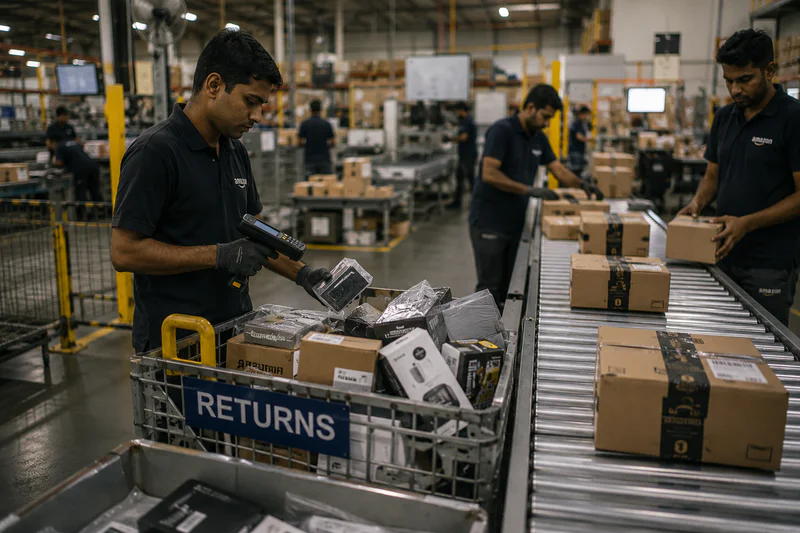
The Numbers Nobody Shows You Before Launch
India's fashion category sees return rates of 25–40%. Electronics isn't far behind at 15–25%. Compare that to the US, where fashion averages 20–25% and electronics sits around 10–15%.
Why is India higher? Two reasons.
First, Amazon India's "No Questions Asked" 10-day return policy trains buyers to order multiple sizes, try them at home, and return the rest. Second, COD (Cash on Delivery) orders - which still account for roughly 40% of Amazon India transactions - have return rates nearly double that of prepaid orders.
Your standard profit calculator shows you a gross margin number. It doesn't show you what happens to that margin after 30% of your fashion inventory walks back in the door.
What Returns Actually Cost You
This is where sellers get blindsided. Returns don't just mean lost revenue - they stack up multiple cost layers simultaneously.
FBA fees are non-refundable on outbound fulfillment. Amazon charges you to pick, pack, and ship the order. If the item comes back, you don't get that fee back. On a $15 fashion item, that's $1.50–$2.50 gone permanently.
Return processing charges. Amazon charges a fee to process the return back into your inventory - typically $0.50–$1.00 per unit.
Inventory condition degradation. A returned garment or electronics unit often comes back graded as "Used" or "Damaged." You either sell it at a steep discount through Amazon Warehouse Deals or write it off. Industry estimates put 20–30% of returned fashion units as unsellable at original price.
Repackaging costs. For electronics, repackaging for resale runs $1–$3 per unit if you use a 3PL or prep center in India.
The Margin Math Nobody Does
Real numbers. You're selling a $20 ethnic kurta on Amazon India.
Your amazon profit calculator india shows:
Looks solid. Now add a 35% return rate across 100 units shipped:
Revenue from 65 paid units: $1,300
FBA fees on all 100 outbound shipments: -$200
Amazon commission on 65 sales: -$104
Return processing (35 units × $0.75): -$26.25
COGS on all 100 units: -$800
10 units unsellable (28% of returns), written off: -$80
Actual profit: $89.75
Actual margin: 6.9%
A 42% calculator margin turned into a 6.9% real margin. One bad return season and you're negative.
Electronics Has a Different Problem
In electronics, the stakes are higher because return rates come with a fraud angle. Seller forums across India are full of reports: buyers returning empty boxes, swapped components, or completely different products.
A $50 Bluetooth speaker with a 20% return rate - and 30% of those returns being fraudulent or damaged - means 6 units lost completely per 100 shipped. That's $300 in inventory written off before you account for FBA fees and processing charges.
Amazon's reimbursement policy covers you if they lose or damage the item. It does not cover buyer fraud. A-to-Z claims and chargebacks stack on top of that.
How to Build Returns Into Your Amazon Profit Calculator India Numbers
Stop treating returns as a variance. Build them into your pricing model from day one.
Step 1: Use category-specific return rate benchmarks
Fashion tops, Kurtis, Sarees: 30% base rate
Footwear: 35–40%
Consumer electronics: 18–22%
Mobile accessories: 12–15%
Step 2: Add a return cost stack to every calculator
Formula: Return Cost per Unit = (Return Rate × FBA fee) + (Return Rate × Processing fee) + (Unsellable Rate × COGS)
For the kurta example:(0.35 × $2.00) + (0.35 × $0.75) + (0.10 × $8.00) = $0.70 + $0.26 + $0.80 = **$1.76 per unit shipped**
Step 3: Raise your breakeven accordingly
If your breakeven without returns was $14.00, your true breakeven is $15.76. Price below that and you're subsidizing your buyers' try-at-home experiment.
Step 4: Track returns at ASIN level, not category level
One listing with misleading images or wrong size charts can hit 60%+ returns while your catalog average looks fine. Per-ASIN return data is what you actually need to act on.
The Fix Is in the Listing, Not Just the Price
Returns aren't purely a pricing problem.
In fashion, 60–70% of returns cite "size didn't fit" or "color different from image." Fix those two things and your return rate drops 10–15 percentage points:
Add accurate size charts with measurements in centimeters
Include a size recommendation callout (runs small / true to size)
Shoot product images in daylight or calibrate to screen-accurate colors
Show garments on a model who matches your target buyer's build
In electronics, 40%+ of returns cite "product didn't work as expected." That's a listing expectation problem. Fix the bullet points, add a compatibility section, and use video content showing actual setup and use.
Closing
Your amazon profit calculator india is a starting point, not a finish line. The sellers who stay profitable in Indian fashion and electronics don't just calculate better - they price for the market reality of returns from day one.
Run the return-adjusted math before you list. If the margin doesn't survive a 30% return rate, the product doesn't belong in your catalog at that price.
FAQ
What is a realistic return rate for fashion sellers on Amazon India?
Fashion return rates on Amazon India typically range from 25–40%, with footwear often hitting 35–40%. COD orders return at nearly double the rate of prepaid orders. Build at least a 30% return rate into your margin calculations before launching any apparel ASIN.
How do I calculate true profit after returns using an Amazon profit calculator India?
Take your calculated gross margin and subtract: (return rate × FBA fee) + (return rate × return processing fee) + (unsellable return rate × COGS). This gives you a return-adjusted margin per unit shipped. If that number falls below 15%, the ASIN is high-risk.
Does Amazon India refund FBA fees when a product is returned?
No. Amazon only refunds the referral commission on returned orders. FBA fulfillment fees - the pick, pack, and ship charges - are non-refundable once the order ships. This is why high return rate categories like fashion have significantly lower real margins than calculator estimates show.
How do high return rates in electronics affect Amazon India profit margins?
Electronics return rates of 15–25% on Amazon India compound margin damage through three channels: non-refundable FBA fees, return processing charges, and inventory write-offs from fraudulent or damaged returns. A $50 electronics item with a 20% return rate and 30% unrecoverable returns can wipe out $50+ in margin per 100 units shipped.
What steps reduce return rates on Amazon India listings?
For fashion: add accurate size charts with centimeter measurements and a clear size recommendation callout. For electronics: use video demos, improve compatibility disclosures, and set accurate performance expectations in bullets. Sellers who fix listing quality typically see 10–15 percentage point drops in return rates within 60 days.