
Scale Amazon PPC when your TACoS is below 15%, your ACoS is 5-10 percentage points below break-even, and your amazon profit calculator shows net margin above 20% at current ad spend. Pull back when TACoS rises above 20% on a mature SKU, ACoS exceeds your break-even threshold, or when net margin in your amazon profit calculator drops below 10% at current ad intensity. Scaling and pulling back should both be data-driven decisions - not reactions to good or bad sales weeks.
What you will learn in this post:
• The exact TACoS and ACoS thresholds that signal when your amazon profit calculator output supports scaling PPC spend
• The four conditions that tell you to pull back ad spend before it destroys your margin
• The break-even ACoS formula and how to use it with your profit calculator to set a hard spending ceiling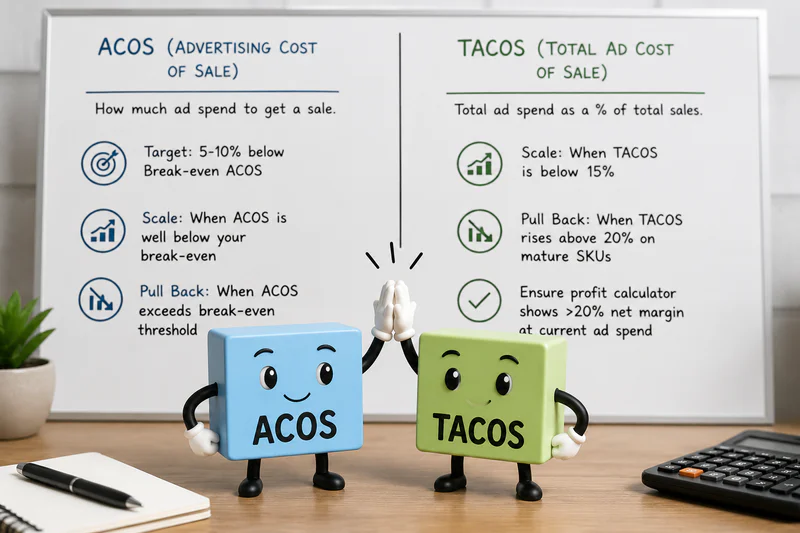
You Scaled PPC Because Sales Were Growing. Your Amazon Profit Calculator Showed Something Different
Revenue was up 40% month over month. The campaigns were working. You doubled the daily budget. ACOS looked acceptable. Then you opened your amazon profit calculator and ran the real numbers.
Net margin: 4.2%.
Here is what happened. Ad spend scaled. Revenue scaled. But the incremental margin on each new sale driven by higher ad spend was so thin that scaling the campaigns actually compressed overall profitability. The headline ACoS looked fine at 22%. But the product break-even ACoS was 26% - meaning ACoS was below break-even and campaigns appeared profitable. The problem: TACoS at 19% on a mature product, combined with 2026 FBA fee increases, had pushed real net margin below 10% before anyone checked the amazon profit calculator.
After working with 300+ Amazon brands across categories like Home & Kitchen, Beauty, and Electronics, the pattern is always the same: sellers scale PPC on the signal of ACoS and ignore what scaling is doing to their fully-loaded margin. The amazon profit calculator has the answer. Most sellers just do not look at it before they scale.
What Is the Amazon PPC Scale Decision Using a Profit Calculator?
The Amazon PPC scale decision is the process of determining whether increasing or decreasing ad spend will improve or damage your net margin per unit - calculated using your amazon profit calculator with real 2026 fees, actual TACoS, and category-specific return rate. It requires two calculations: break-even ACoS (the maximum ACoS before each paid sale loses money) and TACoS margin threshold (the maximum total ad spend as a percentage of total revenue before net margin falls below your minimum viable floor).
The Four Numbers Your Amazon Profit Calculator Needs Before Any PPC Decision
What is my break-even ACoS and how do I calculate it?
Break-even ACoS is the ACoS at which each ad-driven sale makes zero profit. Above this number, each paid sale loses money — even if the product is profitable on organic sales.
Break-even ACoS = (Selling Price - All Variable Costs Excluding Ad Spend) / Selling Price x 100
For a $38 product with $14.00 landed COGS, $5.70 referral fee (15%), $4.22 FBA fee, $0.40 placement fee, $0.70 return allocation, and $0.35 storage - total variable costs excluding ad spend = $25.37. Break-even ACoS = ($38 - $25.37) / $38 x 100 = 33.2%.
If your actual ACoS is 22%, you are 11.2 percentage points below break-even. You have room. If ACoS is 31%, you are 2.2 points below break-even - almost no room. If ACoS is 35%, every paid sale is losing money.
Run your real break-even ACoS in seconds — enter your product numbers in the Sellerview profit calculator below.
Scale when: ACoS is 5-10 percentage points below break-even. Pull back when: ACoS is within 3 percentage points of break-even or above it.
What does my current TACoS tell me about my amazon profit calculator output?
TACoS (Total Ad Spend / Total Revenue x 100) is the metric that connects your ad spend to your amazon profit calculator margin output. While ACoS measures campaign efficiency, TACoS measures the ad spend burden on your total business.
Amazon's advertising business generated $54.5B in 2024 and is projected to exceed $70B by 2026. Rising platform revenue means rising CPCs across all categories. Home & Kitchen targets 3.3-4.5x ROAS (22-30% ACoS). Top sellers across categories benchmark TACoS below 15% as the threshold where ad spend contributes to margin rather than consuming it.
What net margin does my amazon profit calculator show at current ad spend?
Before any scaling decision, run your amazon profit calculator with your current TACoS as the ad spend input - not zero, not your target. Use the actual number from last month. If the calculator shows net margin above 20%, scaling ad spend is safe. If it shows 15-20%, scaling is borderline - watch closely. Below 15% net at current ad spend means you are already running thin, and scaling will push you below 10% or into losses.
Most sellers run the amazon profit calculator with ad spend at zero or as an afterthought. That produces a gross margin estimate. The real number - with current TACoS applied as a per-unit cost - is always lower and always more honest.
Is my TACoS trending down month over month or holding flat?
Direction matters as much as the current number. A product at 18% TACoS that was at 23% TACoS 60 days ago is building organic velocity. TACoS is falling because organic sales are increasing while ad spend is stable. That is a product approaching the point where scaling makes sense - more spend into a growing organic flywheel compounds the return.
A product at 18% TACoS that has been at 18-19% for 3 months is ad-dependent. Organic is not building. Scaling spend here just increases the total ad burden without improving the underlying product economics.
The Amazon Profit Calculator Signals: Scale vs Pull Back Decision Matrix
Scale when all four signals say scale. Pull back when two or more say pull back. This is not about good campaign weeks or bad campaign weeks. It is about the structural economics of the product as shown in your amazon profit calculator.
When Your Amazon Profit Calculator Allows High ACoS
Two situations justify running above break-even ACoS temporarily - and your amazon profit calculator output should reflect theZ strategic intent, not just the current period economics.
New product launch (Days 1-90): You are buying rank, velocity, and reviews. At launch, your break-even ACoS calculation does not account for the organic sales you are seeding. Running ACoS at 5-10 points above break-even for 60 days to build a top-100 BSR and accumulate 30+ reviews is a deliberate investment in future organic margin - not a mistake. But set a hard limit and a review date. If ACoS is still above break-even at day 90 and TACoS has not trended down, it is not a launch investment. It is a structural problem.
Defensive spend on threatened keywords: A competitor is targeting your branded keywords or your top organic terms with aggressive bids. Running at higher ACoS temporarily to protect position can be justified - but only if your amazon profit calculator shows you can absorb the margin compression without going below 10% net. If you cannot absorb it, you cannot defend it.
Both exceptions have time limits and profit floors. No exception justifies running above break-even ACoS indefinitely without a thesis for when it improves.
How to Use Your Amazon Profit Calculator as a PPC Decision Gate
Before any budget change - scale up or pull back - run this sequence:
• Open your amazon profit calculator for the SKU you are evaluating
• Enter your actual last-30-day TACoS as the ad spend input - not your target, the actual
• Check the net margin output against your minimum viable margin (20% for most categories, 25% for electronics, 30% for apparel)
• Calculate your break-even ACoS: (sell price - variable costs excl. ad spend) / sell price x 100
• Compare your actual ACoS to break-even. If ACoS is 5+ points below break-even AND net margin is above 20% AND TACoS is trending down - scale by 20-30%
• If any of those three conditions fails - hold current spend and address the failing condition before scaling
Sellers who actively monitor and optimize PPC metrics against their amazon profit calculator output improve campaign efficiency by 25-40% over time. The sellers who do not look at their profit calculator before scaling are the ones who discover their 40% revenue growth came with a 60% margin compression.
sellerview.ai tracks your real net margin per SKU automatically - with actual 2026 fees, live TACoS, and real return rate - so your PPC scaling decisions start from a real profit calculator output, not a campaign dashboard that shows ACoS in isolation.
Your Amazon Profit Calculator Is the Gate. Not the Campaign Dashboard.
ACoS looks great. Revenue is growing. The campaigns are performing. All of that can be true while your amazon profit calculator shows you are losing margin at scale.
The decision to scale or pull back Amazon PPC is a profit calculator decision - not a campaign manager decision. Break-even ACoS sets your ceiling. TACoS level and trend sets your floor. Net margin output from your amazon profit calculator is the gate. When all three align toward scale - scale. When any one of them signals danger - stop and diagnose before you increase spend.
sellerview.ai shows your real net margin and TACoS per SKU - so every PPC scaling decision starts from your actual profit calculator output, not guesswork. Scale with data
free to start : Sellerview.ai
FAQ: Amazon Profit Calculator and PPC Scaling Decisions
What is the right time to scale Amazon PPC spend according to the profit calculator?
Scale Amazon PPC when your amazon profit calculator shows net margin above 20% at current TACoS, your actual ACoS is 5-10 percentage points below break-even ACoS, and TACoS is trending down month over month. All three conditions should be true simultaneously. If only one or two are met, scaling will compress margin without the organic flywheel effect that makes increased ad spend sustainable. Most sellers target TACoS below 15% as the scale signal for mature products.
How do I calculate break-even ACoS using my Amazon profit calculator?
Break-even ACoS = (Selling Price - All Variable Costs Excluding Ad Spend) / Selling Price x 100. Variable costs include: landed COGS, Amazon referral fee, FBA fulfillment fee, inbound placement fee ($0.40/unit standard for 2026), return rate allocation, and storage. Run your amazon profit calculator to get total variable costs, subtract from sell price, divide by sell price. For a $38 product with $25.37 in variable costs, break-even ACoS = ($38 - $25.37) / $38 x 100 = 33.2%. Any ACoS below 33.2% means each paid sale is profitable.
When should I pull back Amazon PPC spend to protect margin?
Pull back Amazon PPC when: (1) TACoS exceeds 20% on a product live for more than 90 days - the product is ad-dependent with no organic pull; (2) actual ACoS is within 3 percentage points of your break-even ACoS or above it - each paid sale is eroding profit; (3) net margin in your amazon profit calculator drops below 10% at current ad spend - you are one fee change or return rate spike away from losses; or (4) TACoS has been flat or rising for 3 consecutive months - organic velocity is not building regardless of ad spend.
What TACoS percentage should my amazon profit calculator use for PPC scaling decisions?
Use your actual last-30-day TACoS from Campaign Manager divided by your Business Reports total revenue for the same period. Do not use your target TACoS or a blended estimate. For category benchmarks: Home & Kitchen and Pet mature at 8-12% TACoS; Health and Beauty at 7-11%; Apparel at 12-16%; Electronics at 10-15%. Top Amazon sellers across categories benchmark TACoS below 15% as the threshold where ad spend contributes to margin. Above 15% TACoS on a mature product means organic is underperforming and scaling ad spend will amplify the problem, not solve it.
How do 2026 Amazon fee changes affect PPC scaling thresholds in the profit calculator?
Three 2026 changes directly affect your break-even ACoS calculation in the amazon profit calculator. The inbound placement fee of $0.40/unit (Jan 2026) and the 3.5% fuel surcharge (April 2026) both increase variable costs per unit, lowering break-even ACoS. A product that had a 35% break-even ACoS before these changes might now have a 31-32% break-even ACoS - meaning your ACoS ceiling is lower, less ad spend is profitable per unit, and the decision to scale requires more margin buffer than it did in 2025. Recalculate your break-even ACoS using full 2026 fees before any budget change.
Is there a universal good ACoS for Amazon PPC in 2026?
No. ACoS is only meaningful relative to your break-even ACoS - which is product-specific, not universal. A 25% ACoS might be profitable on a high-margin product and loss-making on a thin-margin one. Most sellers aim for ACoS 5-10 percentage points below their break-even level to maintain a profitability buffer. Home & Kitchen sellers typically target 22-28% ACoS (equivalent to 3.3-4.5x ROAS). Electronics sellers often need to target 15-20% ACoS due to higher COGS and return rates compressing break-even. Run your amazon profit calculator to find your product-specific break-even before setting any ACoS target.