
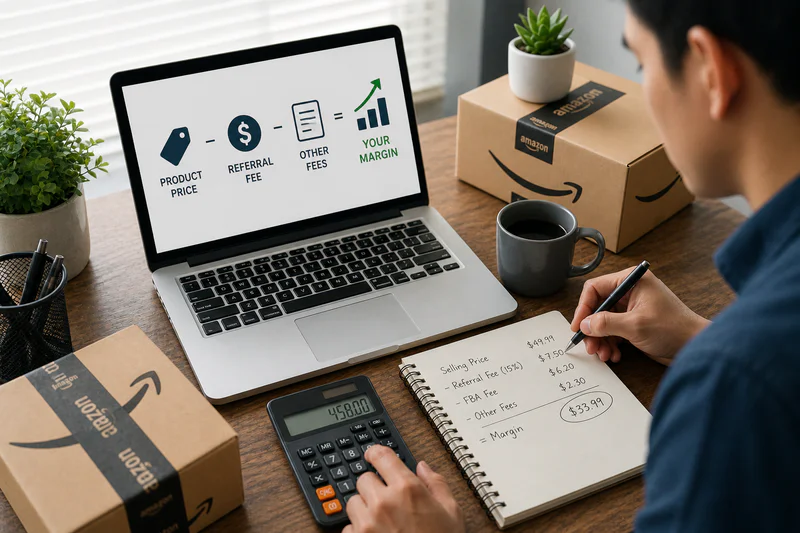
You checked your revenue dashboard last month. Orders were up, BSR was holding, and the top-line number looked fine. Then you sat down to reverse-calculate what Amazon actually took - and the margin was thinner than it had any right to be. Not by a little. By enough to matter.
Here's the thing: most US Amazon sellers can tell you their referral fee percentage. They've seen it in Seller Central. They know electronics is around 8%, clothing is 17%. That part they've got.
What they don't know - what nobody explains clearly enough - is how that percentage gets applied, which price points trigger a completely different fee bracket, and how the same referral fee rate turns into a very different total bill depending on your fulfillment model.
This isn't another post listing percentages. You don't need that. What you need is the operator's view: where the margin is actually leaking, and exactly how to stop it.
What Is the Amazon Referral Fee - And What It's Actually Calculated On
The Amazon referral fee is the commission Amazon charges on every product sold through its marketplace. It's a percentage of your sale, deducted automatically before any money hits your account. No invoice. No line item you manually track. It's gone before you see it.
Here's where most sellers get it wrong from the start:
The referral fee is not calculated on your item price alone.
Amazon applies the percentage to the total amount charged to the buyer - item price + shipping charges + gift wrapping. If you're charging $9.99 for shipping on a heavy product and you've been pricing based only on the item cost, you've been calculating your fee wrong on every single order.
The actual formula:
Referral Fee = (Item Price + Shipping + Gift Wrap) × Category Rate
Minimum: $0.30 per item - whichever is greater.
That $0.30 minimum catches sellers of low-priced accessories. A $1.75 product at 15% gives you $0.26 in math - but Amazon charges $0.30. That's an effective rate of 17.1% on a product you priced assuming 15%. Multiply that across thousands of units and you've got a systematic margin error baked into every pricing decision you've made.
Amazon froze referral fees for 2025 - no new increases, no new fee types. But frozen doesn't mean the damage is already contained. The rate you think you're paying is almost certainly not the rate you're actually paying.
The Fee Cliff: How $0.01 Can Cost You Hundreds of Dollars a Month

This is the margin leak I see most consistently across brands - and it's the most preventable one there is.
Amazon's referral fees aren't always flat percentages. Several major categories use tiered structures where the rate changes at a specific price threshold. The problem isn't the tier itself. It's that the lower rate doesn't apply to just the amount above the threshold - it applies to the entire sale price if you cross it.
Take beauty and personal care as the clearest example:
8% on items priced at or below $10.00
15% on items priced above $10.00
A beauty product at $9.99 pays $0.80 in referral fees. The same product at $10.01 pays $1.50. Price moved $0.02. Fee moved $0.70. That's not a sliding scale - that's a cliff.
At 2,000 units a month, here's what that cliff costs you annually:
Priced at $9.99 (8%): $0.80 × 2,000 = $1,600/month = $19,200/year
Priced at $10.50 (15%): $1.58 × 2,000 = $3,150/month = $37,800/year
Difference: $18,600/year. From a $0.51 pricing decision.
Categories with known price-threshold structures in the US marketplace:
Audit every ASIN you're selling against these thresholds. If you're sitting $0.50–$2.00 above a fee cliff, model the impact of pricing just below it. In most cases, selling at $9.99 instead of $10.50 - with a slightly lower margin per unit - results in significantly better net margin overall because the fee drop more than compensates for the price reduction.
Simple funda: know your cliff before you set your price. Most sellers set price first and discover the cliff later, if ever. For the exact rate in every US category - including subcategories with their own thresholds - refer to our Amazon referral fees by category table.
FBA vs. FBM: Same Referral Fee, Very Different Total Bill
Here's something that trips up a lot of sellers when they're running the numbers: your referral fee doesn't change based on fulfillment model. FBA or FBM - Amazon takes the same category percentage either way.
But that's not the whole story, and treating it as such is expensive.
The referral fee is one line item in your total Amazon seller fee stack. The full stack looks completely different depending on which fulfillment model you're running. Here's a real-world breakdown for a $30 product in Home & Kitchen (15% referral fee), weight 1 lb, at 500 units/month:
At scale, FBA almost always wins on total cost - even with storage factored in. The sellers I work with who've moved from FBM to FBA at 400+ units/month typically recover 8–14% in net margin just from the fulfillment cost difference. The referral fee stayed identical. The total cost didn't.
The referral fee is fixed. Your fulfillment cost is what you can actually optimize. Don't let the referral fee percentage distract you from the line item that's actually movable.
Category Selection Is a Margin Decision - Not Just a Listing Decision
Every guide tells you to pick the most accurate category for your product. Correct from a compliance standpoint. But here's what nobody adds: many products legitimately fit two or more categories with meaningfully different referral fee rates.
A silicone kitchen tool could list under Kitchen (15%) or Tools & Home Improvement (12%). An electric grooming device could list under Health & Beauty (8% on first $10, 15% above) or Electronics (8% on first $100, 3% after). A resistance band might fit Sports & Outdoors (15%) or a health-adjacent classification with a more favorable structure.
The math is straightforward. At $50,000/month GMV, the difference between a 12% and 15% referral fee is $1,500 every month - $18,000 a year. No new traffic. No sourcing changes. Just a category classification review.
Here's how to approach it:
Identify your top 10 ASINs by GMV. Check which category they're currently in and the applicable fee rate.
Check the Browse Tree Guide. Amazon's BTG specifies legitimate category assignments - this is your compliance anchor. If the product genuinely fits a second category, it's a valid candidate for review.
Calculate the monthly fee delta. Multiply the percentage difference by monthly GMV for that ASIN. If it's more than $300/month, it's worth pursuing.
Open a case with Seller Support. Request a category review. Document why the product fits the lower-fee category based on product type and customer use case. This isn't a loophole - it's a classification correction.
Most sellers never do this audit because they assume their category was assigned correctly at launch. It often wasn't. Amazon's category auto-assignment at listing creation is based on keyword matching, not fee optimization. You have to do this manually.
The Refund Administration Fee: You're Paying Twice When Customers Return

When a customer returns a product, most sellers assume they get their referral fee back. They do - but not all of it.
Amazon refunds approximately 80% of the referral fee for non-media items. The remaining 20% is retained as a "refund administration fee," capped at $5.00. It's charged automatically. It doesn't show up as a distinct line in most dashboard views. And in high-return categories, it adds up to a number your P&L almost certainly isn't capturing correctly.
Here's the math on a $35 apparel item at 17% referral fee:
Referral fee paid at sale: $5.95
Refund issued to seller on return: $4.76 (80%)
Amazon keeps: $1.19 per return
At a 20% return rate on 1,000 units/month, that's $238/month - $2,856/year — in non-recoverable referral fee loss. Before you've accounted for the returned inventory itself, repackaging, disposal, or the cost of the original FBA fulfillment that doesn't get refunded. For the full picture of what a return actually costs you beyond this fee, read our breakdown of Amazon return fees and the hidden P&L leak.
Categories with the highest return rates on Amazon US, and therefore the highest exposure to this fee:
Apparel & Accessories: 15–40% depending on subcategory
Shoes: 25–35%
Consumer Electronics: 10–20%
Jewelry: 10–15%
Furniture: 8–15%
The honest benchmark: assume 15–20% of your gross referral fee expense in these categories is non-recoverable when you model out your true cost of returns. Build that into your pricing floor, not your post-mortem.
And if your return rate exceeds 15% on any ASIN, treat that as a product-listing problem first - image accuracy, sizing information, expectation mismatch - not a fee problem. Fix the root cause and the return fee impact goes away. Chase the fee without fixing the root cause and you'll keep bleeding.
Your Stop-Leaking-Margin Checklist
Five things you can audit this week - no new software required for most of them:
Recalculate your referral fee on total checkout value. Pull your Transaction Reports from Seller Central. Confirm whether the fee is being applied to item + shipping. If you've been modeling on item price only, every margin calculation you've done is off.
Map every ASIN to its category's price threshold. For each product, identify whether there's a fee cliff within $2.00 of your current price. If yes, model the P&L impact of pricing just below the threshold.
Run a full FBA vs. FBM cost comparison. Not just referral fees - the entire per-unit cost stack including fulfillment, storage, and shipping. Especially urgent if you're on FBM at 300+ units/month.
Audit your top ASINs by category assignment. Could any legitimately fit a lower-fee category per the Browse Tree Guide? If yes, calculate the monthly delta and open a support case.
Add refund administration fees to your COGS model. Pull your return rate by ASIN. Apply the 20% non-recoverable referral fee factor. Add that number to your per-unit cost model for each product.
Most sellers running $30,000–$100,000/month in GMV are losing 1–3% of revenue to these five issues combined. That's $300–$3,000 a month - not from bad ads, not from sourcing problems, but from an incomplete view of what Amazon is actually taking.
The reason it stays invisible is that Seller Central shows you revenue and a fee summary - not the breakdown of why each fee is what it is, or where the avoidable losses are hiding. That's exactly what Sellerview is built to surface: not another revenue dashboard, but the actual margin picture at the ASIN level, before you convince yourself the business is healthier than it is.
Frequently Asked Questions
Is the Amazon referral fee the same as the FBA fee?
No. These are two separate charges. The referral fee is Amazon's commission on the sale - it applies to every seller regardless of fulfillment method. The FBA fee is a fulfillment charge that only applies if Amazon warehouses and ships your product. Both are deducted from your payout, which is why they're often confused, but they have different rates, different calculation bases, and different refund policies.
Do I pay a referral fee if I use FBM?
Yes. The referral fee applies to every Amazon sale, regardless of whether you fulfill the order yourself or through FBA. The only difference is that FBM sellers don't pay FBA fulfillment fees - they pay their own shipping and handling costs instead.
Does Amazon charge a referral fee on shipping charges?
Yes. For most categories, Amazon calculates the referral fee on the total amount the customer pays - item price plus any shipping charges you collect plus gift wrapping. This is a commonly missed detail that causes sellers to underestimate their true fee burden, especially on heavy items with significant shipping charges.
Can I negotiate my Amazon referral fee?
No. Referral fees are set by Amazon at the category level and are non-negotiable for all sellers. The only lever you have is category classification - ensuring your product is assigned to the most appropriate (and potentially lower-fee) category it legitimately qualifies for.
What happens to my referral fee when a customer returns a product?
Amazon refunds approximately 80% of your referral fee for non-media returns. The remaining 20% (up to $5.00) is kept as a "refund administration fee." For high-return categories like apparel and shoes, this non-recoverable portion represents a meaningful ongoing cost that most P&L models fail to capture as a distinct line item.