
You're doing $40,000 a month on Amazon. Revenue is climbing. BSR is holding. Ads are running. From the outside, the business looks healthy. But when you sit down and actually trace what's landing in your bank account - after every fee, every return, every storage charge - the number doesn't match. Not even close.
I see this constantly with sellers I work with. And every time, the conversation starts the same way: "I know there are fees, but I didn't realize it was this much."
That's the problem. Most Amazon sellers know fees exist. Very few actually know how much they're paying in total. Not because the information isn't available - it is - but because nobody adds it all up in one place and tells you what percentage of your revenue Amazon is actually taking.
That's what this article does. No fluff. No generic fee dictionary. Just the real math, the category traps, the hidden fees killing your launches, and a framework for pricing that actually protects your margin.
This is written for US Amazon sellers in 2026. If that's you, keep reading.
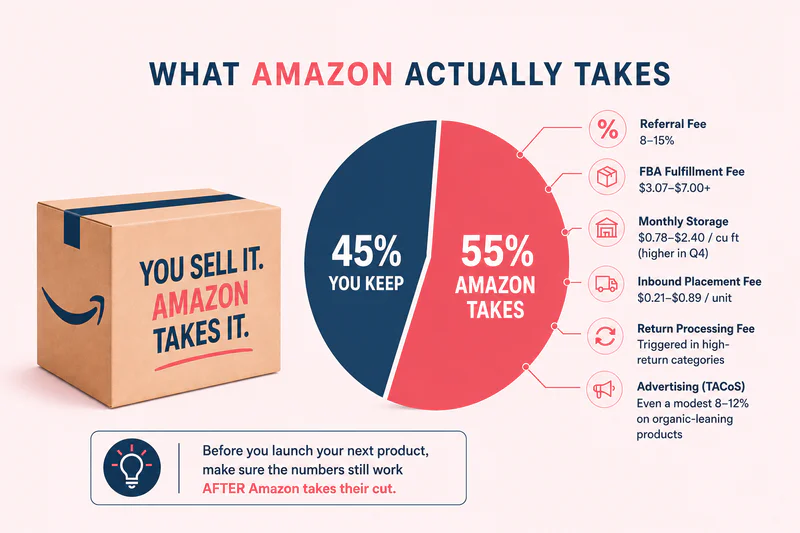
The 55% Problem - What Amazon Actually Takes
Here's the number nobody says out loud: on a typical FBA product, Amazon takes between 40% and 55% of your revenue before you've paid for your product.
Not 15%. Not 25%. Forty to fifty-five percent. Combined.
How? Stack the fees together the way they actually hit your P&L:
Referral fee: 8–15% of sale price
FBA fulfillment fee: $3.07–$7.00+ for standard-size items
Monthly storage: $0.78–$2.40/cubic foot (higher in Q4)
Inbound placement fee: $0.21–$0.89/unit for non-optimized shipments
Return processing fee: Triggered in high-return categories
Advertising (TACoS): Even a modest 8–12% on organic-leaning products
Run the math on a $30 product in a mid-range category. Referral at 9% = $2.70. FBA fee = $4.50. Storage allocation per unit = $0.60. Inbound placement = $0.40. Advertising at 10% TACoS = $3.00. That's $11.20 gone before your product cost enters the conversation.
Add COGS at $8.00 and shipping to warehouse at $1.50 - your net margin is $9.30 on a $30 sale. That's 31%. And that assumes no returns, no long-term storage surcharges, no refund administration fees, no promotional spending.
That 31% isn't bad. But it's built on assumptions that rarely survive contact with a real business at scale. The moment return rates climb, Q4 storage kicks in, or your ad spend increases, that number drops fast.
Nobody covers this clearly enough. So let's fix that.
The Full Amazon Selling Fee Stack - Line by Line
Before you can price correctly, you need to know every line item. Here's what Amazon charges US sellers in 2026:
1. Selling Plan Fee
Individual: $0.99 per unit sold, no monthly fee. Professional: $39.99/month, no per-unit charge. If you're moving more than 41 units a month, Professional is cheaper. This is the only Amazon fee where the math is simple and clean.
2. Referral Fee
Amazon's commission on every sale. Calculated on total sale amount including shipping charged to the buyer. Ranges from 6% (personal computers) to 45% (Amazon Device Accessories). Most everyday categories sit at 8–15%. Here's how referral fees vary by category and where sellers consistently misread their margin exposure.
3. FBA Fulfillment Fee
Charged per unit shipped. Determined by size tier and weight. 2026 rates for standard items:
Small standard (up to 4 oz): $3.07/unit
Large standard (up to 1 lb): $4.75/unit
Large standard (up to 2 lb): $5.40/unit
Large standard (up to 3 lb): $5.69/unit
Large bulky: $9.73/unit base + $0.42/lb over 1 lb
Items under $10 receive a $0.86/unit discount. One of the few seller-friendly adjustments in the 2026 fee schedule.
4. Monthly Storage Fee
$0.78/cubic foot January through September. $2.40/cubic foot October through December. Long-term storage (365+ days) triggers an additional $1.50/cubic foot or $0.15/unit - whichever is greater. If you're not actively managing inventory velocity, Q4 storage will quietly compress your margins in ways most sellers only notice after the damage is done.
5. Inbound Placement Fee
Still catching sellers off-guard in 2026 despite launching in 2024. Amazon charges you to distribute inventory across their fulfillment network when you don't ship to their preferred placement option. Standard items: $0.21–$0.89/unit. Bulky items: up to $2.89/unit. High-volume small-item sellers - this one compounds fast.
6. Return Processing Fee
Applied in high-return categories - Apparel, Shoes, Bags, Jewelry, Watches -when your ASIN's return rate exceeds the category threshold. Charged per returned unit. Separate from the refund administration fee (20% of the referral fee, or $5.00, whichever is less) which applies to every return regardless of category.
7. Low-Inventory-Level Fee
Assessed when your historical days of supply falls below 28 days - now tracked at the FNSKU level, not parent ASIN (changed in 2026). $0.89/unit for standard items when you're consistently undersupplied. The fix is simple: maintain at least 28 days of inventory cover. The cost of not doing this is a per-unit fee on every sale while you're already running lean.
Category Traps - Same Price, Completely Different Margin Reality
Here's where most US sellers get burned. They look at a category, see the competition pricing at $29.99, assume the unit economics will be similar to what they've seen elsewhere, and launch. They won't be similar. The fee structure changes by category in ways that aren't visible until you're already inside.
Same $30 selling price. Three different categories. Here's what actually happens:
The Apparel seller isn't just paying more in referral fees. They're absorbing return processing charges that don't exist in most other categories - and Apparel return rates of 20–35% are normal on Amazon. That 43.7% is Amazon fees alone, before COGS, before advertising, before shipping to the warehouse.
Simple funda: your category choice isn't just a market decision. It's a fee structure decision. And most sellers don't model this before committing to a launch. If you're considering any high-return category, the full return fee waterfall is more painful than most sellers model going in.
The Hidden Fees That Kill Your Launch

Here's what nobody tells you about launching a new ASIN in 2026: you're paying fees you didn't budget for at the exact moment your margins are already thin and your ad spend is elevated.
The launch fee stack most US sellers forget to model:
Amazon Vine: $200 per parent ASIN. You're paying $200 to get early reviews before you've generated a dollar of organic revenue. Necessary in most competitive categories. Non-optional if you're launching without an external review strategy.
Lightning Deal: $150–$500 per event depending on the promotional period. Peak events (Prime Day, Black Friday, Cyber Monday) cost more. You get a traffic spike - but you're paying for the placement upfront, plus discounting the product itself.
Coupon Fee: $0.60 per redemption. Run a 10% launch coupon on 500 units and 400 redeem it - that's $240 in coupon fees on top of the discount cost.
Brand Tailored Promotions: Variable by promotion type. Most sellers treat this as "just a discount." It isn't. There are fees attached to certain promotion formats that don't appear in the headline cost.
Inbound Placement (First Shipment): Your first FBA shipment gets charged inbound placement before you've optimized your shipping plan. Budget $0.40–$0.89/unit on your initial inventory send.
Add it up on a 500-unit launch scenario: Vine ($200) + one Lightning Deal ($300) + coupon fees on 300 redemptions ($180) + inbound placement on 500 units ($250) = $930 in launch fees before your first organic sale closes.
That's not a business-breaking number. But it's $930 that most launch P&Ls don't have a dedicated line item for. It hits during the exact window when ad spend is highest and BSR hasn't moved yet. That combination is why most sellers think their launch "underperformed" when the math was wrong before the first unit shipped.
The discipline here isn't avoiding launch fees. It's modeling them before you go live so they don't hollow out your launch budget mid-campaign.
Amazon Fee Creep - What 6 Years of Data Actually Shows
Every fee article covers what Amazon charges today. None of them show you the trend. And the trend is what matters if you're building a business on this platform for more than one product cycle.
FBA fulfillment fees for a standard small item (approximately 12 oz, standard-size):
From 2020 to 2026, the all-in cost of fulfilling a standard item through FBA has increased by 45–60% depending on inbound placement optimization. US seller average selling prices in most categories have not increased 60%.
This is the structural problem. Not a hack problem. Not something a better listing title or a lower ACoS fixes. The math only works two ways long-term: you're growing volume fast enough that fixed-cost fee increases are diluted across more units, or you're deliberately moving up in average selling price so fees represent a smaller slice of revenue.
If neither is happening, fee creep is compressing your margin every year — even in years when your revenue is growing.
The Fee Floor Formula - Price from the Bottom Up
Most US sellers price against the competition. They look at the current Buy Box price, try to match or beat it, and build the business from there. That approach works until it doesn't - and when it stops working, it's usually because the price they've been competing at was never profitable to begin with.
You can't price sustainably without knowing your floor. And your floor is determined by fees - not by what your competition is charging.
Here's the framework: The Fee Floor Formula.
Floor Price = COGS + Shipping to FBA + All Amazon Fees + Minimum Target Margin
Walk through it on a real product:
COGS (product + packaging): $7.50
Shipping to FBA warehouse (per unit): $1.20
Referral fee at 9% (solved algebraically): ~$2.39
FBA fulfillment fee: $4.75
Storage allocation per unit: $0.55
Inbound placement fee: $0.40
Advertising at 10% TACoS target: ~$2.65
Target net margin: 20%
Solving for price with these constraints gives you a minimum viable price of approximately $26.50 to hit 20% net margin after all fees and a 10% TACoS assumption. If the Buy Box is sitting at $22.99, you have a strategic decision to make - not a price to match.
The decision is: can you reduce COGS? Can you optimize packaging to drop a size tier and cut your FBA fee? Can you reduce TACoS by improving organic rank? If none of those levers move enough, the category might not work at current market pricing for your cost structure.
That's not a failure. That's the analysis working correctly. Below your fee floor, no optimization saves you. Not better copy. Not a lower ACoS. Not a higher conversion rate. If your price doesn't cover your costs, you are scaling a loss - just more efficiently.
What to Do With This
The sellers who win on Amazon long-term aren't the ones with the best products or the most aggressive ad budgets. They're the ones who know their numbers better than their competition does.
That means knowing your fee floor before launch. It means modeling category-specific return rates before you commit to a product line. It means understanding that fee creep is a structural, permanent feature of this platform - not a temporary headwind you wait out.
That's exactly what Sellerview is built for. Your real fee stack per SKU, your floor price versus actual selling price, where your margin is going and which ASINs are worth scaling. Not another dashboard full of charts. Actual answers, simplified. Try it here.
If your revenue is growing but your bank account isn't following - you now know where to look.
Pre-Launch Checklist: Amazon Selling Fees for US Sellers
Before you launch your next ASIN - or before you keep running a current one that isn't profitable - run through this:
Confirm your referral fee rate for the exact category and subcategory. Don't assume - check Amazon's current fee schedule.
Measure your FBA fee at actual packaged dimensions. The packaged product weight and dimensions, not the product itself.
Estimate storage allocation per unit based on expected velocity and cubic footage. Run both Jan-Sep and Q4 rates.
Add inbound placement fees to both your first shipment and ongoing replenishment models.
Check your category's historical return rate. If you're in Apparel, Shoes, or Electronics, model return processing fees into unit economics before launch.
Budget launch fees as a separate line item: Vine, Lightning Deals, coupons. These are not marketing spend - they are launch infrastructure costs.
Calculate your Fee Floor Price. If the current Buy Box is below your floor, decide whether you can close the gap before committing inventory.
Model margin at three TACoS scenarios: 8%, 12%, and 18%. Know which one breaks your unit economics before your campaigns go live.
Amazon's fee structure does not forgive sellers who aren't watching it closely. The math is available. Run it before you ship - not after you've already sent 500 units to the warehouse.