
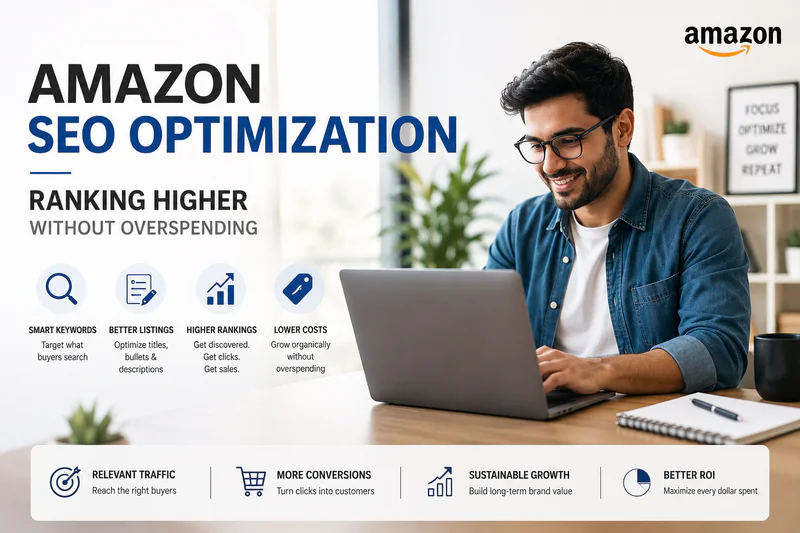
You finally cracked page one for your money keyword. Sessions doubled. Your Best Seller Rank jumped three spots in a week. You screenshotted it, dropped it in the team chat, felt like a genius.
Then the settlement report landed two weeks later — and you'd made less money than the month you were stuck on page three.
That's the trap. Amazon SEO optimization: ranking higher without overspending isn't a keyword problem or a prettier-listing problem. It's a math problem. You ranked for something that brought traffic but didn't pay you, and you paid for the privilege in ad spend, fees, and returns you never tracked. Every "Amazon SEO guide" out there will teach you to climb. Almost none teach you to climb profitably — which is the only kind of climbing that matters once your money is on the line.
Key Takeaways
Ranking is only a win if you keep the money. A page-one position that runs at a loss is a more expensive version of page three.
Most "Amazon SEO" advice ignores cost entirely — it optimizes for visibility and assumes profit follows. It doesn't.
You can't decide what to rank for until you know your true unit margin after referral fees, FBA fees, storage, returns, and ad spend.
Free levers move rank too — conversion rate, images, reviews, in-stock rate — and they don't show up on your ad bill.
Set a break-even CPC ceiling per product and refuse to chase any keyword that forces you above it.
Why "Just Rank Higher" Is Bad Advice

Rank is a means, not the goal. The goal is contribution profit. Yet the entire Amazon SEO conversation treats position #1 as the finish line, as if visibility automatically converts into a bank balance.
It doesn't. Here's the harsh truth most sellers learn too late: you can buy your way to the top of search results in a week. Bid high enough on Sponsored Products, push enough velocity, and the algorithm rewards you with organic rank because it reads sales velocity as relevance. The question is never can you rank. It's whether the rank pays for itself once the ad spend stops — and whether the keyword you fought for even attracts buyers who keep the product.
A high-volume keyword with a 6% conversion rate and a 30% return rate will wreck you faster than no ranking at all. You paid to rank, paid the referral fee, paid FBA twice (out and back), and ate the returns-processing fee. The screenshot looked great. The settlement didn't.
What Every Top Amazon SEO Guide Leaves Out

I read the five articles ranking on page one for this exact topic before writing this. They're competent. They all walk you through the A9 → A10 → COSMO algorithm story, keyword placement in titles and backend fields, image specs, A+ Content, reviews as social proof, and conversion rate as a ranking factor. Useful, standard, fine.
Here's what not one of them does:
They never quantify what ranking costs you. No break-even math, no CPC ceiling, no "is this keyword even affordable."
They assume ranking equals winning. None ask whether a given position is profitable or just visible.
They ignore which keywords deserve your money. Every ranking is treated as good. It isn't — some keywords convert and lose money.
They never connect returns, fees, and storage to the ranking decision. Those line items decide whether your climb netted cash, and they're invisible in a keyword tool.
That's the gap. The whole genre optimizes for being seen and goes silent the moment money enters the picture. Ranking higher without overspending lives entirely in that silence — so let's fill it.
The PPC-to-Organic Flywheel — and Its Hidden Bill

Here's how ranking actually gets built on Amazon, stripped of mysticism: ads create sales velocity, velocity signals relevance to the algorithm, relevance lifts organic rank, organic rank brings free sales, free sales sustain velocity. That's the flywheel. PPC seeds it.
This is real and it works. But the flywheel has a bill attached during the seeding phase, and that bill is where sellers overspend without noticing. You're paying full ad cost to manufacture the velocity that earns organic rank. If the unit economics don't work during seeding, you're betting that future organic sales will bail you out — and that bet only pays if the keyword's organic traffic actually converts profitably once the ads taper.
So the discipline is simple: know your ceiling before you push. Your break-even CPC is the most you can pay per click and still come out flat:
Break-even CPC = ASP × Conversion Rate × Break-even ACoS
(Your break-even ACoS is just your net margin percentage after every deduction.)
If a keyword's real CPC sits above your number, you're not "investing in rank." You're bleeding and calling it strategy. Sometimes a short, deliberate loss to seed a high-intent keyword is worth it — but only if you've decided that on purpose, with a number, not by accident.
The Profit-Weighted Ranking Method

This is the framework I give brands who want to rank without torching margin. Five steps, in order. Skip step one and the rest is guessing.
1. Lock your true unit margin first. Before you touch a keyword, run the product through an honest Amazon FBA profit calculator— one that subtracts referral fee, FBA fulfillment, storage, returns, and COGS, not just the obvious stuff. If you don't know your real number per SKU, you have no business deciding what to rank for. A good Amazon profit calculator turns "I think we're around 25%" into "this SKU nets 18.4% after returns."
Here is your Free Amazon Profit Calculator
2. Set a break-even CPC ceiling per product. Use the formula above. Write the number down. That's your spend discipline for every campaign touching that SKU.
3. Rank for keywords you can defend, not the biggest ones. A mid-volume keyword you can own at a profitable CPC beats a head term you'll always lose money on. Profit-per-keyword, not search-volume-per-keyword.
4. Pull the free levers before the paid ones. Conversion rate, images, A+ Content, reviews, and in-stock rate all move organic rank and cost you nothing per click. Maxing these lowers the CPC you need to rank, because higher CVR means cheaper velocity.
5. Re-judge every 14 days against profit, not position. Not daily — daily data is noise. Every two weeks, ask one question per keyword: did this make money? Kill what didn't. Scale what did.
Healthy targets to anchor against: 20–25% net margin after all deductions, and TACoS under 15% for a mature brand (15–20% while you're still building). If ranking pushes you outside those for more than a cycle or two, the rank isn't worth it.
Free Ranking Levers vs. Paid Ranking Levers
Most overspending happens because sellers reach for the paid lever when a free one would've done the job. Both move rank. Only one shows up on your ad bill.
Free Levers (Lower the Cost of Every Future Push)
Conversion rate — the single biggest organic ranking input. Better images, sharper bullets, clearer benefits-features-use-cases copy.
Reviews and rating — below 4 stars, conversion falls off a cliff and no amount of ad spend fixes it.
A+ Content — brand-registered and free; lifts conversion, which lifts rank.
In-stock rate — going out of stock kills velocity and rank. Don't advertise a product you can't keep stocked.
External traffic — the newer algorithm rewards off-Amazon clicks from social, email, and creators.
Paid Levers (Effective, but Metered)
Sponsored Products to seed velocity on target keywords
Product-targeting campaigns against competitor ASINs for new launches
Bid increases to hold a position during a push
The rule: exhaust the free levers first. A listing converting at 12% needs a fraction of the ad spend to rank that a 6% listing needs. Fixing conversion is an Amazon SEO tactic — the cheapest one you have.
The Fees That Decide Whether Your Ranking Push Made Money
Here's the part the SEO guides skip. Two sellers can rank identically and one makes money while the other loses it — the difference is in fees they never tracked.
Amazon's referral fee runs roughly 8–15% depending on category, with most categories at 15%. FBA fulfillment, storage, and returns stack on top, and for 2026 Amazon raised FBA fees by an average of about $0.08 per unit after holding them flat in 2025 (Amazon's official 2026 fee update). Always confirm your exact category and size-tier rates in the Amazon Seller Central fee schedule — they vary by product.
Illustrative stack on a single $30 FBA unit:
Figures illustrative; confirm yours in Seller Central.
Now picture ranking #1 for a keyword that drives 200 sales but a 25% return rate. You paid FBA on 200 units, ate returns processing and re-fulfillment on 50, and your "winning" keyword quietly turned negative. The position looked like a win. The P&L said otherwise. This is exactly the leak an Amazon revenue calculator built on revenue alone will never show you — revenue isn't profit, and ranking that grows one while shrinking the other is the most expensive mistake on the platform.
Amazon SEO Optimization: Ranking Higher Without Overspending in Practice
You're overspending if you can't answer this in under ten seconds: which of my ranked keywords actually made money last month, after every fee and return?
If that answer lives across four spreadsheets and a settlement export, you're flying blind — and blind sellers overspend by default. The fix isn't another keyword tool. It's visibility into profit at the SKU and keyword level: real TACoS, true margin after fees, returns impact, and which positions are paying versus draining.
That's the whole reason Sellerview.ai exists. It shows you exactly where the money leaks — fees, PPC, returns, storage — SKU by SKU, in one dashboard, so "we ranked higher" and "we made more money" stop being two separate, unconnected facts.
FAQ
Does Amazon SEO mean I can stop running ads? No. Ads seed the velocity that builds organic rank, especially for newer products. The goal isn't zero ad spend — it's spending only up to your break-even CPC and letting organic carry the rest over time.
What's the single biggest free ranking factor? Conversion rate. Amazon rewards listings that turn clicks into purchases. Better images, copy, and reviews raise conversion, which raises rank and lowers the ad spend needed to get there.
How do I know if a keyword is worth ranking for? Check profit, not volume. If its real CPC sits above your product's break-even CPC and organic traffic doesn't convert profitably, skip it — no matter how big the search volume looks.
How often should I optimize for ranking and spend? Every 14 days. Daily changes react to noise and burn money on immature data. A two-week cycle gives you enough signal to judge each keyword on profit and cut what's losing.
Do Amazon fees really change my ranking strategy? Yes. Referral fees, FBA, storage, and returns set your true margin, and your margin sets your break-even CPC. Two products at the same price can afford completely different bids depending on their fee load.
Can I rank higher without spending more at all? Often, yes. Fix conversion rate, reviews, A+ Content, and in-stock rate first. These lift organic rank without per-click cost and make every future paid push cheaper.
See What Your Ranking Push Is Actually Costing You
Ranking higher is easy to chase and easy to fake. Ranking higher while keeping the money takes one thing the guides won't give you: a clear view of your real profit per SKU and per keyword.
Run your numbers through Sellerview's free Amazon profit calculator and see your true margin after every fee — then start your free trial to track which rankings are paying you and which are quietly bleeding.
Calculate your real profit free → Sellerview.ai