
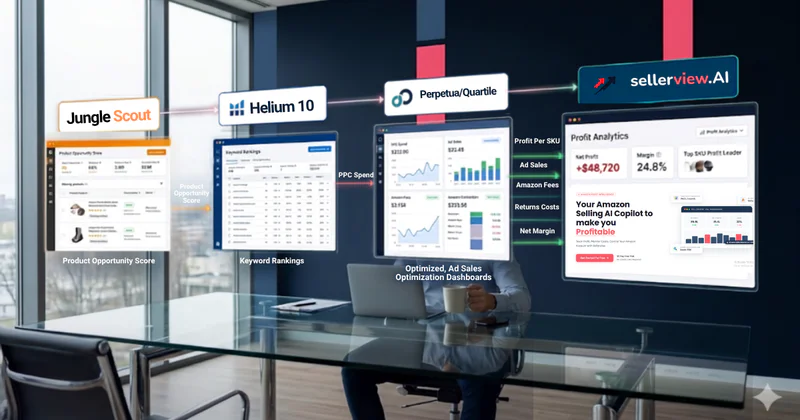
The best Amazon seller tools in 2026 are not a single all-in-one suite - they are a tight stack of 3-4 specialized tools that each do one thing at 95% quality. The right stack depends on where you are: product research, active selling, scaling with ads, or protecting your profit margin. This post breaks down 16 tools by category so you can build yours without wasting money on features you will never use.
Key Takeaways
• The average Amazon seller uses 4-6 tools - often overlapping, which doubles cost and scatters data .
• Sellers waste an average of 12+ hours per week cobbling together disconnected tools and spreadsheets
• Nearly 42% of sellers say poor software decisions cost them profit in their first 6 months
• The biggest mistake: picking an all-in-one that does everything at 60% quality instead of combining 3 specialized tools at 95%
• Profit visibility is the one category every seller underinvests in - and the one that costs the most when ignored
• Over 60% of sellers switch tools within the first year due to feature gaps or pricing traps
Why Most Amazon Sellers Pick the Wrong Software
You Googled "best Amazon seller tools," got slammed with affiliate articles, picked the one with the most features, and hoped for the best. Sound familiar?
The problem is not the tools themselves. It is the assumption that more features equals more profit. It does not. A tool you do not fully use is a tool you are overpaying for.
Here is what the data actually says: over 60% of Amazon sellers switch tools within their first year due to feature gaps or pricing traps. Nearly 42% say poor software decisions cost them profit in the first six months.
I have spent 7+ years in Amazon ecommerce, managed ad campaigns for 300+ brands, and watched sellers throw money at tool subscriptions while their actual profit numbers stayed invisible. The sellers who build smart stacks - narrow, specialized, and integrated - consistently outperform the ones chasing all-in-one dashboards.
This guide cuts through the noise. Sixteen tools, organized by what they actually solve.
At a Glance: 16 Best Amazon Seller Tools (2026)
Category 1: Profit Analytics and Visibility
This is the category most sellers underinvest in - and the one that costs the most when ignored. Revenue is not profit. BSR is not profitability. If you do not know your real margin per SKU after fees, ad spend, returns, and COGS, you are flying blind.
1. sellerview.ai - Best for Profit Leak Detection
What it does: sellerview.ai gives you SKU-level P&L - not blended account-level averages that hide which products are actually killing your margin. It breaks down every cost: FBA fees, referral fees, ad spend, returns, and COGS - so you can see exactly where your profit is going. The platform is built specifically around profit leak detection - identifying the hidden costs that erode margin without showing up in standard Seller Central reports.
Why it matters: Most sellers think they are profitable until they look at the numbers properly. A product with a $30 selling price and a $6 FBA fee looks fine until you add 15% referral fee ($4.50), a 12% TACoS ($3.60), a 5% return rate impact ($1.50), and landed COGS ($9). Actual margin: $5.40, or 18%. That is before storage fees and any seasonal returns spike. sellerview.ai makes this visible - SKU by SKU, not as a blended average that masks the problem.
Best for: Active FBA/FBM sellers doing $5,000+/month in revenue who want SKU-level profit clarity, TACoS vs ACoS visibility, and profit leak alerts before they damage the business.
Sellerview.ai also offers a free Amazon FBA profit calculator with no signup required - useful if you want to check a single product's real margin before committing to the full platform.
Starting price: Free trial available. Visit sellerview.ai to see your real profit.
see our deeper comparison of profit analytics tools.
2. Sellerboard - Best for P&L Tracking on a Budget
What it does: Sellerboard pulls your Seller Central data and builds a P&L dashboard showing sales, fees, ad spend, and estimated profit. It also includes an FBA reimbursement tool that flags overcharges and damaged inventory claims.
The honest limitation: Sellerboard measures what happened - it does not diagnose why your margin dropped or which SKU is the problem. The dashboard gives you numbers; interpreting those numbers to find the leak is still on you. For sellers who want measurement plus diagnosis, a tool like Sellerview.ai handles the diagnostic layer.
Starting price: $19/month. Strong value for entry-level P&L visibility.
Category 2: All-in-One Research Suites
These are the big suites every seller has heard of. They are genuinely useful - but they come with feature bloat, pricing complexity, and a steep learning curve. Use them for research and keyword intelligence. Do not expect them to tell you if you are actually making money.
3. Helium 10 - Best All-in-One Suite for Established Sellers
What it does: Helium 10 is the most widely used Amazon seller software suite, with 30+ tools covering product research (Black Box), keyword research (Magnet, Cerebro), listing optimization (Scribbles), rank tracking, PPC management (Adtomic), and basic profit analytics. It is genuinely comprehensive.
The real story in 2026: Helium 10 raised its prices significantly in April 2026. The Starter plan ($39/month) has been retired for new users. The cheapest paid plan is now Platinum at $129/month on a monthly basis or $99/month billed annually. Diamond runs $359/month ($279/month annually). The removal of the entry plan has been widely criticized in seller communities. (RevenueGeeks, 2026)
Best for: Sellers doing $500K+ annually who need one platform for keyword research, reverse ASIN analysis, and listing optimization. Not ideal for new sellers on a tight budget post the 2026 price restructure.
Starting price: $129/month (monthly) or $99/month (annual). Free plan available with severely limited tool access.
4. Jungle Scout - Best for Product Research and Launch
What it does: Jungle Scout is the go-to tool for product validation and pre-launch research. Its product database, Opportunity Finder, and AccuSales estimator give sellers reliable data on demand, competition, and realistic revenue potential before they commit to a SKU. The Chrome Extension lets you analyze any Amazon search results page in real time.
Where it fits: Jungle Scout is strongest at the pre-launch stage - finding products, validating demand, sourcing suppliers. Once you are actively selling and running ads, you will need additional tools for keyword tracking, PPC optimization, and profit analysis.
Starting price: $49/month (monthly) or $29/month (annual). 7-day money-back guarantee. No free trial.
5. AMZScout - Best for Product Validation with AI Scoring
What it does: AMZScout is a product research platform built around a Product Database you can filter by sales, reviews, and competition, and a PRO AI Extension that shows a niche score, product score, sales history, and estimated FBA costs right on the Amazon page. Its Skill + MCP connector also lets you query Amazon market data from Claude or ChatGPT.
Where it fits: AMZScout is strongest before launch, when you are deciding what to sell and checking whether demand is stable. It does not track your own account profit, so pair it with a profit tool once you are selling.
Best for: New and growing private label sellers who want to validate products and niches before buying inventory.
Starting price: From $59.99/month ($169.99 for 3 months or $399.99 for 12 months), with a free trial available and a 10-day money-back guarantee.
Category 3: Market and Competitor Intelligence
These tools tell you what the market is doing - not just what your own account shows. Essential for category expansion decisions and competitive positioning.
6. SmartScout - Best for Category and Brand Intelligence
What it does: SmartScout shows you the Amazon marketplace from the top down - categories, subcategories, brands, and sellers - rather than from individual products. You can identify underserved subcategories, find brands that are under-optimized but growing, and spot whitespace before competitors do.
Why it is different: Where Helium 10 and Jungle Scout answer "is this product viable?", SmartScout answers "where is the next opportunity?" It is a fundamentally different research lens - more valuable for sellers thinking about their next product line than their next listing tweak.
Starting price: $29/month with a free Chrome Extension offering 1,000 lookups per month.
7. Data Dive - Best for Keyword Architecture
What it does: Data Dive is the specialist tool for keyword clustering and listing architecture. It takes raw keyword lists from Helium 10 or Brand Analytics and organizes them by buyer intent, search volume, and relevance - so you know which keywords belong in your title, which go in bullets, and which feed your PPC campaign structure.
Best for: Sellers who are serious about listing SEO and PPC keyword strategy. If you are using Helium 10 for research but struggling to turn keyword data into a structured listing, Data Dive closes that gap.
Starting price: $97/month.
Category 4: PPC Automation and Ad Management
Amazon advertising generated over $68 billion in revenue in 2025, making it one of the largest digital ad platforms globally. Competition for ad placement is intense - and manual campaign management at scale does not work anymore.
One important thing to understand first: AI bid management tools genuinely reduce ACoS - but only when the campaign structure feeding them is sound. Automation amplifies what is already there. Bad structure plus AI = faster losses.
8. Perpetua - Best AI PPC Automation for Growth-Stage Sellers
What it does: Perpetua uses AI to manage Amazon Sponsored Products, Sponsored Brands, and Sponsored Display campaigns. It continuously adjusts bids based on sales velocity, margin targets, and seasonal patterns - without requiring you to manually optimize every keyword every 14 days.
The key trade-off: Perpetua works well when your campaign structure is already clean - single-product campaigns, clear research vs. performance separation, and healthy keyword lists. Feed it a messy account and it will optimize around the mess. Get your structure right before handing it to AI.
Starting price: Custom pricing based on ad spend. Contact Perpetua for a quote.
9. Quartile - Best for Sellers with High Ad Spend
What it does: Quartile uses machine learning across all Amazon ad types - Sponsored Products, Brands, Display, and DSP - to optimize bids in real time. It pulls signals from sales data, competitor activity, and external market factors to adjust spend automatically.
Best for: Sellers spending $20,000+/month on Amazon ads who need bid optimization at a scale that manual management cannot match. Under-utilized by smaller sellers who would get more ROI from fixing their campaign structure first.
Starting price: Custom pricing. Best suited for larger ad budgets.
Category 5: Pricing and Repricing
The Buy Box drives the vast majority of Amazon sales. Repricing tools automate your price response to competitor changes - so you stay competitive without racing to the bottom on margin.
10. Keepa - Best Price History and Alert Tool
What it does: Keepa is the industry standard for Amazon price history tracking. It shows the complete price history of any ASIN - including sales rank changes, Buy Box ownership shifts, and new seller entry. You can set alerts for price drops or rank movements on any product.
Why every seller should have it: Keepa is not a strategy tool - it is a data layer. Before sourcing any product, check its Keepa chart. A flat price history with consistent sales rank is healthy. Wild swings mean volatile margins or a race-to-the-bottom category. $19/month is one of the best-value subscriptions in a seller stack.
Starting price: $19/month.
11. Seller Snap - Best AI Repricing for Buy Box Strategy
What it does: Seller Snap uses game theory algorithms - not just rule-based if/then logic - to compete for the Buy Box. It analyzes competitor repricing behavior and adjusts your price intelligently, with the goal of maximizing Buy Box share without unnecessarily dropping margin.
Best for: Wholesale and reseller sellers in competitive categories where Buy Box ownership directly drives revenue. Less critical for private label sellers who own the ASIN and face less direct price competition.
Starting price: $250/month.
Category 6: Inventory Management and COGS Tracking
FBA fees - fulfillment, storage, and returns - typically consume 25-40% of a product's selling price for most categories. (eComBrainly, 2026). Inventory management is not just about stock levels - it is about knowing the true landed cost of every unit sitting in an Amazon warehouse.
12. InventoryLab - Best for COGS Tracking and FBA Workflow
What it does: InventoryLab combines shipment creation, COGS entry, and profitability tracking in one workflow. When you create a shipment in InventoryLab, you enter your cost per unit - which flows directly into your P&L reports. It is one of the cleanest ways to track true COGS without spreadsheets.
Why COGS accuracy matters: Most sellers either estimate COGS loosely or forget to update it when their supplier costs change. If your COGS figure is wrong, every profit metric downstream is wrong. Your ACoS target is wrong. Your margin benchmark is wrong. Your restock decision is wrong. InventoryLab disciplines that process.
Starting price: $69/month.
13. Carbon6 - Best for FBA Reimbursement Recovery
What it does: Carbon6 audits your Amazon account for FBA overcharges, lost inventory, damaged goods, and miscalculated fees - then files the reimbursement claims on your behalf. Amazon's fulfillment errors are more common than most sellers realize, and manual auditing is time-consuming.
The business case: Sellers on Carbon6 typically recover a meaningful percentage of revenue in reimbursements that would otherwise go unclaimed. The tool operates on a percentage-of-recovery model, so there is no upfront risk. Only worth using if you are FBA-heavy and have not audited your reimbursements recently.
Pricing model: Percentage of recovered reimbursements. No monthly flat fee.
Category 7: Review Management
Reviews drive conversion. Conversion drives organic ranking. Organic ranking reduces your dependence on paid ads. It is a direct chain - and it starts with a disciplined review request strategy.
14. FeedbackWhiz - Best for Review Requests and Monitoring
What it does: FeedbackWhiz automates Amazon's "Request a Review" button at scale, with timing controls and order filters. It also monitors your listings for new reviews and seller feedback in real time, with instant alerts so you can respond quickly to negative reviews before they impact your rating.
Why it matters: A drop below 4 stars causes a measurable conversion rate cliff on most Amazon listings. Getting your review request process dialed in - the right timing, the right order filters, the right frequency - is one of the highest-ROI activities for a seller at any stage.
Starting price: $19.99/month.
Category 8: Rank Tracking and Analytics
15. DataHawk - Best for Organic Rank and Market Share Tracking
What it does: DataHawk tracks organic keyword rankings, Share of Voice, market share trends, and competitor positioning across Amazon marketplaces. It surfaces whether your listing is climbing, holding, or losing ground on the keywords that drive your organic traffic - and shows you how that compares to competitors.
Why it belongs in your stack: Most sellers focus obsessively on ad metrics and ignore organic rank trends. But organic rank is the output of your entire strategy - listing quality, conversion rate, review velocity, and sales history all feed into it. DataHawk makes that output visible and trackable.
Starting price: $39/month.
Category 9: Listing Creative and Design
16. Canva - Best for A+ Content and Listing Images
What it does: Canva is the most accessible design tool for Amazon sellers who are not professional designers. It has Amazon-specific templates for A+ Content modules, infographic images, and comparison charts. The Pro plan unlocks brand kits, background removal, and collaboration features that are genuinely useful for multi-SKU brands.
Why it is on this list: Listing creative is a conversion driver, not a nice-to-have. A well-designed main image can significantly lift your click-through rate from search. An infographic that answers buyer questions reduces the "read reviews to decide" friction. Canva makes this accessible without a design agency budget.
Starting price: Free plan available. Canva Pro at $15/month per person.
How to Build Your Amazon Seller Tool Stack by Stage
Not every tool is relevant at every stage. Here is how to build your stack based on where you are in your seller journey.
Stage 1: Pre-Launch (0-1 products, validating an idea)
• Jungle Scout - product validation and supplier sourcing
• Keepa - price history check before committing to any ASIN
• Canva - listing image and A+ content creation
Monthly budget: ~$70-80. You do not need profit analytics or PPC tools yet. Focus on finding a good product first.
Stage 2: Active Selling ($5K-$50K/month revenue)
• Sellerview.ai - start here. Know your real margin before you scale anything
• Helium 10 Platinum or SmartScout - keyword research and competitor tracking
• FeedbackWhiz - review request automation
• InventoryLab - COGS tracking and shipment workflow
Monthly budget: ~$220-280. The biggest unlock at this stage is profit visibility - knowing which SKUs are actually making money versus which are silently losing it.
Stage 3: Scaling ($50K+/month revenue, running ads)
• Sellerview.ai - SKU-level P&L to protect margin as ad spend scales
• Perpetua or Quartile - AI PPC automation once campaign structure is solid
• Data Dive - keyword architecture for listing and PPC alignment
• DataHawk - organic rank and market share visibility
• Carbon6 - FBA reimbursement audit
Monthly budget: $400-800+ depending on ad spend tiers. At this stage, the cost of not having profit visibility is far higher than any tool subscription.
The One Mistake That Costs Sellers the Most
Scaling ad spend before you know your real margin per SKU.
It sounds obvious. But it is the single most common pattern I see with sellers who have been running for 12-18 months. They are growing revenue month over month. TACoS is at 15%. BSR is climbing. And then they look at their actual bank account and realize the money is not there.
The reason is almost always invisible: a return rate that crept up, a storage fee spike in Q4, a referral fee category adjustment they missed, or COGS that has not been updated since their first shipment. Any one of those individually is manageable. Together, they erase what looked like a healthy margin.
This is exactly what sellerview.ai is built to surface - before it becomes a cash flow crisis, not after.

FAQ: Amazon Seller Tools
What are the best Amazon seller tools in 2026?
The best Amazon seller tools in 2026 depend on your selling stage, but the highest-impact stack for active sellers is: Sellerview.ai for SKU-level profit visibility, Helium 10 or Jungle Scout for keyword and product research, a PPC automation tool like Perpetua, and Keepa for price history monitoring. The average seller uses 4-6 tools - the key is choosing ones that complement each other rather than overlap.
How much do Amazon seller tools cost per month?
Amazon seller software costs range widely. Entry-level tools like Keepa start at $19/month and FeedbackWhiz at $19.99/month. Mid-tier suites like Helium 10 Platinum run $129/month (or $99/month annually). A complete seller stack for an active FBA brand typically runs $200-$400/month. At scale, PPC automation tools add significant cost but are justified by the ad spend they manage.
Do I need all 16 tools to run an Amazon business?
No. Start with 2-3 tools matched to your current stage. A new seller needs product research (Jungle Scout or SmartScout) and price history (Keepa) - nothing more. An active seller needs to add profit visibility (Sellerview.ai) and review management (FeedbackWhiz). A scaling seller adds PPC automation and keyword architecture tools. Building your stack incrementally prevents over-investment in tools you are not ready to use.
What is the best tool for tracking Amazon profit per SKU?
Sellerview.ai is purpose-built for SKU-level profit tracking. It breaks down every cost - FBA fees, referral fees, ad spend (TACoS and ACoS), returns, and COGS - so you can see your actual margin per product, not a blended account average. Most standard dashboards show you blended P&L, which hides which individual SKUs are profitable and which are quietly draining your account.
Is Helium 10 worth it in 2026 after the price increase?
Helium 10 raised prices significantly in April 2026, retiring the $39/month Starter plan and making $129/month (Platinum) the new entry point for new subscribers. For established sellers doing $500K+ in annual revenue who use the keyword research, listing, and rank tracking tools heavily, the value proposition still holds. For new sellers or those below $100K in annual revenue, the price jump is harder to justify - Jungle Scout ($49/month) or SmartScout ($29/month) offer better value at that stage.
What is the difference between ACoS and TACoS for Amazon sellers?
ACoS (Advertising Cost of Sale) measures ad spend against ad-attributed sales only. TACoS (Total ACoS) measures ad spend against total sales - both organic and ad-driven. TACoS is the honest metric. A brand spending $1,000 in ads that generates $3,000 in ad sales and $7,000 in organic sales has an ACoS of 33% but a TACoS of 10%. TACoS tells you whether your ad spend is growing the business overall. ACoS tells you how efficiently you are converting ad clicks. You need both, but TACoS should be the headline number.
Sources
• Seller Labs: Best Amazon Seller Software in 2026
• RevenueGeeks: Helium 10 Pricing 2026
• Scribe: Jungle Scout Pricing 2026
• SalesDuo: Amazon Statistics 2026