
Your FBA Fee Calculator Shows Amazon Fees. It Has No Idea What the Product Cost to Land
You ran your FBA fee calculator. Referral fee, fulfillment fee, storage - all there. You entered your COGS as the factory price. You got a margin number that looked fine. You launched.
Your first shipment just cleared customs and the duty bill arrived. $1,900 on a 1,000-unit order you thought you had modelled correctly. That is $1.90 per unit your FBA fee calculator never showed you.
Landed cost is the most consistently underestimated input in any FBA fee calculator. Most sellers use the factory price. The actual COGS that should go into your calculator is the factory price plus every dollar spent getting the product from that factory to an Amazon shelf - freight, import duty, customs broker, drayage, last mile, and prep. In 2026, with US tariffs at a weighted average of 10.2% and the de minimis exemption eliminated entirely, getting this wrong is more expensive than it has ever been.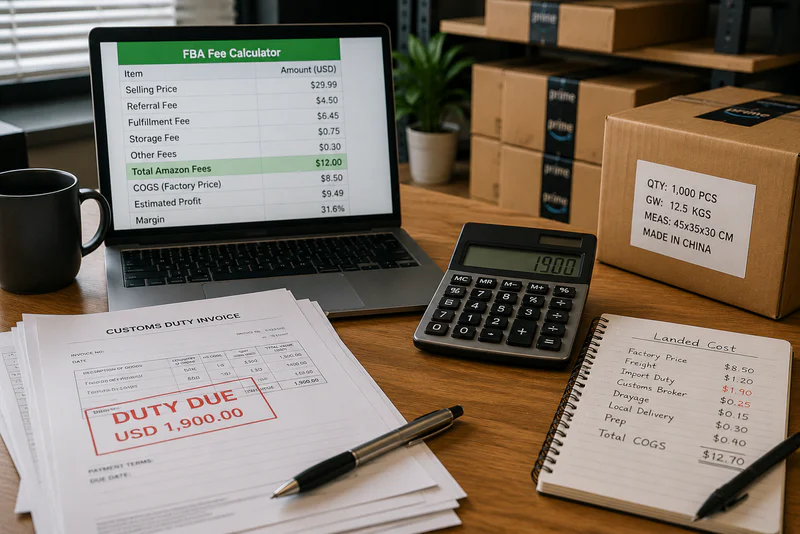
The FBA Fee Calculator Does Not Know What Happened Before the Product Got to Amazon
Here is the gap most sellers miss. Your FBA fee calculator calculates what Amazon charges on a sale. It does not calculate what you paid to acquire and import the inventory. Those are two different cost stacks - and both have to appear in your full landed cost before your margin means anything.
Amazon fees - referral plus FBA fulfillment - typically consume 25-35% of your selling price. That is well documented. What most sellers do not track with the same discipline is the full import cost stack, which adds another $2-8 per unit depending on product size, weight, origin country, and shipping method.
On a product selling at $30, a $5 landed cost gap that your FBA fee calculator never captured means your stated 22% margin is actually 5%. That is the difference between a business and a loss.
The FBA fee calculator gives you the cost of selling on Amazon. Landed cost gives you the cost of owning what you are selling. Both are required before your margin number is real.
The Full Landed Cost Stack - Every Component Your FBA Fee Calculator Does Not Include
Component 1: Factory Price (FOB)
This is what goes in your FBA fee calculator as COGS. It is your supplier invoice price at the factory gate - before anything moves. Make sure you are using the most recent order price. Exchange rate movements since your last order change this number even if the unit cost in the foreign currency stayed flat.
Component 2: Ocean or Air Freight
The main shipping leg. Ocean freight from China to US runs approximately $2-5 per kg for LCL and $60-140 per CBM for FCL (based on 2025-2026 market rates). Air freight is $3.5-6 per kg. Express (DHL/UPS) runs $12-40 per kg. Calculate freight as a per-unit number by dividing total shipment freight cost by units shipped. If you shipped 1,000 units at a freight cost of $2,400 - that is $2.40 per unit.
The critical mistake: testing a new product with 300 units in a container that normally ships 1,200 units quadruples your per-unit freight cost. The FBA fee calculator cannot know this. You have to calculate it per shipment, not as an average.
Component 3: Import Duty
Duties are calculated as a percentage of the CIF value (Cost + Insurance + Freight) of your shipment. Every product has an HTS (Harmonized Tariff Schedule) code that maps to a specific duty rate. For products from China in 2026, duty can stack three layers:
• Base MFN (Most Favored Nation) duty rate - typically 3-15% depending on category
• Section 301 tariffs on Chinese goods - 25-145% additional, depending on product classification
• Section 122 global surcharge - applies in specific product categories
A product with a 3.4% base MFN rate might owe 43.4% in combined duties when Section 301 stacks. On a $10 FOB product, that is $4.34 per unit in duties alone. Your FBA fee calculator never shows this.
Component 4: Customs Broker and Port Fees
Customs broker fees run $200-500 per shipment. Port handling, ISF filing ($35-80), and any examination fees if your container is selected for inspection add to this. Divide total by units. On a 1,000-unit shipment with $500 in total broker and port fees, that is $0.50 per unit.
Component 5: Last Mile - Drayage and Inland Freight
Last mile is the trucking leg from the destination port to your prep center or directly to an Amazon FC. Drayage from a major US port to an inland warehouse or Amazon FC typically runs $150-400 per LCL shipment or $400-1,800+ per 40-foot container depending on port and distance. Convert to per-unit by dividing by units in the shipment.
Component 6: Prep and Labeling (Post January 2026)
Amazon eliminated FBA prep and labeling services in January 2026. This cost now falls entirely on you or your 3PL. Budget $0.15-$0.50 per unit for poly-bagging and FNSKU labeling depending on product complexity and prep partner.
Component 7: Marine Cargo Insurance
Typically 0.3-0.5% of declared shipment value. On a $10,000 shipment, that is $30-50 - or $0.03-$0.05 per unit. Small but should be included for accuracy.
FBA Fee Calculator Landed Cost - Worked Example
Here is what a real landed cost looks like per unit for a $10 FOB product sourced from China, shipping to the US via ocean LCL:
A seller entering $10 in their FBA fee calculator sees 22% margin on a $30 selling price. A seller entering $17.16 sees 0.5% margin - essentially break-even before any ad spend or returns. Same product. Same price. Completely different business reality.
Don't Just think Give a try to Amazon Profit Calculator
The 2026 Change That Made This Even More Critical: De Minimis Is Gone
For years, the de minimis rule allowed shipments valued under $800 to enter the US duty-free with no customs entry required. That rule was a significant advantage for small Amazon sellers testing new products with small first orders.
Executive Order 14324 suspended the de minimis exemption in early 2026. Every shipment, regardless of declared value, now owes duty. Every shipment needs a customs broker for a formal entry. The $800 duty-free threshold no longer exists.
This means a 100-unit test order that used to arrive duty-free now attracts full import duty plus a customs broker fee of $200-500 - which on 100 units is $2-5 per unit in broker fees alone, before the duty calculation. Sellers who were using small test orders to validate products at low cost now face a fundamentally different landed cost structure for any small-quantity import.
Your FBA fee calculator was never designed to model this. You have to add it manually - or use a tool that tracks actual COGS per batch, per shipment.
3 Steps to Fix Your FBA Fee Calculator COGS With Real Landed Cost
Step 1: Pull Your Last Customs Entry Summary
Contact your customs broker or freight forwarder. Request the formal entry summary for your last 2-3 shipments. This document shows declared value, CIF value, duty rate applied, and total duty paid. Pull the freight invoice separately. Divide each cost by units in that shipment. You now have a real per-unit landed cost baseline - not an estimate.
Step 2: Calculate Per Shipment, Not Per Year
Most sellers average freight and duty across a year to get a single COGS number. That is wrong. Freight rates change quarterly. Duty rates change with trade policy. Prep costs change when you switch suppliers or update packaging. Calculate a fresh landed cost number for every new purchase order, using actual quotes - not last quarter's numbers. The 2026 freight market and 2026 tariff structure are different from 2025. Your FBA fee calculator input needs to reflect the shipment you are actually sending.
Step 3: Enter Landed Cost Into Your FBA Fee Calculator - Not FOB Price
Once you have your real per-unit landed cost, this is the number that goes into your FBA fee calculator as COGS. Run the calculator. If the margin output is below 15% at your current selling price, you have a fundamental problem - either pricing too low for the real cost structure, or COGS negotiation is needed before you reorder. Do not launch or restock a product until the FBA fee calculator shows viable margin using real landed cost, not supplier invoice price.
sellerview.ai lets you update COGS per batch - so your margin view uses the actual landed cost of the inventory currently in Amazon warehouses, not an old estimate. When you get a new shipment with updated freight rates and duties, update once and your entire SKU-level P&L reflects the change.
Your FBA Fee Calculator Is Right. Your COGS Input Is Not.
The FBA fee calculator does its job correctly. It calculates Amazon fees on a sale. The problem is the input: factory price is not COGS. Landed cost is COGS.
In 2026, with import duty stacking up to 43%+ for Chinese goods, de minimis gone for all shipments, ocean freight rates shifting quarterly, and mandatory prep costs now that Amazon eliminated FBA prep services - the gap between factory price and landed cost is the widest it has ever been.
Fix the input. Run the calculator again. Then make every pricing, sourcing, and inventory decision based on the number that is actually true.
sellerview.ai tracks COGS per batch and shipment automatically - update landed cost once, see your real margin across your entire catalog. Get your real numbers
free to start : Sellerview.ai
FAQ: FBA Fee Calculator and Landed Cost
What is landed cost for Amazon FBA and how is it different from factory price?
Landed cost is the total cost of getting a product from your supplier to Amazon's fulfillment center. It includes factory price (FOB), ocean or air freight, import duties, customs broker fees, drayage and last-mile trucking, prep and labeling costs, and insurance. Factory price is only the starting point. Your FBA fee calculator needs landed cost as the COGS input - not factory price - to produce an accurate margin number.
How do I calculate import duty per unit for my Amazon FBA fee calculator?
Identify your product's HTS code and look up the duty rate on the USITC website. For Chinese goods in 2026, apply the base MFN duty rate plus any Section 301 tariffs (25-145% depending on classification). Duties are calculated on the CIF value - your FOB factory price plus freight and insurance. Divide total duty paid by units in the shipment to get per-unit duty. Your customs broker's entry summary shows this breakdown for each shipment.
What is last mile cost for Amazon FBA and how much does it add per unit?
Last mile is the trucking cost from the destination port (or your domestic warehouse) to an Amazon FBA fulfillment center. For LCL shipments, this typically runs $150-400 per shipment. For full containers, drayage ranges from $400-1,800+ depending on port location and distance to the FC. Divide by units in the shipment to get a per-unit allocation. For a 1,000-unit LCL shipment with $300 in trucking, that is $0.30 per unit - small, but should be in your FBA fee calculator.
How does the de minimis rule elimination in 2026 affect my FBA fee calculator?
Executive Order 14324 suspended the $800 de minimis duty exemption in early 2026. Every US import now owes full duty regardless of value. Every shipment - even a 50-unit test order - requires a formal customs entry and broker fees of $200-500. A small test order that used to arrive duty-free now adds $2-5 per unit in broker fees alone before the duty calculation. Update your FBA fee calculator COGS for any new small-quantity imports to reflect this cost.
How often should I update my landed cost in my FBA fee calculator?
After every shipment. Ocean freight rates change quarterly and shifted significantly in 2025-2026. Import duty rates change with trade policy - Section 301 tariffs have been adjusted multiple times since 2018. Prep costs shift when you change suppliers or packaging. Using a landed cost figure from 6-12 months ago understates your real COGS by $0.50-$2.50 per unit depending on the changes in freight and tariff rates. Calculate fresh landed cost with actual quotes for every new purchase order before entering COGS into your FBA fee calculator.