
Here is Your Free Amazon Profit Calculator
PPC is working when organic rank improves on target keywords while ad spend stays stable or decreases - your fba fee calculator will show improving net margin over time. PPC is not working when organic rank is flat or declining, you are spending more to maintain the same revenue, and pausing ads causes sales to drop 60-70% within days. The signal is in your TACoS direction and your organic-to-paid sales ratio - not in ACoS alone. If your ads stop and your sales stop, your PPC has been buying sales, not building a business.
What you will learn in this post:
• The 4 signals that tell you whether PPC spend is genuinely building organic rank or just buying ad-dependent revenue
• How to use your fba fee calculator to diagnose whether current ad spend is sustainable for the margin this product actually has
• The pause test and organic ratio method - two practical ways to check whether your ads are working in 2026
You Paused Your Ads for 3 Days to Test. Sales Dropped 70%. Your FBA Fee Calculator Confirmed the Problem
You paused your campaigns for a long weekend. Sales cratered. You restarted ads on Tuesday. Sales recovered. Your fba fee calculator showed the same 11% net margin it always shows. You concluded the campaigns were necessary and moved on.
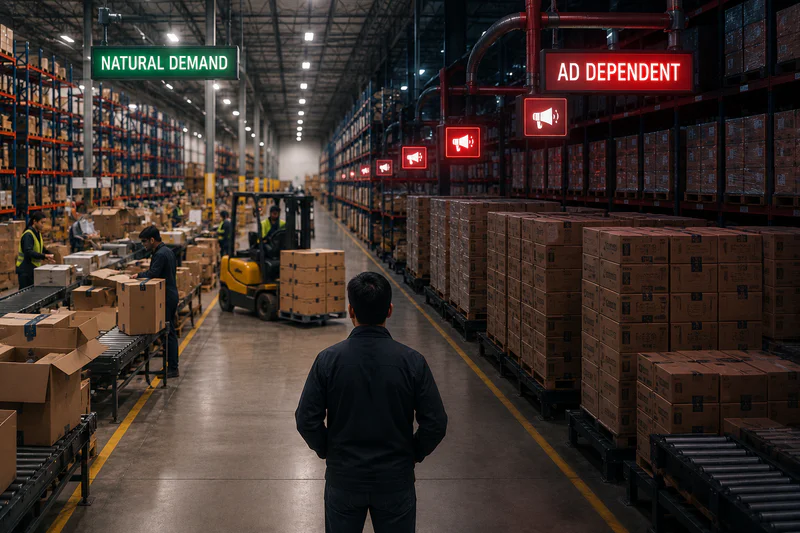
Here is the problem with that conclusion. If your sales drop 60-70% when ads pause, your product has no organic engine. You are not building a business. You are renting visibility from Amazon's ad platform every single day - and paying for it through your fba fee calculator as a recurring margin drain with no residual value.
Ads that are working build organic rank over time. They generate conversion signals - paid clicks that convert - which Amazon's algorithm uses to improve your organic position on those keywords. As organic rank improves, a growing share of your revenue comes without ad spend. TACoS falls. Your fba fee calculator shows improving real net margin. That is PPC working.
After working with 300+ Amazon brands across Home & Kitchen, Beauty, and Electronics, the pattern is always the same: sellers confuse activity with progress. Their campaigns are busy. They have keywords. They have bids. They have weekly optimisations. And three months later, organic rank has not moved. TACoS is the same. The fba fee calculator shows the same margin it did at launch. The ads are running. They are not working.
What Is the PPC-Organic Rank Relationship in Your FBA Fee Calculator?
The PPC-organic rank relationship on Amazon describes how paid advertising spend influences a product's unpaid search ranking. When PPC campaigns drive high-quality traffic that converts well, Amazon's algorithm reads these conversion signals as demand indicators and improves the product's organic position - producing sales without ongoing ad spend. When PPC produces low-quality traffic, high bounce rates, or poor conversion, it generates spend without organic rank improvement, creating permanent ad dependency that appears in your fba fee calculator as an unchanging margin drain.
Why PPC Dependency Is a FBA Fee Calculator Problem
Most sellers track PPC as an advertising cost. It is also a fba fee calculator variable. Here is why.
Your fba fee calculator shows pre-ad net margin - what the product earns before ad spend. If ad spend stays permanently at 15-18% of revenue because organic rank is not building, your fba fee calculator margin is structurally compressed. There is no path to expanding real net margin without organic growth. You are at whatever the calculator shows at current TACoS - and you will stay there as long as organic is not building.
In 2026, this problem is more expensive than ever. Average CPC has reached $1.12 across categories, up $0.15 from the prior year. Over 70% of Amazon sellers now run PPC campaigns, up from roughly 40% five years ago. With more advertisers bidding on the same keywords, organic rank is declining as Amazon adds more ad placements to search results. Sellers who previously relied on organic rank now need to advertise just to maintain visibility. Against this backdrop, every dollar of ad spend that does not build organic rank is permanently expensive - not a temporary investment.
When ads stop and sales stop within 48 hours, you do not have a PPC problem. You have an organic rank problem that PPC has been masking. Your fba fee calculator cannot fix what only listing quality and conversion signals can build.
The 4 FBA Fee Calculator Signals: Is Your PPC Working or Wasting Margin?
Signal 1: Is my organic-to-paid sales ratio improving month over month?
Pull your Business Reports total revenue. Pull Campaign Manager total ad-attributed revenue for the same period. Calculate: Organic Revenue = Total Revenue - Ad-Attributed Revenue. Organic ratio = Organic Revenue / Total Revenue x 100.
If this ratio is increasing month over month - 30% organic in month 1, 38% in month 2, 45% in month 3 - your PPC is working. Paid traffic is converting, producing organic rank signals, and organic is growing. If the ratio is flat or declining, PPC is buying revenue but not building the product's independent velocity. Track this monthly alongside your fba fee calculator output.
Signal 2: Is my organic rank improving on my 2-3 target keywords?
Check your keyword rank for your 2-3 highest-volume target terms weekly using a rank tracker (Helium 10, Jungle Scout, or similar). A product with working PPC shows progressive organic rank improvement over 60-90 days on those terms. From position 45 to 32 to 18 is PPC working. Flat at position 45 for 90 days with steady ad spend is PPC buying a position it never consolidates into organic.
Organic rank improvement correlates with your CVR - conversion rate on paid clicks. If CVR is above 10% on your primary terms, those clicks are sending strong demand signals to Amazon. If CVR is below 7%, clicks are not converting at the rate needed to drive organic rank movement regardless of how much you spend.
Signal 3: What happens to sales when I pause ads for 48 hours?
The pause test is the most direct diagnostic. Pause all campaigns on a Wednesday (mid-week, away from weekends). Monitor sales for 48 hours. Three outcomes:
• Sales drop 60-70% or more: Product is fully ad-dependent. Organic rank has not built. PPC has been buying visibility with no residual effect.
• Sales drop 20-40%: Partial organic engine. PPC is working but not complete. Expected for a product at 60-90 days of life. Organic should continue building.
• Sales drop under 15%: Strong organic engine. Ads are incremental, not foundational. This is what a mature working PPC strategy looks like.
The pause test outcome tells you where your organic rank actually is - not where you think it should be based on your ad activity.
Signal 4: Is my TACoS trending down with stable ad spend?
TACoS falls when organic sales grow faster than ad spend. If you are spending $2,000/month on ads and TACoS is falling from 18% to 14% to 11% - total revenue is growing while ad spend is stable. That is organic doing its job. Run this calculation alongside your fba fee calculator to see: pre-ad net margin + improving TACoS = genuinely improving real business margin.
If TACoS is flat at 17-19% for 3 consecutive months with consistent ad spend, organic is not growing relative to paid. The product has a rank ceiling that paid traffic is not moving.
The FBA Fee Calculator Signal Table: PPC Working vs Not Working
Two or more "PPC Is Not Working" signals means your ad spend is renting sales, not building the product. Your fba fee calculator margin today is the ceiling - there is no path to improvement without organic rank growth. Fix the conversion problem before adding more spend.
When Ad Dependency Is Acceptable - And When It Becomes a Trap
Launch phase (Days 1-90): Ad dependency is expected and intentional. You are building conversion history, accumulating reviews, and generating the signals Amazon needs to assign organic rank. A 60-70% sales drop on pause during launch is a feature, not a bug. The question is whether dependency is decreasing by month 3.
Mature product (Day 91+) with flat organic: Ad dependency past 90 days means the product has not built the organic foundation the launch investment was supposed to create. One of three things went wrong: CVR is too low to generate strong ranking signals (listing quality problem), the keyword targeting is wrong (too broad or too competitive), or the product review score has not reached the threshold needed for competitive conversion (below 4.0 stars with fewer than 30 reviews).
The fba fee calculator cannot tell you which of these is the problem. It can tell you that real net margin is not improving despite consistent ad spend - and that is the signal to stop adding budget and start diagnosing the cause.
How to Use Your FBA Fee Calculator to Diagnose and Fix an Ad Dependency Problem
Step 1: Run your fba fee calculator with full 2026 costs - landed COGS, referral fee, FBA fee, placement fee ($0.40/unit standard), return rate allocation, storage. Record pre-ad net margin.
Step 2: Calculate real net margin: pre-ad net margin minus current TACoS. If real net margin is below 10% and TACoS has been flat for 60+ days, you have a margin problem driven by ad dependency.
Step 3: Run the pause test. If sales drop over 50%, confirm the ad dependency diagnosis.
Step 4: Fix the conversion problem before adding spend:
• If CVR is below 7% on primary keywords: fix the listing first. Main image, primary bullet, first review response. Improving CVR from 7% to 12% on a high-volume keyword improves both ranking signals and break-even ACoS by 71%.
• If organic rank is flat despite acceptable CVR: review keyword targeting. You may be bidding on category-level terms too competitive to rank for organically. Shift to secondary keywords where ranking movement is achievable in 60 days.
• If rating is below 4.0 stars with fewer than 30 reviews: pausing aggressive spend and running a vine or early reviewer strategy builds the review floor organic rank requires. Spending heavily on a product below the conversion floor accelerates cost without rank improvement.
sellerview.AI tracks your real fba fee calculator margin per SKU automatically - with actual 2026 fees, live return rate, and real TACoS - so you can see whether ad spend is compressing or improving your net margin month over month.
Your FBA Fee Calculator Shows Margin Drain. The Organic Ratio Shows Why.
PPC spend that builds organic rank is one of the best investments in FBA. Every dollar that converts into organic rank produces future sales with no additional spend. PPC spend that does not build organic rank is one of the worst - it permanently inflates your cost structure with no compounding return.
Your fba fee calculator shows the current margin state. Your organic sales ratio, keyword rank trend, pause test result, and TACoS direction tell you whether that margin is improving or permanently locked at the current level.
Check the four signals. If two or more say PPC is not working - fix the conversion problem first. More spend into a product that is not converting and not ranking compounds the cost without compounding the return.
sellerview.AI tracks your real fba fee calculator margin per SKU with actual 2026 fees - so ad dependency shows up in your numbers before it becomes a cash flow problem. Check your real margin
free to start: https://sellerview.ai/
FAQ: FBA Fee Calculator and PPC vs Organic Rank
What is the PPC-organic rank relationship on Amazon and why does it matter for my fba fee calculator?
The PPC-organic rank relationship describes how paid advertising generates conversion signals that Amazon's algorithm uses to improve a product's unpaid search position. PPC that converts well at above 10% CVR produces ranking signals that build organic rank over time, reducing TACoS and improving the real net margin your fba fee calculator shows. PPC that converts poorly generates spend without rank improvement, permanently inflating costs and keeping fba fee calculator margin at a ceiling it never breaks through.
How do I know if my Amazon PPC is building organic rank or just buying sales?
Four signals indicate whether PPC is working: (1) Organic sales ratio increasing month over month - organic revenue growing as a share of total revenue; (2) Keyword rank improving on target terms over 60-90 days; (3) Sales drop under 20% when ads are paused for 48 hours - a strong organic engine; (4) TACoS trending down with stable ad spend - organic growing faster than paid. If two or more signals show the opposite, PPC is generating ad-dependent revenue without building the organic foundation that compounds into margin improvement in your fba fee calculator.
What percentage of my Amazon sales should come from organic vs paid in 2026?
For a mature product (live 90+ days), healthy organic sales ratio targets are: 40-60% organic in Home & Kitchen, Health, and Pet; 35-55% in Beauty and Personal Care; 25-45% in Electronics and Apparel (higher ad dependency due to competitive CPCs and return rates). A product with less than 30% organic sales after 90 days is ad-dependent regardless of how the fba fee calculator shows the margin. The 2025 Amazon data shows that when advertising pauses, sales drop 60-70% within days for ad-dependent products - confirming the organic foundation was never built.
How do 2026 Amazon fee changes affect whether PPC can build organic rank profitably?
Three 2026 changes make ad-dependent PPC more expensive. The 3.5% fuel surcharge (April 2026) and $0.08/unit FBA fee increase (January 2026) reduce pre-ad margin from the fba fee calculator by $0.63-$0.98/unit - narrowing the ceiling TACoS can operate within. Average CPC rose to $1.12 in 2026 (up $0.15), meaning more spend is required to generate the same conversion volume. Over 70% of sellers now run PPC, up from 40% five years ago, compressing organic visibility. The combination means ad spend that does not convert into organic rank is more expensive to sustain in 2026 than any prior year.
What conversion rate does my PPC need to generate organic rank signals on Amazon?
Amazon's algorithm weights conversion rate as a primary signal for organic rank assignment. CVR above 10% on a target keyword generates meaningful rank signals. CVR above 15% on a high-volume keyword can move organic rank from position 40-50 to position 15-25 within 60-90 days of sustained spend. CVR below 7% produces minimal rank signal regardless of spend volume - you are paying for clicks that do not tell Amazon the product deserves organic visibility. If your primary keyword CVR is below 7%, fix listing quality before increasing PPC budget.
How does pausing Amazon PPC reveal whether ads are working or creating dependency?
Pause all campaigns mid-week for 48 hours. If sales drop under 20%, the product has strong organic rank and PPC is incremental. If sales drop 40-60%, partial organic has built but the product still depends on ads significantly. If sales drop over 60%, the product has no organic engine and PPC has been buying visibility with no rank residual - confirming the fba fee calculator margin will remain unchanged until organic rank is built. The pause test is the most direct diagnostic available without expensive third-party rank tracking tools.