
You Pay Every Time a Customer Returns - Here's What Amazon Takes
You checked your FBA fees. Fulfillment fee - expected. Referral fee -expected. Then there's a line item you glossed over: return processing fee. If you sell in apparel, shoes, or accessories and haven't built this into your FBA fee calculator, you're bleeding margin on every single return without realizing it.
Return processing fees are one of the most under-discussed costs in FBA. Not because they're rare - they hit every seller in affected categories - but because they don't show up clearly until you audit your actual P&L.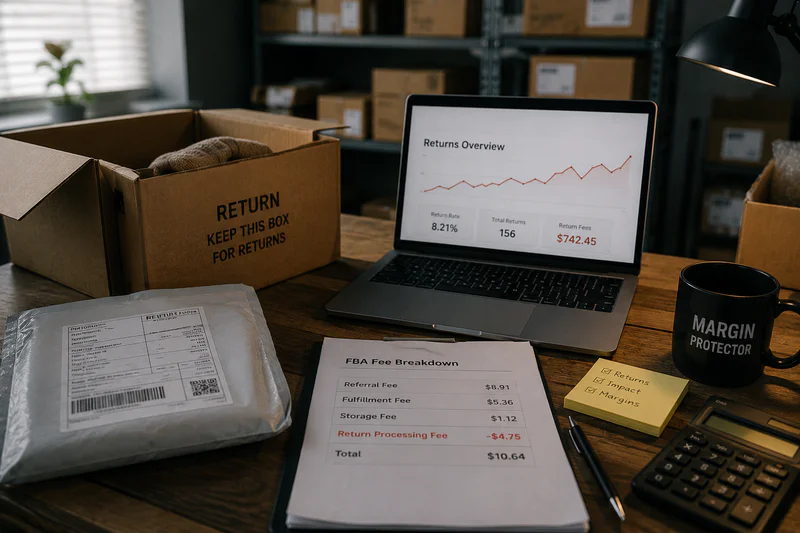
What Is the FBA Return Processing Fee?
When a customer returns an FBA item, Amazon normally refunds your outbound fulfillment fee. Standard behavior. No extra charge.
But here's the exception: in categories where Amazon offers free customer returns, instead of refunding your fulfillment fee, Amazon charges you a separate return processing fee. That fee equals the original fulfillment fee. So you're not just losing the fulfillment fee credit - you're paying an equivalent charge on every return.
The categories subject to return processing fees:
Apparel (clothing)
Shoes
Handbags & accessories
Jewelry
Watches
Sunglasses
For every return in these categories, you pay as if you shipped the item a second time.
How Much Does the Return Processing Fee Actually Cost?
The return processing fee mirrors your outbound fulfillment fee exactly. Here are real numbers based on Amazon's current fee schedule:
Doesn't look like much per unit. Stack a 15–20% return rate across 500 monthly units, and the math changes fast.
Real example: 500 shoes/month × 18% return rate = 90 returns × $4.75 per return = $427.50/month in return processing fees alone - before counting refunded unit costs or unsellable inventory write - offs.
Why Your FBA Fee Calculator Missed This
Amazon's Revenue Calculator shows fulfillment fees, referral fees, and storage costs. It calculates based on a single clean sale.
It does not account for:
Your category's actual return rate
Return processing fees charged per return
The cost of units graded unsellable post-return
This is the core gap between what an FBA fee calculator shows and what your actual P&L reflects. The calculator assumed every sale was final. Your bank account knows better.
A well-built fee model needs return processing fees as a per-unit cost, weighted by your expected return rate - not excluded from the model entirely.
How to Build Return Processing Fees Into Your Unit Economics
Use this formula for any product in a return-fee category:
True Per-Unit Cost = COGS + Fulfillment Fee + Referral Fee + (Return Rate × Return Processing Fee) + (Return Rate × Refund Rate × COGS)
Here's a live example for a $35 shoe:
COGS: $8.00
Fulfillment fee: $4.75
Referral fee (15%): $5.25
Return rate: 18%
Return processing fee: $4.75
Refund rate: 90%
Return processing cost per unit: 0.18 × $4.75 = $0.86
Refund COGS cost per unit: 0.18 × 0.90 × $8.00 = $1.30
Total true per-unit cost: $20.16
True margin: $14.84 (42.4%)
A standard FBA fee calculator would show ~$17 margin (48.6%). That 6-point gap compounds at scale. At 500 units/month, you're $1,360 worse off than the calculator told you.
Which Sellers Get Hit the Hardest
High-return categories by design
Fashion returns 15–30% on Amazon versus 5–10% across other categories. The same return processing fee hits harder when your return rate is 3× the average.
New launches in size-dependent categories
A new shoe or apparel ASIN commonly sees 25–35% returns in the first 60 days while buyers figure out sizing. Factor that into your launch P&L — not your steady-state model.
Thin-margin sellers competing on price
Running a $3 margin and absorbing an $0.86 return processing fee on 18% of orders? You just surrendered 30% of your profit on every order that comes back. Price without this buffer and the category slowly drains you. These are exactly the kinds of FBA mistakes that quietly kill profits before you notice them in the data.
What Happens to Returned Inventory
The return processing fee is just the entry cost. After a return, Amazon evaluates the item:
Sellable condition: Goes back to your FBA inventory. No extra charge beyond the return fee.
Unsellable / customer-damaged: Sits in your inventory as unfulfillable. You still pay storage - $0.08 to $0.30 per unit per month - until you request disposal or removal.
Amazon-damaged: Amazon typically reimburses this, but the reimbursement process requires manual follow-up and isn't automatic.
High-volume fashion sellers accumulate 30–80 unsellable units per month. At $0.20/unit/month in Q1–Q3 storage rates, 60 dead units = $12/month in storage on items that will never sell again.
How to Reduce the Financial Impact
You can't opt out of return processing fees in these categories. But you can manage the exposure.
Cut return rates at the listing level
Add a size guide with actual measurements - not vague "runs true to size" copy
Use real customer-worn photos alongside studio shots
Write accurate descriptions - overselling fit or quality is the #1 driver of preventable returns
Price with returns baked in
Use 15% as your baseline return rate if you don't have ASIN-level data yet. For shoes, use 20%. Build the weighted return processing fee cost into your floor price before you set any PPC bids.
Track returns by ASIN, not blended account-level
A 22% return rate on one ASIN and 4% on another blend to 13% at the account level. That blended number hides the problem ASIN. Track Amazon SKU-level refunds and returns separately - fix the outlier, not the average.
Remove unsellable inventory quarterly
Don't let non-sellable returned inventory pile up in FBA. Removal costs $0.97–$1.80 per unit - still cheaper than months of dead storage fees adding up on items you'll never relist.
FAQ
What is an FBA return processing fee?
An FBA return processing fee is a charge Amazon applies when a customer returns an item in specific product categories - primarily apparel, shoes, jewelry, handbags, and accessories. The fee equals the outbound fulfillment fee for that item and is charged per return event.
Which Amazon product categories have return processing fees?
Return processing fees apply to apparel, shoes, handbags, jewelry, watches, sunglasses, and related accessories. These are the categories where Amazon provides free returns to customers - the fee offsets that cost back to the seller.
Does Amazon refund the fulfillment fee on FBA returns?
It depends on the category. For most categories, yes - Amazon refunds your fulfillment fee when an item is returned. But in return-fee categories (apparel, shoes, jewelry, accessories), Amazon charges a return processing fee equal to the fulfillment fee instead of refunding it.
How do I calculate the return processing fee for my product?
Find your product's outbound fulfillment fee based on size tier and weight - that's your return processing fee per return. Multiply by your expected return rate to get the per-unit cost. A $4.75 fulfillment fee with a 15% return rate adds $0.71 in return fees per unit sold.
Why does my actual profit look worse than what my FBA fee calculator showed?
Most FBA fee calculators compute fees on a single clean sale and don't factor in return rates or return processing fees. The higher your category's return rate, the larger the margin gap. Always model unit economics using your actual return rate - not zero.
Can I avoid FBA return processing fees by switching to FBM?
Yes. FBM sellers handle their own returns and don't pay Amazon return processing fees. The trade-off is losing Prime eligibility and typically lower conversion rates. Whether that math works depends on your specific return rate and margin structure.