
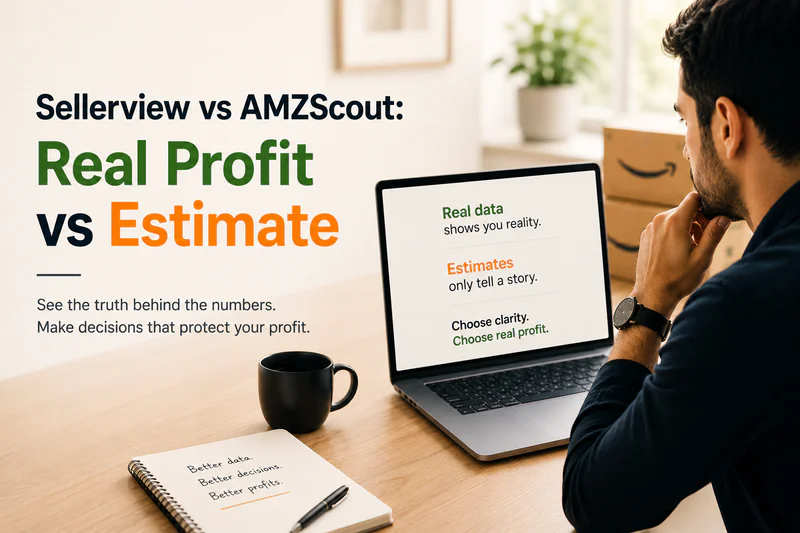
One Tool Finds Products. The Other Finds Where Your Money Went
You closed the month at $82,000 in sales. Your FBA calculator told you each unit nets around 22%, so on paper you cleared roughly $18,000. You already spent it in your head — restock, a new hire, maybe a holiday.
Then the Amazon settlement lands in your bank: $9,400.
You refresh the page. Still $9,400. You open a spreadsheet, start pulling fee reports, and an hour later you're staring at $8,000 that simply… evaporated. Returns. A storage surcharge. Three SKUs bleeding on ads. A referral fee tier you didn't know jumped.
That gap - between what the calculator promised and what actually hit your account - is the entire reason this Sellerview.ai vs AMZScout comparison exists. One tool tells you what a product might make before you buy it. The other tells you what your business actually made after you sold it. Confusing the two costs sellers thousands every month.
Key Takeaways
AMZScout estimates profit before you sell. It's a product-research and sourcing tool. Its FBA calculator gives you a one-time projection for a single product on a single page.
Sellerview tracks profit after you sell. It reconciles real settled fees, returns, ad spend, and storage at the SKU level - so you see actual P&L, not a forecast.
A "good" estimate and a "bad" month coexist constantly. The number a calculator shows you is the best case. Reality strips 5–10 points off it through leaks no estimate catches.
They're not really competitors — they're different stages. Sourcing a product? AMZScout. Already doing $10K–$500K/month and unsure where your money goes? Sellerview.ai.
The fee stack is the killer. Amazon's combined fees routinely eat 30–45% of selling price, and most of that only becomes visible in your settlement reports — never in an upfront estimate.
Sellerview vs AMZScout: What Each Tool is Actually For:
Here's the simple truth most comparison posts miss: AMZScout and Sellerview.ai answer two completely different questions.
AMZScout asks: "Should I sell this, and what might it make?"
Sellerview.ai asks: "What is each SKU making me right now, and where is the money leaking?"
Every "AMZScout vs Helium 10 vs Jungle Scout" article ranks these tools on product discovery — niche scoring, keyword databases, competitor spying. That's because AMZScout is, at its core, a sourcing tool. It's built to help you find a product before you commit inventory. Useful. But it stops being useful the moment your first units sell.
AMZScout's job: decide what to sell
AMZScout's stack - the PRO AI extension, product database, keyword tracker, and the free FBA calculator - is designed for one phase of the journey: research and launch. You point it at a product, it pulls estimated demand and fees, and it tells you whether the niche looks worth entering. It's a flashlight for the dark room before you walk in.
Sellerview's job: know what you're actually making
Sellerview.ai doesn't care what a product might do. It connects to your live Amazon account and reconciles what already happened - settled referral fees, FBA fulfillment charges, returns, reimbursements, storage, and ad spend - and maps it to net profit per SKU. No projection. No "estimated monthly earnings." The actual number, after Amazon took its cut and customers sent things back.
That's the line. AMZScout is a forecast. Sellerview.ai is a P&L.
Where the Amazon FBA profit calculator stops working

Let's give AMZScout full credit. The Amazon FBA Calculator it ships is genuinely handy. You drop in your product cost, shipping, and CPC, and it spits out fulfillment fees, referral fees, storage estimate, profit per unit, net margin, ROI, and a projected monthly profit. As a free FBA Profit Calculator for vetting a sourcing decision, it does the job.
But notice the verb in every sentence above: estimate.
An Amazon FBA Profit Calculator is a snapshot. You calculate it once, on one product page, using inputs you typed in by hand. It assumes:
Every unit sells at full price (no coupons, no PPC discounts, no Subscribe & Save)
Zero returns
Average storage, never a Q4 spike or an aged-inventory surcharge
The fee tier you entered never changes
Your real ad spend matches the single CPC you guessed
None of that survives contact with a real account. The Amazon Revenue Calculator — Amazon's own version — has the same ceiling: it models a clean, single transaction. It was never built to reconcile 4,000 messy ones across a month.
Estimate ≠ settlement
This is the part nobody writing these comparison posts says out loud. A calculator gives you the best-case number. Your settlement report gives you the real one. The space between them is where margin quietly dies — and an upfront Amazon Profit Calculator, by design, can't see into it. It's looking forward. Your leaks are behind you, in data you've already generated and aren't reading.
The Leak Ledger: 5 profit leaks your calculator can't see

Pull the settlement data from any account doing real volume and the same five leaks show up again and again. Every one of them is invisible to a pre-purchase estimate, because every one of them happens after the sale. Call this The Leak Ledger — run it against your last 90 days.
1. Returns you paid to ship twice. A customer returns a unit. You ate the outbound fulfillment fee, you eat the return processing, and Amazon keeps a slice of the referral fee. A 5% return rate on a thin-margin SKU can erase a third of its profit. Your calculator assumed zero returns.
2. FBA reimbursements Amazon owes you — and never paid. Lost inventory, damaged units, overcharged weights. Amazon makes errors at scale, and the reimbursements you're owed don't appear unless someone (or something) is watching the discrepancy. This is free money sitting in your account, unclaimed.
3. Storage and aged-inventory creep. Monthly storage stacks. Inventory older than a year gets hit with long-term surcharges. Q4 storage rates spike. A SKU that looked profitable in March is underwater by November because it sat too long — and no estimate models the calendar.
4. Ad overspend hiding inside a "healthy" ACoS. This is the big one. A 25% ACoS can still be unprofitable once you account for the fees and returns on those ad-driven sales. Sellers stare at ACoS and feel safe while TACoS — total ad spend against total sales — tells the real story. A calculator never sees your ad account at all.
5. Fee-tier creep. You tweaked packaging, added a bonus item, or your supplier shipped slightly heavier units. You crossed a size or weight threshold and your per-unit fulfillment fee jumped. Multiply that by every unit, every month. The estimate you ran six months ago is now fiction.
Add those five up and you've usually found your missing $8,000. Sellerview's entire reason for existing is to surface this ledger automatically, SKU by SKU, instead of forcing you to rebuild it in a spreadsheet at 11 p.m.
The real Amazon fee stack — and why an estimate misses it
Bad advice you'll hear constantly: "Just keep 15% for fees and you're fine." That number is the referral fee alone. The full stack is heavier, and it compounds. Here's the 2026 reality, straight from Amazon's published schedules.
Amazon confirmed that 2026 referral and FBA fees rose only marginally — about $0.08 per unit on average — but the base was already steep, and new line items like the fuel surcharge and low-inventory-level fee keep getting added. Stack it all and total fees commonly consume 30–45% of selling price before you've paid for the product or a single click of advertising.
You can verify every number against Amazon's own documentation: the 2026 US referral and FBA fee update and the Seller Central FBA fulfillment fee reference. Read them once and you'll never trust a single-number estimate again.
A calculator can model two or three of these cleanly. Your settlement report contains all of them, tangled together. Reading that tangle correctly is the whole game — and it's not a job for a tool built to help you pick products.
Side-by-side: Sellerview vs AMZScout
If you read one row, read the data source. AMZScout works off numbers you supply and market estimates. Sellerview.ai works off the money that actually moved. That difference is everything once you have real volume.
Which one should you actually pay for?

Skip the "buy the tool with the most features" instinct — that's how sellers end up paying for five dashboards and reading none of them. Match the tool to your stage.
Pick AMZScout if you're still sourcing. You don't have a catalog yet, you're validating niches, and you need demand estimates and keyword data to choose a product. AMZScout is a reasonable, affordable research tool for exactly that. Its free FBA calculator is a fine gut-check before you place a PO.
Pick Sellerview.ai if you're already selling. You've got inventory live, you're spending on PPC, and your gut says you're profitable but your bank balance keeps disagreeing. You don't need another estimate — you need to know which SKUs to scale and which to kill. That's Sellerview's job: real P&L, the Leak Ledger surfaced automatically, TACoS that tells the truth.
Plenty of mature sellers run both, and that's fine - they live in different phases of your business. But if you're choosing one to fix the problem in the opening scenario, the estimate tool was never going to do it. You can't fix a settlement leak with a sourcing calculator.
FAQ
Is Sellerview.ai a product research tool like AMZScout? No. Sellerview.ai is a profit analytics tool. It doesn't help you find products to sell — it connects to your existing Amazon account and shows your real, SKU-level profit after fees, returns, ads, and storage. AMZScout is for sourcing; Sellerview.ai is for the selling that comes after.
Does AMZScout's FBA calculator show my real profit? It shows an estimate. You type in product cost, shipping, and CPC, and it projects fees and margin for one product. It can't see your returns, real ad spend, reimbursements, or storage creep — so the number is a best-case forecast, not your actual P&L.
What's the difference between an estimate and real profit? An estimate is calculated once from inputs you type in, assuming clean sales and zero returns. Real profit comes from your settlement data — what Amazon actually charged and paid after every order, return, and fee. The gap between them is usually 5–10 margin points.
Why does my Amazon profit calculator say I'm profitable when my bank says otherwise? Because the calculator models a perfect single sale. Reality adds returns, ad overspend hidden inside a "good" ACoS, storage surcharges, and fee-tier jumps. Those leaks only appear in your settlement reports, never in an upfront estimate.
Can I use both AMZScout and Sellerview.ai? Yes, and many sellers do. Use AMZScout while researching and launching products, then use Sellerview.ai once those products are live to track actual profitability and catch leaks. They cover different stages, so they don't really overlap.
Who is Sellerview.ai built for? Amazon FBA and FBM sellers doing roughly $10K–$500K/month who are running ads and unsure if they're actually profitable. It's built around the leaks that surface in real, high-volume accounts — not theory — so it earns its keep once you have live inventory and ad spend to track.
See your real profit — not an estimate
Stop guessing what your products might make and find out what they're actually making. Run your own numbers through the Sellerview free profit calculator, or start a free trial to connect your account and watch the Leak Ledger fill itself in — SKU by SKU, leak by leak.
Find the leaks before they find you.