
JungleScout helps you find and launch products. Sellerview.ai helps you keep the money once you've launched them. They're not the same tool - and if you're using a research tool to track profit, you're flying blind on the numbers that actually decide whether you have a business.
You had your best month ever. $50,000 in sales. You open JungleScout's Sales Analytics, ACoS looks healthy at 18%, and you feel like a genius. Three weeks later your accountant sends the real number: you cleared $750 in actual profit on that $50,000. Not 75 grand. Seven hundred fifty dollars.
You didn't have a bad month. You had a blind month. And no product research tool was ever going to tell you that.
That gut-punch is exactly why people end up Googling Sellerview.ai vs JungleScout at 1 AM — they bought a tool to grow, scaled hard, and still can't answer one question: where did the money go? Let's settle which tool answers that, and which one was never built to.
Key Takeaways
JungleScout is a research and launch tool. Product Database, Opportunity Finder, Keyword Scout, listing builder. It's built to help you start, not to protect your margin.
Sellerview.ai is a profit analytics tool. SKU-level P&L, real TACoS, and automated profit-leak detection across fees, PPC, returns, and storage.
JungleScout's profit reporting is a side feature. Its Sales Analytics shows ACoS and revenue — not the five leaks quietly eating your net margin.
Different jobs, not better-or-worse. You research with one, you stay profitable with the other. Many sellers run both.
If you can't see profit per SKU after every Amazon fee, ad dollar, and return — you're guessing. That's the gap Sellerview closes.
Table of Contents
Why you're even comparing Sellerview.ai vs JungleScout
What JungleScout actually does well
The 5 Money Leaks JungleScout can't see
What Sellerview.ai does that a research tool can't
Sellerview.ai vs JungleScout: side-by-side
Which one should you actually buy?
FAQ
Why You're Even Comparing Sellerview.ai vs JungleScout
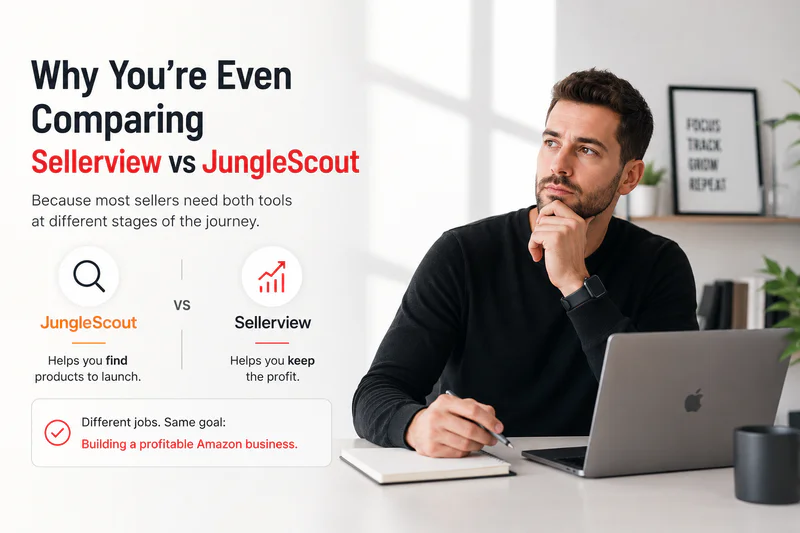
Here's the simple truth most "best Amazon tools" listicles won't tell you: comparing Sellerview.ai vs JungleScout is like comparing a metal detector to a bank statement. One helps you find treasure. The other tells you what's left after everyone took their cut.
JungleScout was built in 2015 around one job — product research. Find a product, validate demand, grab the keywords, launch. It does that job well, and it bolted on a Sales Analytics dashboard later so sellers could track orders in the same login.
Sellerview was built around a different job entirely: showing you your real profit, SKU by SKU, after Amazon has finished helping itself. It's an Amazon profit analytics tool, not a research suite. Amazon-only. No product database, no opportunity finder. On purpose.
So the honest framing isn't "which is better." It's "which problem do you have right now?" If your problem is what should I sell — JungleScout. If your problem is am I actually making money on what I already sell — that's a different tool, and most research suites are bad at it.
What JungleScout Actually Does Well
Credit where it's due. JungleScout earned its reputation, and pretending otherwise would be dishonest.
Product research and validation
The Product Database and Opportunity Finder are genuinely strong for spotting demand, estimating sales, and sizing a niche before you commit cash to inventory. For a first or second launch, that de-risking is worth real money.
Keyword research for launch
Keyword Scout pulls search volume and keyword ideas you'll feed into your listing and your first campaigns. Solid for getting a new ASIN indexed and visible.
Beginner-friendly onboarding
The interface is clean and the learning curve is gentle. If you've never sold on Amazon, you won't drown.
If you're hunting for a Jungle Scout alternative purely for research, the real fight is JungleScout vs Helium 10 vs SellerApp — all research-first tools. None of that has anything to do with whether your existing catalog is bleeding margin.
The 5 Money Leaks JungleScout Can't See

This is the part the top-ranking comparison articles skip entirely — they list features and pricing tiers, then nudge you toward whichever tool pays their affiliate commission. Nobody breaks down what you're actually losing.
Here's the framework. Call it The Profit Leak Audit — the five places your money disappears that a research tool's dashboard won't flag:
1. The fee creep leak.Amazon's referral fee is usually around 15% per sale, varying widely by category, and FBA fulfillment fees rose again in 2026 — an average of about $0.08 more per unit on top of existing rates (Amazon's official 2026 fee update). Small per unit. Brutal at 40,000 units. A research tool shows you revenue; it doesn't track these line items against each SKU.
2. The PPC-on-the-wrong-SKU leak. You're spending profitably in aggregate (nice ACoS) while three specific SKUs lose money on every ad-driven sale. Blended numbers hide the bodies.
3. The returns leak. Return rates plus returns processing fees plus unsellable inventory quietly turn your "bestseller" into your worst margin product. Most dashboards count the sale and ignore the reversal.
4. The storage leak. Monthly inventory storage and aged-inventory surcharges punish slow movers. Send three months of stock instead of three weeks and you fund Amazon's warehouse, not your growth (Amazon FBA storage fees, Seller Central).
5. The COGS-blindness leak. If your landed cost per unit isn't wired into your reporting, every "profit" number you've ever seen is fiction. This is the leak that makes a $50,000 month worth $750.
Here's the equation JungleScout's Sales Analytics doesn't run for you:
Real profit = Revenue − Amazon fees − ad spend − returns − COGS
Most sellers can see two of those five. Sellerview tracks all five, per SKU, automatically.
What Sellerview.ai Does That a Research Tool Can't
Sellerview starts where JungleScout's job ends — the day your product is live and the money starts moving in both directions.
SKU-level P&L, not blended vanity numbers

You see profit per product, after every fee, ad dollar, return, and storage charge. The $50,000-for-$750 problem becomes a list: these three SKUs made you money, these two cost you money, kill or fix them. That's SKU profitability you can act on, not a revenue chart you can frame.
TACoS vs ACoS: the metric that actually matters
ACoS only measures ad sales against ad spend. It tells you nothing about whether ads are eating your whole margin.TACoS (Total Advertising Cost of Sales) measures total ad spend against total revenue — the honest number.
A low ACoS with a climbing TACoS means you're buying sales you'd have gotten organically. A research tool rarely surfaces this. Sellerview puts ACoS and TACoS side by side so you know if your ad spend is fueling growth or just inflating it. For mature brands, keep TACoS under ~15%; newer brands run 15–20% while building rank.
Profit-leak detection on autopilot
Instead of a data dump, you get answers: where the leak is, which SKU, how much. This is the difference between a dashboard and a decision. As the positioning goes — not just another dashboard, simplified actionable profit insights.
Built for the seller who's already scaling
This isn't a beginner Amazon FBA profit calculator you run once. It's an ongoing Amazon seller profit tracker for the operator doing $10K–$500K a month who's scaling on gut and needs to scale on data instead.
Sellerview vs JungleScout: Side-by-Side
Notice the pattern: almost none of the rows overlap. That's the whole point — these tools barely compete. They cover for each other's blind spots.
Which One Should You Actually Buy?
Stop asking "which tool is best." Ask "which stage am I in." Here's the call, by where you actually are:
You're pre-launch or hunting your next product → JungleScout (or Helium 10). You need demand data and keywords, not a P&L for products you don't sell yet.
You're live, scaling, and can't explain your bank balance → Sellerview. You don't have a research problem. You have a profit-visibility problem, and a research suite won't solve it no matter how many tabs it has.
You're doing both — launching new SKUs while scaling existing ones → run both. Research in JungleScout, profit in Sellerview. They're not redundant; one finds revenue, the other protects it.
The mistake isn't picking the "wrong" tool. It's buying a research suite, glancing at its sales tab, and assuming you can see your profit. You can't. That assumption is the most expensive one on Amazon.
Here your Free Amazon Profit Calculator
FAQ
Is Sellerview.ai a JungleScout alternative? Not exactly. JungleScout is a research and launch suite; Sellerview.ai is a profit analytics tool. If you want product research, compare JungleScout with Helium 10. If you want true SKU-level profit, Sellerview.ai is the better fit — and many sellers run both alongside each other.
Does JungleScout show my real Amazon profit? Partially. Its Sales Analytics shows revenue and ACoS, but profit reporting is a secondary feature. It doesn't deeply track COGS, returns, and storage drag per SKU — the leaks that decide your net margin. That's Sellerview's core job, not a bolt-on.
What's the difference between ACoS and TACoS? ACoS is ad spend ÷ ad sales. TACoS is total ad spend ÷ total revenue. ACoS tells you if a campaign is efficient; TACoS tells you if advertising is eating your whole margin. TACoS is the more honest profitability signal, and Sellerview.ai shows both.
Which is cheaper, Sellerview.ai or JungleScout? JungleScout's plans typically start around $49/month for research tooling. Sellerview is priced for profit tracking specifically. The better question isn't price — it's which one pays for itself. A single profit leak it catches usually covers the subscription many times over.
Can I use JungleScout and Sellerview.ai together? Yes, and it's a smart stack. Use JungleScout to find and launch products, then use Sellerview to track whether those products are actually profitable after fees, ads, returns, and storage. Research with one, stay profitable with the other.
Do I need a profit tool if my ACoS already looks good? Yes — that's exactly when you need it. A healthy ACoS can hide unprofitable SKUs, COGS blind spots, and storage drag. Looking profitable and being profitable are different things, and only SKU-level P&L tells you which one you are.
See Your Real Profit for free
You've read enough comparison posts. Here's the actual test: can you name your most profitable SKU and your least profitable SKU right now, after every fee, ad dollar, and return? If you hesitated, you have leaks you can't see.
Find them. Run your numbers through the Sellerview free profit calculator or start a free trial and watch your true profit appear, SKU by SKU. Stop guessing. Start knowing.