
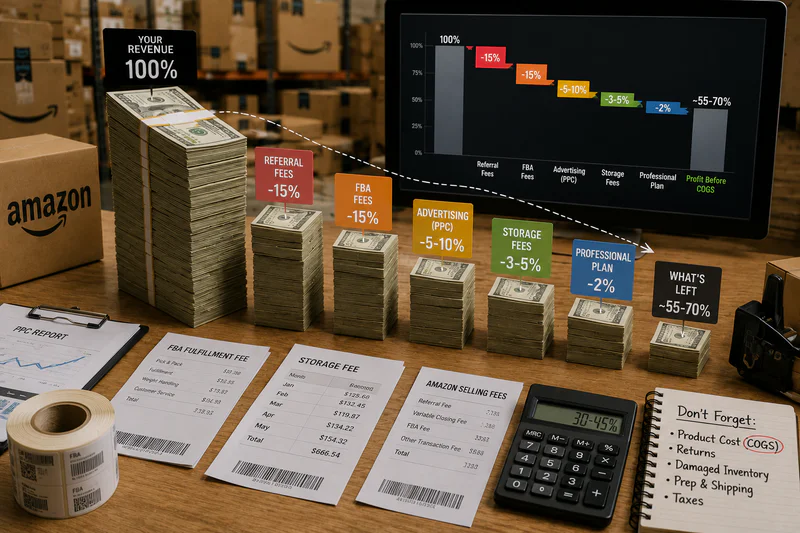
A third-party seller on Amazon is an independent business or individual that lists and sells products directly to customers through Amazon's marketplace - not through Amazon's own retail operations. Third-party sellers now account for over 60% of all units sold on Amazon. But most new 3P sellers don't understand the full cost stack until after they've launched. Referral fees, FBA fulfillment fees, the $39.99/month Professional plan, storage fees, and advertising together consume 30–45% of your selling price before you count your cost of goods.
What you'll learn in this post:
Exactly what a third-party Amazon seller is - and how it differs from selling directly to Amazon
Every fee a 3P seller pays in 2026, with real numbers for each line item
The total cost picture that most new sellers only discover after their first P&L lands in the red
You launched on Amazon. Orders came in. You checked your Seller Central balance - and it was a lot less than your sales number. So you added up referral fees and shipping. Still didn't match. Then you found the storage fee. Then the return processing fee. Then the advertising cost you forgot to count.
This is how most Amazon third-party sellers discover what selling on Amazon actually costs. Not before they launch. After.
After working with 300+ Amazon brands, the pattern is consistent: sellers understand one or two fees at launch, and spend the next six months finding the rest. The total adds up faster than almost anyone expects. Here's the full picture - upfront.
What Is a Third-Party Seller on Amazon?
A third-party seller on Amazon is an independent individual or business that sells products directly to customers through Amazon's marketplace, using Amazon's customer base and infrastructure, without selling inventory to Amazon itself first.
When you see "Sold by [business name] and fulfilled by Amazon" or "Sold and fulfilled by [business name]" on a product page, that's a third-party seller. When you see "Ships from and sold by Amazon.com," that's Amazon's own retail operation - a first-party (1P) arrangement where Amazon buys inventory wholesale and resells it directly.
Here is your free Amazon Profit Calculator
How Is a Third-Party Seller Different from Amazon Itself?
As a 3P seller, you own your inventory, set your own price, manage your own listings, and are responsible for your own profitability. Amazon provides the marketplace infrastructure - the customer traffic, the payment processing, the fulfillment network (if you use FBA), and the trust layer that makes buyers click.
In exchange, Amazon takes fees. Lots of them.
What is the difference between 1P and 3P selling on Amazon?
Most independent sellers, private label brands, and resellers operate as 3P sellers. In early 2025, there were approximately 1.9 million active third-party sellers on Amazon worldwide - 1.1 million of them in the US alone.
What Does It Actually Cost to Be a Third-Party Amazon Seller in 2026?
This is where most guides stop at two line items. Here's the complete picture.
What is the Amazon seller account fee for third-party sellers?
Amazon offers two selling plans:
Individual plan: $0.99 per item sold, no monthly fee. No Buy Box eligibility. No advertising access. Only viable below 40 units/month.
Professional plan: $39.99/month flat, no per-item fee. Unlocks Buy Box eligibility, advertising tools, bulk listing, and advanced reporting.
The break-even is 41 units per month. Sell more than that and the Professional plan saves money - and gives you tools you need to compete. Almost every serious 3P seller is on the Professional plan.
What referral fee does Amazon charge third-party sellers on every sale?
Amazon charges a referral fee on every sale - a percentage of the total selling price including shipping. Referral fees are unchanged for 2026 vs. 2025 per Amazon's official fee update.
On a $30 product in a standard category, Amazon takes $4.50 before anything else.
How much do FBA fulfillment fees cost a third-party seller?
If you use FBA - which most 3P sellers do for Buy Box advantages and Prime eligibility - Amazon charges a fulfillment fee per unit based on size and weight. Effective January 15, 2026, FBA fees increased by an average of $0.08 per unit.
Typical FBA fulfillment fee ranges for 2026:
On a $30 product, a $4.37 FBA fee is another 14.6% of your selling price — on top of the referral fee.
What storage fees do third-party sellers pay to Amazon?
Monthly inventory storage fees apply to all FBA inventory:
Standard size: $0.87/cubic foot (January–September) | $2.40/cubic foot (October–December)
Oversize: $0.56/cubic foot (January–September) | $1.40/cubic foot (October–December)
A 3.5% fuel and logistics surcharge took effect April 17, 2026, adding to fulfillment costs across all FBA shipments.
Inventory held over 271 days also triggers aged inventory surcharges - starting at $0.50/unit and escalating. Most sellers don't see this coming until the fee hits.
Does advertising count as a fee for third-party sellers?
It's not a fee Amazon charges directly - but it functions like one in practice. Most 3P sellers need Amazon PPC (Sponsored Products) to get visibility, especially for new listings. The average PPC spend for sellers maintaining Page 1 placement in competitive categories runs approximately 15% of total revenue.
On $5,000/month in sales, that's $750 going to ads before you've counted any of the above fees.
What Does the Full Cost Stack Look Like on One Product?
Here's a real example on a $29.99 product in the Home & Kitchen category:
That's before returns. A 5% return rate on this product would add approximately $0.50–$1.00/unit in return processing costs, dropping net margin to roughly 21-23%.
This is what third-party selling looks like when the full cost stack is visible. The sellers who don't run this math before launching are the ones who post in forums asking where their profit went.
How Do Profitable Third-Party Sellers Keep Track of All This?
Can you track every Amazon fee manually as a third-party seller?
Technically yes. In practice, almost no one does it consistently. Amazon charges 40+ distinct fee types across referral, fulfillment, storage, returns, removals, and inbound placement. Most sellers miss 8–15 fee types when calculating manually - according to 2026 analysis by Nova Analytics.
A 3% fee calculation error on a $30,000/month business means $900/month you don't know is missing.
Sellerview.ai tracks every fee automatically at the SKU level - so your real net profit is visible without a spreadsheet, and you catch margin problems before they compound into a bad quarter.
See your actual third-party seller profit on Sellerview.ai. Free to start.
The Real Takeaway for Third-Party Amazon Sellers
Being a third-party seller on Amazon gives you access to 200+ million active customers, a world-class fulfillment network, and one of the highest-converting shopping platforms on the internet. That's genuinely valuable.
But Amazon's marketplace isn't free. Total fees as a percentage of selling price run 30–45% for most 3P sellers before you count your cost of goods. The sellers who build profitable businesses on Amazon aren't the ones who found cheaper fees - they're the ones who know every fee they're paying and price their products accordingly from day one.
Frequently Asked Questions
What is a third-party seller on Amazon?
A third-party seller on Amazon is an independent business or individual that lists and sells products directly to customers through Amazon's marketplace, rather than selling inventory to Amazon itself. Third-party sellers set their own prices, manage their own listings, and either fulfill orders themselves (FBM) or use Amazon's fulfillment network (FBA). Over 60% of all units sold on Amazon come from third-party sellers.
How much does Amazon charge third-party sellers in fees per sale?
Amazon charges third-party sellers a referral fee of 8–15% on every sale (depending on category), plus a FBA fulfillment fee of $3.22–$10+ per unit if using FBA. A Professional seller account costs $39.99/month. Combined with storage fees and advertising, total Amazon-related costs typically consume 30–45% of a product's selling price before cost of goods is subtracted.
What is the difference between a first-party and third-party Amazon seller?
First-party (1P) sellers sell their inventory directly to Amazon, which then resells it to customers - Amazon controls pricing and the listing shows "sold by Amazon.com." Third-party (3P) sellers sell directly to customers through Amazon's marketplace and control their own pricing, listings, and inventory. As a 3P seller, you pay Amazon fees per sale; as a 1P vendor, Amazon pays you wholesale and controls the retail price.
Are Amazon seller fees going up in 2026 for third-party sellers?
Amazon froze US referral fees for both 2025 and 2026 - the standard 15% rate and all category-specific rates remain unchanged. However, FBA fulfillment fees increased by an average of $0.08 per unit effective January 15, 2026. A 3.5% fuel and logistics surcharge also took effect April 17, 2026, adding to all FBA fulfillment costs. Storage fees and aged inventory surcharge structures also updated in 2026.
How do I calculate my actual profit as a third-party Amazon seller?
Start with your selling price, then subtract: referral fee (8–15%), FBA fulfillment fee ($3.22–$10+ per unit), monthly storage allocation, your cost of goods including freight, PPC ad spend, and return processing costs. What remains is your net profit per unit. Most sellers who calculate this honestly for the first time discover their actual margin is 8–15 percentage points lower than they assumed. Tools like Sellerview.ai automate this at the SKU level so the real number is always visible.
What happens if a customer returns a product to a third-party FBA seller?
When a customer returns an FBA order, Amazon refunds the customer and returns the item to your inventory - or deems it unsellable. Amazon keeps the lesser of $5 or 20% of the referral fee as a restocking/processing charge. If the returned unit is unsellable, you lose the inventory value plus the original FBA fee. In high-return categories like Clothing (20–30% return rate), this cost can meaningfully compress monthly profit - which is why tracking return rates by SKU matters as much as tracking sales.