
Over 80% of all Amazon purchases happen through the Buy Box. If you're not winning it, you're handing sales to your competitors — and most sellers don't even know why they're losing it.
Here's the part nobody tells you: it's not about having the lowest price. Sellers reprice themselves into negative margins chasing the Buy Box and still lose it. The algorithm is more nuanced than that — and once you understand the actual levers, winning it becomes an engineered outcome, not a guessing game.
What is the Buy Box?
The Buy Box is the "Add to Cart" and "Buy Now" button on an Amazon product detail page. When multiple sellers offer the same product, Amazon chooses one seller to occupy this prime real estate — that's the Buy Box winner. Everyone else gets buried in the "Other Sellers on Amazon" section that most buyers never click.
Amazon officially calls it the "Featured Offer." The name change doesn't matter. What matters is this: if you're not the Featured Offer, you're invisible to 80-90% of shoppers.
The Buy Box isn't random. It's algorithmically assigned based on a weighted combination of price, fulfillment speed, seller performance metrics, and inventory health. Amazon rotates it between eligible sellers — but not equally. The better your metrics, the larger your share of the rotation.
Buy Box Eligibility: The Floor, Not the Ceiling
Before you can win the Buy Box, you have to qualify for it. Most sellers assume they're eligible by default. They're not.
Requirements as of 2026:
Professional Seller account (Individual plan sellers are ineligible)
Account must have a performance history — brand new accounts are often excluded for 30-90 days while Amazon establishes their baseline metrics
Order Defect Rate below 1% — sellers above this threshold are removed from Buy Box rotation entirely
Valid Tracking Rate above 95% — this became a hard requirement in 2025
Product must be in new condition for most categories (used condition has separate Buy Box mechanics)
If you're not meeting these floors, no amount of repricing will help. Fix the eligibility first.
How the Buy Box Works on Amazon
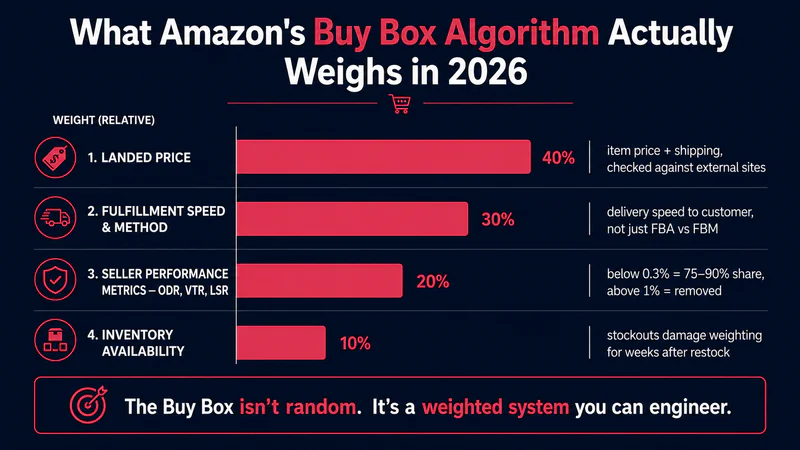
Amazon evaluates every seller on a product listing and decides who gets the Buy Box based on these primary factors:
1. Landed Price (Not Just Your Item Price)
Amazon compares total cost to the customer — item price plus shipping. A seller at $19.99 with free shipping beats a seller at $17.99 plus $3.99 shipping. Every time.
Amazon also cross-checks your price against external websites. Price significantly higher than what's available elsewhere and you lose the box within hours. This is the price parity clause — Amazon expects you to offer your best price on their platform.
The practical implication: if you run a DTC Shopify store at a lower price than your Amazon listing, Amazon's algorithm will notice and penalize you in Buy Box allocation. Price parity across channels isn't optional.
2. Fulfillment Method and Delivery Speed
For years, FBA almost guaranteed the Buy Box. Amazon's algorithm now treats fulfillment channels more equally — what actually matters is delivery speed to the customer.
If an FBM seller can offer faster regional delivery than an FBA warehouse located far from the buyer, they can win. Seller Fulfilled Prime sellers get near-FBA treatment if they maintain Prime delivery standards.
The practical reality: FBA still wins the Buy Box more consistently than FBM for most products because the logistics network is built to deliver fast nationwide. But the assumption that FBA = Buy Box is outdated. Delivery speed is the metric. FBA just happens to optimize it more reliably.
3. Seller Performance Metrics
Amazon tracks these obsessively. Here's what the numbers actually mean for your Buy Box share:
Order Defect Rate (ODR):
Below 0.3%: 75-90% Buy Box share in rotation
0.3-0.8%: Share starts declining noticeably
0.8-1.0%: Buy Box share drops to 40-55%
Above 1.0%: Removed from Buy Box rotation
ODR includes A-to-Z claims, credit card chargebacks, and negative feedback. It runs on a 60-day rolling window. A single bad week follows you for two months.
Valid Tracking Rate: Must be above 95%. Hard requirement since 2025's algorithm update. If you're FBM and not using Amazon Buy Shipping, you're at risk.
Late Shipment Rate: Below 4% required, below 2% recommended. This one moves fast — a bad weekend of shipments can spike it quickly.
Cancellation Rate: Must stay under 2.5%.
4. Inventory Availability
No inventory equals no Buy Box. Zero exceptions. And if you go in and out of stock repeatedly, Amazon's algorithm starts trusting you less even when you're back in stock. The algorithm has memory. Repeated stockouts damage your Buy Box weighting for weeks after you restock.
5. Customer Experience Signals
Amazon also considers review velocity, response time to customer messages, and return processing speed. These are secondary signals but they matter at the margin — especially when you're competing with a seller whose core metrics are similar to yours.
Why the Buy Box Matters for Your Profitability
Let's put this in P&L terms.
Say your product does 200 units per month at $30 ASP. That's $6,000 in revenue. If you're winning the Buy Box 60% of the time instead of 90%, you're leaving roughly $1,800 in revenue on the table every single month — before accounting for ad spend you're wasting on clicks that convert at lower rates because you don't have the box.
The Buy Box also directly affects your advertising efficiency. Sponsored Product ads default to driving traffic to the Buy Box winner. If a competitor has the box when your ad fires, you could be paying for a click that converts to their sale. This is how sellers end up with inexplicably high ACoS — their ads are working, but someone else is getting the conversion.
There's a second-order effect that most sellers miss: the Buy Box affects organic rank. More conversions equals better organic position equals more free traffic. Losing the Buy Box creates a compounding decay in performance. You lose conversions, your organic rank drops, you get less free traffic, you need more ad spend to compensate, your ACoS rises. It spirals fast.
The Buy Box Percentage Benchmark Nobody Talks About
Most sellers check whether they have the Buy Box. The smarter question is what percentage of the time they have it — and how that compares to competitors.
Amazon doesn't display your Buy Box percentage prominently. You have to find it in Seller Central under Business Reports → By ASIN → Buy Box Percentage column.
Here's what healthy looks like by situation:
Sole seller on listing (private label): 95-100%. If you're below this, something is wrong with your metrics or you have a hijacker on the listing.
Multiple sellers, competitive listing: 60-80% is reasonable. Below 50% means a competitor has a structural advantage on price or metrics.
FBA vs FBM mixed listing: FBA seller should hold 70%+ even with a slightly higher price, assuming metrics are clean.
Anything below 70% on a core SKU needs immediate investigation — price check, metric review, inventory audit.
Common Mistakes Sellers Make with the Buy Box
Mistake 1: Chasing the Lowest Price Without Understanding Landed Price Math
Sellers slash item prices to win the Buy Box and forget about shipping costs. If you're FBA with free Prime shipping and your competitor is FBM charging $5 shipping, you can often price $3-4 higher and still win. Run the landed price math before you reprice.
The floor question to ask before any price change: what is my break-even price including FBA fees, referral fee, COGS, and minimum acceptable margin? Never reprice below that floor. The Buy Box is not worth winning at a loss.
Mistake 2: Ignoring ODR Until It's Too Late
ODR is a lagging indicator. By the time you see it spike in Seller Central, you've already been losing the Buy Box for weeks. A-to-Z claims, chargebacks, and negative feedback all feed into ODR — and Amazon's 60-day rolling window means mistakes follow you for two months.
Monitor it weekly. Set a Seller Central notification if ODR crosses 0.5%. Don't wait for it to show up in your dashboard naturally — that's too late.
Mistake 3: Going Out of Stock and Assuming Recovery Is Instant
Amazon doesn't forget. Repeatedly going out of stock damages your Buy Box weighting for weeks after you restock. Sellers running lean on inventory to avoid storage fees often pay for it in lost Buy Box share — which costs far more than the storage fee savings.
The math is usually brutal: saving $50-100/month in storage fees by running lean costs you hundreds in lost Buy Box share. Run the numbers per SKU before you decide on inventory strategy.
Mistake 4: Manual Repricing at Scale
If you're manually adjusting prices across a catalog of 50+ SKUs, you're already losing. The Buy Box rotates in real time. Competitors using automated repricing tools are adjusting prices every 15-30 minutes. By the time you update your spreadsheet, the algorithm has cycled through a dozen rotations.
Mistake 5: Treating the Buy Box as Binary
You either have it or you don't — that's how most sellers think about it. The reality is it's a percentage. A seller with 85% Buy Box share is in a completely different business position than a seller at 55%, even on the same ASIN. Track the percentage, not just the yes/no.
How to Win the Buy Box the Right Way
Step 1: Get Your Eligibility Basics Locked In
Professional Seller account plus ODR below 0.5% plus valid tracking rate above 95% plus late shipment rate under 2%. These aren't optional — they're table stakes.
Step 2: Use Automated Repricing with Floor/Ceiling Rules
Set a minimum price based on your break-even — COGS plus FBA fees plus ad spend plus desired margin. Set a ceiling at your target price. Let a repricer manage the spread. Never reprice below your floor. The goal is Buy Box share at acceptable margins, not Buy Box share at a loss.
The repricer should be set to match or beat the Buy Box price, not the lowest price on the listing. There's a meaningful difference — you don't need to undercut everyone, just the current Buy Box holder.
Here is your Free Amazon Profit Calculator
Step 3: Keep Inventory Healthy
The 90-day inventory window matters. Maintain at least 30-45 days of cover at your FBA warehouse. Use reorder alerts based on sell-through rate, not just raw unit count. A product with 500 units in stock but 200 sales per day is four days from stockout — the unit count looks fine, the days-of-supply doesn't.
Step 4: Track Buy Box Percentage by SKU Weekly
Your overall Buy Box rate can look healthy while 3-4 high-velocity SKUs are bleeding. Pull Buy Box share at the ASIN level in Seller Central every week. Anything below 70% for a core SKU needs immediate investigation.
Step 5: Address Negative Feedback and A-to-Z Claims Fast
A single A-to-Z claim can spike your ODR. Respond to any claim or negative feedback within 24 hours. Proactively reach out to customers flagging issues before they escalate. Prevention is cheaper than ODR recovery — once ODR climbs, it takes 60 days to roll off even after you fix the underlying problem.
Step 6: Watch for Listing Hijackers on Private Label ASINs
If you're a private label seller and your Buy Box percentage is dropping without any metric changes or pricing issues, check the listing for unauthorized sellers. Hijackers undercut your price to steal the Buy Box. The fix is a cease-and-desist, a test buy to document the counterfeit, and an Amazon IP complaint. Don't let this sit — every day a hijacker holds your Buy Box is revenue you're not recovering.
How Sellerview.ai Helps You Track Buy Box Performance
Sellerview.ai tracks your profitability SKU by SKU — so you can see exactly which products are winning or losing the Buy Box and what it's costing your bottom line in real margin terms. When a competitor takes your Buy Box share, you see the revenue and margin impact immediately, not at the end of the month when the damage is already done.
FAQS
Q1: What is the Amazon Buy Box?
The Amazon Buy Box is the "Add to Cart" and "Buy Now" button on a product detail page. When multiple sellers offer the same product, Amazon's algorithm selects one seller to occupy this button — called the Buy Box winner or Featured Offer. All other sellers are listed in the "Other Sellers on Amazon" section that most buyers never visit. Over 80% of all Amazon purchases happen through the Buy Box, making it the single most important real estate on any product listing.
Q2: How does the Amazon Buy Box algorithm work?
The Amazon Buy Box algorithm evaluates every seller on a listing and assigns Buy Box share based on a weighted combination of four primary factors: landed price (item price plus shipping cost to the customer), fulfillment method and delivery speed, seller performance metrics including Order Defect Rate, Valid Tracking Rate, and Late Shipment Rate, and inventory availability. Amazon rotates the Buy Box between eligible sellers — but not equally. Sellers with better metrics receive a larger share of the rotation. The algorithm updates continuously in real time, not on a fixed schedule.
Q3: What is Buy Box price on Amazon?
Buy Box price refers to the total landed price Amazon uses to evaluate Buy Box eligibility — the item price plus shipping cost to the customer. A seller at $19.99 with free shipping beats a seller at $17.99 charging $3.99 shipping because the landed price is lower. Amazon also cross-checks your price against external websites — pricing significantly higher than competitors outside Amazon can cause you to lose the Buy Box within hours even if your on-platform price is competitive.
Q4: What does winning the Buy Box mean for Amazon sellers?
Winning the Buy Box means your listing occupies the "Add to Cart" and "Buy Now" buttons — capturing 80-90% of purchase intent on that product page. At 90% Buy Box share versus 60% on a product doing 200 units per month at $30, the difference is approximately $1,800 in monthly revenue on a single SKU. Buy Box share also directly affects advertising efficiency — Sponsored Products ads default to driving traffic to the Buy Box winner, meaning a competitor holding the box when your ad fires can result in you paying for a click that converts to their sale.
Q5: How do I win the Amazon Buy Box consistently?
To win the Amazon Buy Box consistently: maintain an Order Defect Rate below 0.5% (sellers at 0.3% or lower hold 75-90% Buy Box share), keep Valid Tracking Rate above 95% and Late Shipment Rate below 2%, use automated repricing with floor and ceiling rules set to your break-even price, maintain 30-45 days of FBA inventory cover to avoid stockouts, and price competitively on landed price not just item price. Buy Box share is engineered through metrics and operations — not achieved by having the lowest price alone.
The Bottom Line
The Buy Box controls 80-90% of Amazon's sales flow. Winning it isn't about having the lowest price — it's about having the best combination of competitive landed price, reliable delivery, clean metrics, and consistent inventory.
Most sellers treat the Buy Box as a mystery. It's not. It's a system. Once you understand the levers, you can engineer your Buy Box share the same way you'd engineer any other business metric.
The sellers consistently winning the Buy Box in 2026 are not the ones with the lowest prices. They're the ones with clean ODRs, automated repricing, healthy inventory levels, and the data to catch problems before they compound.
See your real profit and Buy Box impact on Sellerview.ai — free trial, no credit card needed.