
Most sellers sign up for FBA because they want Prime eligibility and hands-off fulfillment. By the time they realize FBA is eating 20%+ of their revenue, they have already scaled a money-losing operation. Here is what FBA actually costs and how to use it without wrecking your margins.
What is FBA (Fulfillment by Amazon)?
FBA is Amazon's logistics program where you ship inventory to Amazon fulfillment centers, and Amazon handles storage, picking, packing, shipping, and customer service. When a customer buys, Amazon ships. When a customer returns, Amazon processes it. You focus on sourcing, pricing, and marketing. 82% of third-party sellers use FBA — it is the default model for anyone serious about scaling on Amazon. But it comes with a price tag most sellers underestimate.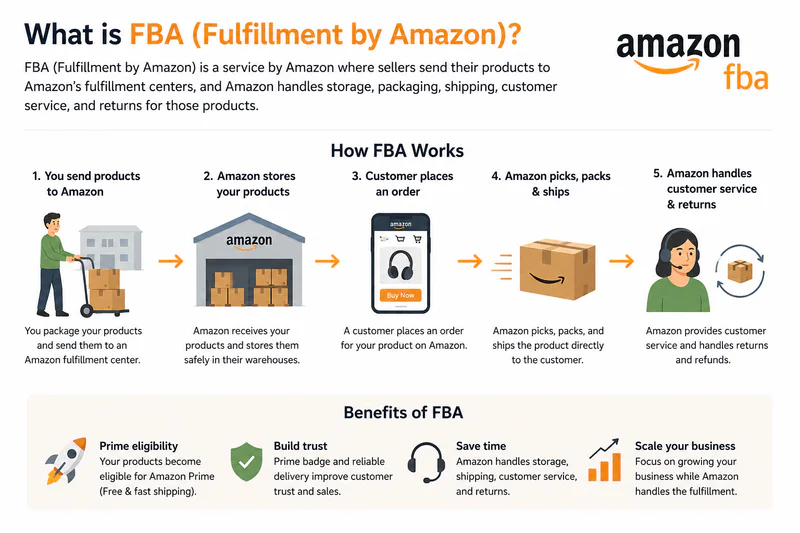
How FBA Works on Amazon
You prep and ship inventory to Amazon fulfillment centers. Amazon stores it and charges monthly storage fees. A customer orders — Amazon picks, packs, and ships with Prime delivery. Returns go through Amazon's return centers; many come back unfulfillable. Amazon deducts all fees before disbursing your balance every 14 days. The 2026 FBA fee structure: Fulfillment fees start at $3.06/unit for small standard items under 1 lb, reaching $5–$7+ for large standard. Referral fees are 8–15% of sale price (most categories: 15%). Storage costs $0.78/cubic ft Jan–Sep and $2.40/cubic ft Oct–Dec. Aged inventory surcharges begin at 181 days. The inbound placement fee — added in 2024 — hits you if you do not ship to Amazon's designated split locations. Amazon raised fulfillment fees $0.08/unit in 2026. Stack all surcharges and most sellers pay 8–10% more year-over-year.
Why FBA Matters for Your Profitability
FBA determines whether your margin is real or imaginary. The P&L most sellers avoid: Revenue minus Referral Fee minus FBA Fulfillment Fee minus Storage minus Inbound Fee minus Returns minus COGS equals Actual Profit. On a $30 product: revenue $30, referral fee $4.50, fulfillment fee $4.50, storage $0.30, inbound $0.20, returns $0.50, COGS $8 — actual profit $12 (40%). Add 10% ad spend and margin is 30%. Raise COGS to $12, margin drops to 23%. Add Q4 storage spikes and a 12% return rate — you are at 15% or below. The benchmark to hold: 20–25% net margin after all fees and ad spend. Below 15% and FBA is working against you.
Common Mistakes Sellers Make with FBA
Mistake 1: Not calculating the full FBA cost before launch
Most sellers check the fulfillment and referral fees. They miss storage, inbound placement, return processing, and aged inventory charges. Real FBA cost is 30–40% of revenue for most products — not the 20% sellers assume at sourcing.
Mistake 2: Sending too much slow-moving inventory
If your product sells 5 units a month and you shipped 200 units to FBA, that is 40 months of inventory in Amazon warehouses. At $0.78/cubic ft per month (and $2.40 in Q4), that is a storage fee time bomb. Aged inventory surcharges start at 181 days. Products that do not turn every 90–120 days are silently destroying your margin.
Mistake 3: Treating returns as fully recoverable
FBA processes returns automatically. Many come back unfulfillable — opened, damaged, customer-used. Amazon reimburses some, not all. Sellers with 10%+ return rates who have not audited FBA reimbursements are leaving hundreds to thousands of dollars on the table every month.
Mistake 4: Ignoring the inbound placement fee
Since Amazon restructured inbound shipping in 2024, sending to a single location triggers placement fees. Most sellers have not adjusted. Shipping to Amazon's preferred split locations or using a 3PL buffer cuts this cost on every shipment.
How to Use FBA the Right Way
Step 1: Run the full fee calculation before you source. Use Amazon's FBA Revenue Calculator. Input COGS, shipping to Amazon, every fee. If margin does not clear 25% before ad spend, the product is not ready for FBA.
Step 2: Match inventory depth to sell-through velocity. Keep 60–90 days of inventory in FBA — not 6 months. Check your Inventory Age report in Seller Central every week.
Step 3: Build a removal process. Units approaching 150 days should trigger removal review. Paying $0.25–$0.50/unit to remove is almost always cheaper than the aged inventory surcharge.
Step 4: Audit FBA reimbursements every quarter. Amazon loses, damages, and miscounts inventory. They owe you money. Reconciling FBA inventory recovers $500–$5,000+ for most active sellers annually.
Step 5: Run a hybrid strategy. 34% of Amazon sellers now use FBA and FBM together. Slow-moving SKUs, oversized items, and seasonal products belong in FBM or a 3PL. Keep fast movers in FBA. Route the rest elsewhere.
Here is your free Amazon Profit Calculator
How Sellerview Helps You Track FBA Costs
Sellerview breaks down your true profit per SKU automatically — FBA fees, ad spend, COGS, and returns — so you always know which products are making money and which are quietly draining it.
Stop guessing what FBA is actually costing you. See your real profit on Sellerview.ai — free trial available now.
FAQS
Q1: What is Amazon FBA?
Amazon FBA (Fulfillment by Amazon) is a logistics program where sellers ship inventory to Amazon's fulfillment centers and Amazon handles storage, picking, packing, shipping, and customer service. 82% of third-party Amazon sellers use FBA because it provides Prime eligibility and hands-off fulfillment. The trade-off is a fee structure that typically costs 30–40% of revenue when all charges are stacked.
Q2: How much does Amazon FBA cost in 2026?
Amazon FBA costs in 2026 include fulfillment fees starting at $3.06 per unit for small standard items, referral fees of 8–15% of sale price, storage fees of $0.78 per cubic foot (rising to $2.40 in Q4), aged inventory surcharges starting at 181 days, and inbound placement fees introduced in 2024. Stacked together, most sellers pay 30–40% of revenue in FBA-related costs before advertising.
Q3: What is the difference between FBA and FBM?
FBA (Fulfillment by Amazon) means Amazon stores and ships your inventory — you pay FBA fees but get Prime eligibility and hands-off logistics. FBM (Fulfillment by Merchant) means you store and ship inventory yourself — no FBA fees but you manage logistics and lose automatic Prime eligibility. FBM wins on margin for heavy products, slow movers, and oversized items where FBA fulfillment fees consume 30–35% of the selling price.
Q4: When does FBA hurt your profitability?
FBA hurts profitability when your net margin after all fees and ad spend drops below 15%. This happens most often with slow-moving inventory accumulating aged inventory surcharges after 181 days, high return rate products where returned units come back unfulfillable, oversized or heavy items where fulfillment fees consume 30–35% of selling price, and products with thin margins that cannot absorb the 3.5% fuel surcharge added in April 2026.
Q5: How do I calculate my true FBA profit?
True FBA profit is calculated as: Revenue minus referral fee minus FBA fulfillment fee minus storage allocation minus inbound placement fee minus returns cost minus COGS minus ad spend. On a $30 product with 10% ad spend, this typically leaves 20–30% net margin. The benchmark to hold is 20–25% net after all fees and advertising — below 15% and FBA is working against you.