
Most sellers default to FBA without ever running the math. For a lot of SKUs — heavy products, slow movers, low-margin items — that decision is quietly killing their profit. FBM exists for exactly this reason, and sellers who use it strategically consistently outperform those who don't.
What is FBM (Fulfillment by Merchant)?
FBM, or Fulfillment by Merchant, is Amazon's model where you — the seller — handle all storage, picking, packing, and shipping directly to the customer. No Amazon warehouse. No FBA fees. Your inventory, your shipping carrier, your fulfillment process.
When a customer places an order, Amazon notifies you and you ship it yourself (or through a third-party logistics provider). You're responsible for hitting Amazon's shipping windows and maintaining performance metrics — late shipment rate, order defect rate, valid tracking rate.
FBM is not the lazy option. It's the right tool for specific products, and using it incorrectly is just as costly as using FBA incorrectly.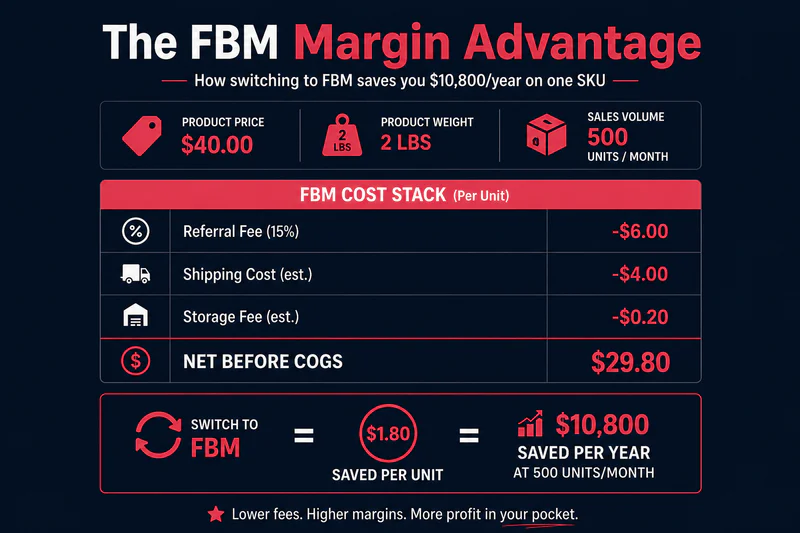
How FBM Works on Amazon
When you create a product listing, you choose your fulfillment method — either FBA (Amazon stores and ships) or FBM (you store and ship). You can run both simultaneously on the same ASIN with different offers — this is the hybrid strategy most serious sellers use.
Standard FBM process: Customer orders on Amazon → Amazon notifies you → You ship within 1-2 day handling time → You upload tracking via Seller Central or Amazon Buy Shipping → Amazon releases payment after delivery confirmation.
Amazon Buy Shipping is worth using even for FBM. Amazon has negotiated bulk carrier rates with USPS, UPS, and FedEx — you often get 30% below retail carrier rates just by buying postage through Seller Central.
The fee structure for FBM in 2025: Referral fee: 8-15% of sale price. Monthly Professional plan: $39.99/month. Shipping cost: your direct cost. Storage: your own warehouse or 3PL cost. What you do NOT pay: FBA fulfillment fees (starting at $3.22 for small standard, scaling with size and weight), monthly storage fees ($0.78-$2.40 per cubic foot), and long-term storage surcharges. For a 5-lb product with an FBA fulfillment fee of $7-9, the savings are immediate.
Why FBM Matters for Your Profitability
FBA fulfillment fees eat 15-35% of revenue for heavy or bulky products. When you layer on referral fees (15%), FBA storage, and Amazon's inbound placement fees, many sellers are operating at negative margin without knowing it.
Simple P&L comparison for a $40 product, 2 lbs. FBA: Sale $40, referral -$6, FBA fee -$5.50, storage -$0.50, net before COGS $28.00. FBM: Sale $40, referral -$6, shipping -$4, storage -$0.20, net before COGS $29.80. That $1.80 difference across 500 units/month is $10,800/year in additional profit — just from switching fulfillment method on the right SKU.
FBM wins on margin when: Products are over 2 lbs (FBA fees scale aggressively). Inventory moves slowly (FBA storage fees compound; FBM avoids them). ASP is high but volume low. Custom or fragile items where packaging control reduces damage and returns.
FBM loses when: Sub-1 lb products where FBA fulfillment fee is $3.22 and Prime drives conversion. High-velocity SKUs where FBA shipping speed is a competitive moat. Categories where Prime badge is table stakes for the Buy Box.
Common Mistakes Sellers Make with FBM
Mistake 1:
Treating FBM as the backup option, not a strategic one. Most sellers only activate FBM when they run out of FBA inventory. That's reactive, not strategic. The right move is to model both fulfillment costs at the SKU level and make a deliberate decision — not scramble when FBA stock runs out.
Mistake 2:
Not using Amazon Buy Shipping. Buying labels outside Amazon Buy Shipping means paying retail carrier rates. You also lose Amazon's INR claim protection — Amazon absorbs that cost when you use their labels. That protection alone is worth the 30-second extra step.
Mistake 3:
Setting handling time too long. FBM sellers often pad to 3-5 days to be safe. That hurts Buy Box eligibility. Amazon treats handling time as a ranking signal — 1-2 days is the expected standard. If you can't hit it, fix your operations before expanding FBM volume.
Mistake 4:
Not monitoring FBM performance metrics separately. Amazon tracks your late shipment rate (must stay under 4%), order defect rate (under 1%), and valid tracking rate (over 95%) for FBM orders separately from FBA. Missing these can get your account flagged or suspended. Check weekly, not quarterly.
How to Use FBM the Right Way
Step 1: Run an FBM profitability model for every SKU. Formula: FBM Net = Sale Price - Referral Fee - Your Shipping Cost - Your Storage Cost - COGS. If FBM wins by more than $1 per unit over FBA, switch — or run hybrid.
Step 2: Identify FBM-eligible SKUs. Best candidates: over 2 lbs, slow-moving (under 10 units/month), high ticket (over $75 ASP), or custom/fragile where packaging quality matters.
Step 3: Set up a reliable fulfillment process before flipping the switch. Confirm your carrier, set up Amazon Buy Shipping label integration, set 1-2 day handling time, define your pick-pack workflow.
Step 4: Consider Seller Fulfilled Prime (SFP) for high-margin SKUs. SFP lets FBM sellers display the Prime badge — closing most of the conversion gap with FBA. Requirements: same-day or next-day carrier pickup, 99%+ on-time delivery. As of 2025, Amazon allows 3 SFP trial attempts per calendar year.
Step 5: Run a hybrid model. The best-performing accounts use FBA for fast-moving, lightweight SKUs and FBM for the rest. Use FBA where Prime and speed drive conversion. Use FBM where fees erode margin. Track both P&Ls separately.
How Sellerview Helps You Track FBM Profitability
Sellerview shows your actual profit per SKU — including whether FBM or FBA is the more profitable fulfillment method — so you stop guessing at the unit economics.
FAQS
Q1: What is FBM on Amazon?
Amazon FBM (Fulfillment by Merchant) is a selling model where the seller — not Amazon — handles all storage, picking, packing, and shipping directly to the customer. There are no FBA fulfillment fees or Amazon storage charges. The seller ships orders independently using their own warehouse or a third-party logistics provider, and is responsible for meeting Amazon's performance thresholds: late shipment rate under 4%, order defect rate under 1%, and valid tracking rate above 95%.
Q2: What is the difference between FBA and FBM on Amazon?
FBA (Fulfillment by Amazon) means Amazon stores and ships your inventory — you pay fulfillment fees starting at $3.22 per unit plus storage fees of $0.78–$2.40 per cubic foot. FBM means you store and ship your own inventory — you pay only referral fees and your direct shipping cost. FBA wins for lightweight, fast-moving products where Prime eligibility drives conversion. FBM wins for heavy, slow-moving, or high-ticket products where FBA fees erode margin. On a $40 product at 2 lbs, FBM saves $1.80 per unit — $10,800 per year on 500 monthly units.
Q3: Do FBM sellers get the Prime badge on Amazon?
FBM sellers can get the Prime badge through Seller Fulfilled Prime (SFP). SFP requires same-day or next-day carrier pickup and a 99%+ on-time delivery rate. Amazon allows 3 SFP trial attempts per calendar year. Without SFP, FBM listings do not display the Prime badge, which can reduce Buy Box competitiveness in categories where Prime is a dominant filter.
Q4: What fees do Amazon FBM sellers pay?
Amazon FBM sellers pay a referral fee of 8–15% of the sale price depending on category, and the $39.99 monthly Professional selling plan fee. They do not pay FBA fulfillment fees, monthly storage fees, long-term storage surcharges, or inbound placement fees. The seller pays their own direct shipping cost and warehouse or 3PL storage cost instead. For a 5-lb product with an FBA fee of $7–9, the per-unit savings from switching to FBM are immediate and significant.
Q5: When should an Amazon seller use FBM instead of FBA?
An Amazon seller should use FBM instead of FBA when products weigh over 2 lbs and FBA fulfillment fees consume 20–35% of revenue, when inventory velocity is below 10 units per month and FBA storage fees compound, when the product is custom or fragile and packaging control reduces damage rates, or when the selling price is high enough that referral fees alone are the primary cost and FBA storage adds unnecessary overhead. The most profitable Amazon accounts run a hybrid model — FBA for fast lightweight SKUs, FBM for heavy and slow-moving products.
Stop defaulting to FBA for everything. Run the math SKU by SKU, flip your heavy and slow-moving products to FBM, and keep the margin that is currently going to Amazon's warehouses. See your real profit by fulfillment method on Sellerview.ai — free trial available.
Confused in numbers? Give a try to Sellerview.ai's free Amazon Profit Calculator