
Most sellers treat Sponsored Brands like a fancy version of Sponsored Products. They're not. They serve a different purpose, measure success differently, and if you run them the same way, you'll waste budget and wonder why your ROAS looks terrible.
Here's what Sponsored Brands actually are, how they work, and how to use them without burning money.
What is Sponsored Brands?
Sponsored Brands (formerly called Headline Search Ads) are Amazon's banner-style ad format that appears at the top of search results pages — above Sponsored Products. They require you to be enrolled in Amazon Brand Registry and are designed to drive brand awareness, capture category-level shoppers, and protect your branded search from competitors.
Unlike Sponsored Products, which push a single ASIN, Sponsored Brands can showcase your logo, a custom headline, and up to three products — or link directly to your Brand Store. They're a mid-to-upper funnel tool. That's not a weakness, it's the point.
As of 2026, there are three Sponsored Brands formats:
Headline Search Ads — Static banner at the top of search results with logo, headline, and product grid
Sponsored Brands Video (SBV) — Auto-playing video in search results (no sound by default — 71% of plays are muted)
Store Spotlight — Drives shoppers directly to specific subpages of your Brand Store
All three require Brand Registry. All three can appear at the top of search results. The difference is in what they're optimized for and how you measure them.
How Sponsored Brands Works on Amazon
When a shopper searches a keyword you're targeting, your Sponsored Brands ad competes in an auction. You pay per click (CPC model). Here's the core structure:
You bid on a keyword → shopper searches → your ad appears at the top → shopper clicks → you pay.
The CPC for Sponsored Brands is meaningfully higher than Sponsored Products. Expect $1.10 to $2.50 per click in most categories, compared to $0.80–$1.25 for Sponsored Products. That's not a bug — you're paying for premium placement at the top of page, not a middle-of-results product listing.
CTR for SB is typically 0.2–0.3%, which sounds low but matters less than you think. Sponsored Brands drives brand recall even from non-clicks. A shopper who sees your brand name at the top of a search doesn't always click — but they do remember.
The key metric that makes SB different from everything else in Amazon Ads is New-to-Brand (NTB). NTB measures orders and revenue from customers who haven't purchased your brand in the past 12 months. SB campaigns averaged a 38% NTB rate across managed accounts in 2026, versus 22% on Sponsored Products. That gap tells you something: if your goal is acquiring new customers (not just capturing repeat buyers), Sponsored Brands is doing more of that work.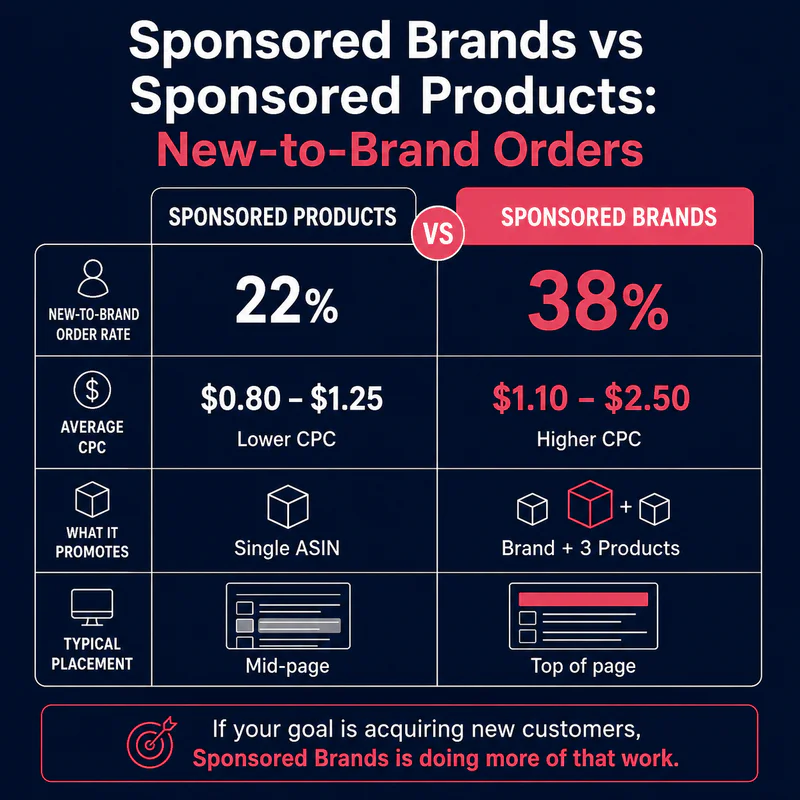
Why Sponsored Brands Matters for Your Profitability
The P&L math on Sponsored Brands looks worse on the surface. Higher CPC, lower CTR, harder to attribute — until you measure NTB.
Here's why it matters:
Customer acquisition cost is not just the ad cost on that one order. If a buyer from SB converts and then buys again (Subscribe & Save, repeat purchase), the LTV of that customer is higher. A 38% NTB acquisition rate at $1.50 CPC is different from that same CPC going to an existing customer who was already going to buy.
For branded search defense specifically, the math is blunt: if you don't run Sponsored Brands on your own brand keywords, your competitors will. Branded keyword CPCs jumped 22–31% over the past 12 months as competitors got more aggressive. Not defending your brand name means you're handing that search intent to someone else — and paying a different kind of cost.
For category-level awareness, the right SB campaign running on broad category keywords at a target ACoS of 30–40% (higher than your SP threshold) is profitable when you factor in: branded search lift over the following 30 days, organic rank signal from traffic, and new customer LTV vs. one-time order value.
If you're optimizing SB with the same ACoS target as Sponsored Products, you're measuring the wrong thing.
Common Mistakes Sellers Make with Sponsored Brands
1. Running the same ACoS target as Sponsored Products
SB's job is not just to convert — it's to build brand equity and acquire new customers. A 35% ACoS on SB might be perfectly healthy. A 15% ACoS target on SB usually means you're under-investing in discovery and only running branded keywords that would've converted anyway.
2. Not defending your own brand name
This is the single most expensive mistake. If you're not running SB on your brand keyword, a competitor is. Branded keywords typically deliver 5–12% ACoS because intent is high, but more importantly, every click a competitor captures on your brand name is a customer you didn't convert. Run branded SB. Always.
3. Ignoring Sponsored Brands Video
As of 2026, SBV accounts for ~58% of total SB spend across professionally managed brands — and it earns that share. SBV outperforms static SB by 1.6x on CTR and 1.3x on CVR. Most sellers don't run SBV because it requires a video asset. That barrier is exactly why it's the less crowded, more effective format. A 30-second product demo shot on a phone beats a stale static banner.
4. Letting video creatives go stale
71% of SBV plays happen with the sound off. That means your video must communicate value visually — and it needs to be refreshed. After 90 days on the same creative, performance degrades. The refresh cadence for hero SKUs should be every 60–90 days. Most sellers set it and forget it for 6+ months.
5. Sending SB traffic to a product detail page instead of a Store
Sponsored Brands that link to a Brand Store or Store subpage convert at a meaningfully higher rate for category explorers. Shoppers in discovery mode (which is who SB reaches) respond better to curated experiences than a single product page. If you're sending SB clicks to a PDP, you're wasting the upper-funnel advantage.
How to Use Sponsored Brands the Right Way
Step 1: Set up branded defense first
Create an SB campaign targeting your brand name and product names. Bid conservatively — these keywords are cheap and convert well. This is non-negotiable.
Step 2: Build category-level SB campaigns with realistic ACoS targets
For category keywords (e.g., "stainless steel water bottle"), set your SB ACoS target at 30–40% — higher than SP. Track NTB rate as your primary KPI, not ACoS alone.
Step 3: Launch Sponsored Brands Video on your top 3-5 SKUs
Use a 15–30 second video that shows the product solving a problem, with text overlays since most plays are muted. Launch on your highest-volume, highest-converting keywords first.
Step 4: Drive traffic to a Brand Store or curated Store subpage
Build at least one Store page that groups your products by use case or category. Route SB discovery traffic there, not to individual PDPs.
Step 5: Measure NTB metrics, not just ACoS
In your SB campaign reports, track New-to-Brand Orders, New-to-Brand Revenue, and NTB Rate. A campaign with 40% ACoS and 45% NTB rate is probably your best-performing acquisition channel. Evaluate it that way.
Step 6: Refresh video creatives every 60–90 days
Set a calendar reminder. When CTR on SBV starts dropping, the creative is stale. New creative doesn't require a big budget — it requires a new angle.
How Sellerview.ai Helps You Track Sponsored Brands
Sellerview.ai tracks your ad spend, ACoS, and revenue at the SKU level — so you can see exactly which products are pulling SB spend without returning margin. If Sponsored Brands is eating into profitability on specific ASINs, Sellerview surfaces that before it becomes a problem.
FAQS
Q1: What is Amazon Sponsored Brands?
Amazon Sponsored Brands are a banner-style ad format that appears at the top of search results pages, above Sponsored Products. They require enrollment in Amazon Brand Registry and allow sellers to showcase their logo, a custom headline, and up to three products — or link directly to their Brand Store. There are three formats in 2026: Headline Search Ads, Sponsored Brands Video, and Store Spotlight. Unlike Sponsored Products which promote a single ASIN, Sponsored Brands are designed to drive brand awareness, capture category-level shoppers, and protect branded search from competitors.
Q2: What is the difference between Sponsored Brands and Sponsored Products?
Sponsored Products promote a single ASIN and appear mid-page in search results at a CPC of $0.80–$1.25. Sponsored Brands promote your brand with logo, headline, and up to three products at the top of search results at a CPC of $1.10–$2.50. The most important difference is new-to-brand performance — Sponsored Brands averaged a 38% new-to-brand order rate in 2026 versus 22% for Sponsored Products. This means Sponsored Brands acquires new customers at nearly double the rate, making it the stronger customer acquisition tool while Sponsored Products excels at converting existing demand.
Q3: How much do Amazon Sponsored Brands cost?
Amazon Sponsored Brands operate on a cost-per-click model with CPCs typically ranging from $1.10 to $2.50 in most categories — meaningfully higher than Sponsored Products at $0.80–$1.25. CTR for Sponsored Brands averages 0.2–0.3%. The higher CPC reflects premium top-of-page placement and the brand awareness value even from non-clicking impressions. For branded defense campaigns targeting your own brand name, CPCs are typically much lower and deliver 5–12% ACoS because purchase intent is already high.
Q4: What is Sponsored Brands Video and is it worth it?
Sponsored Brands Video is an auto-playing video format that appears in Amazon search results. As of 2026 it accounts for 58% of total Sponsored Brands spend across professionally managed accounts. SBV outperforms static Sponsored Brands by 1.6x on CTR and 1.3x on conversion rate. The key constraint is that 71% of plays happen with sound off — meaning your video must communicate value visually using text overlays. SBV requires a video asset but delivers the highest performance of all three Sponsored Brands formats and is less competitive than static because most sellers avoid the production requirement.
Q5: What is new-to-brand rate in Amazon Sponsored Brands?
New-to-brand rate measures the percentage of orders from customers who have not purchased from your brand in the past 12 months. It is the most important metric for evaluating Sponsored Brands performance because it measures customer acquisition, not just revenue. Sponsored Brands averaged a 38% new-to-brand rate in 2026 versus 22% for Sponsored Products. A Sponsored Brands campaign with 40% ACoS and 45% new-to-brand rate is often more profitable long-term than a Sponsored Products campaign at 20% ACoS acquiring mostly repeat buyers — because new customer lifetime value compounds over subsequent purchases.
The Bottom Line
Sponsored Brands is not a set-it-and-forget-it channel and it's not just a "brand awareness" expense you write off. When run correctly — with the right ACoS targets, SBV creatives, branded defense, and NTB measurement — it's one of the most efficient customer acquisition tools on Amazon.
The sellers winning on Sponsored Brands in 2026 aren't the ones spending the most. They're the ones measuring the right things.
See your real profit on Sellerview.ai → free trial
Here is your Free Amazon Profit Calculator